

Key Takeaways:
Arizona’s land market heading into 2026 is supported by strong in-migration, low unemployment, and growth in key industries, keeping statewide land demand steady. Home prices are expected to rise more moderately (about 3–5% in 2026), signaling a more balanced market than the early 2020s.
Arizona’s land market varies by region: Phoenix/Maricopa remains the hottest and priciest, while Tucson/Pima and surrounding suburban counties are generally more affordable but still growing. Rural areas like Mohave and Apache have more vacant listings and lower per-acre prices, drawing buyers looking for cheaper acreage.
Prime Arizona land is still tight in many areas, with places like Sedona seeing far fewer listings since 2019 and sharply higher lot prices (up 28% year-over-year by mid-2025). Even though land tends to sit longer statewide (median around 452 days), well-priced parcels can still sell faster when demand is strong.
Arizona land values are driven by zoning flexibility and access to infrastructure like roads, utilities, and growth corridors. In an arid state, reliable water rights and sewer access can significantly raise prices, and ongoing investments in highways, power, and broadband are making more areas viable for development.
To sell land in 2026, price it using recent comps (and consider an appraisal), market its best features like access, utilities, and zoning potential, and clean up the property by clearing debris and marking boundaries. Make sure the title is clear, expect negotiations, and consider seller financing to widen your buyer pool, since land often takes longer to sell.
Arizona’s Economic & Real Estate Market Overview (2026)
Arizona enters 2026 with a resilient economy that underpins its real estate market. The state has seen robust job growth in sectors like technology manufacturing (e.g. semiconductor plants in Phoenix), healthcare, logistics, and renewable energy.
Major employers continue to expand, keeping unemployment low and drawing in workers. Population growth remains strong: people from high-cost states are relocating to Arizona for its lower taxes, sunny climate, and affordable lifestyle.
This steady influx of residents – including retirees (helped by no state tax on Social Security) – bolsters demand for housing and land statewide.
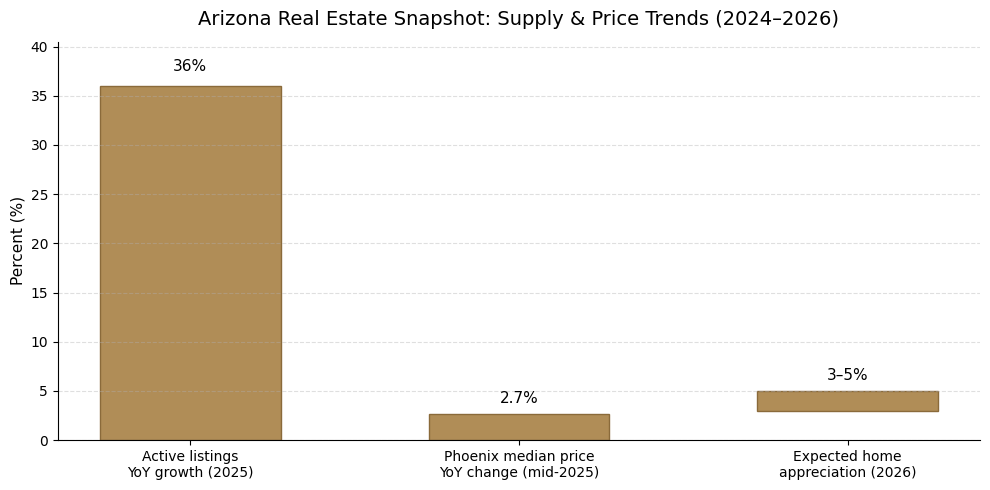
Overall, real estate conditions have shifted from the feverish boom of 2021–2022 to a more stable footing by 2025. After a period of extremely tight supply, housing inventory rebounded significantly in 2025 – Arizona’s active listings jumped ~36% year-over-year, ranking #4 nationally for inventory growth.
This surge in supply eased the severe shortage of the pandemic years, giving buyers more choices and tempering price escalation. Statewide home sales volumes held up decently even with higher interest rates, though days on market lengthened (around 70 days on average by late 2025, versus the rapid selling of previous years).
Price trends stabilized: for example, Phoenix’s median home price in mid-2025 was ~$477,000, up a modest ~2.7% from 2024. In short, Arizona moved from a hot seller’s market to a more balanced market, with healthy activity but more rational pricing.
For landowners, this normalization means 2026 offers opportunities without the frenzy – well-priced properties can attract buyers, but buyers are more discerning than during the peak boom.
Interest rates remain higher than the 2020 lows, but begin leveling off in 2025, and are projected to stay relatively stable or decline slightly in 2026. More stable rates improve buyers’ ability to plan purchases, which helps land transactions too (particularly for those who may finance land buys or build projects).
Arizona’s overall outlook is positive: economists expect continued economic growth and in-migration, supporting real estate demand even as affordability is watched carefully.
One notable driver is tourism and outdoor recreation, a major part of Arizona’s economy that indirectly boosts land markets.
In 2024 the state hosted over 46 million visitors who spent $30+ billion. Outdoor recreation alone contributed $15 billion to Arizona’s GDP in 2024. This boom in tourism and recreation translates into interest in rural and recreational lands – for example, investors see potential in properties near scenic areas for vacation rentals, campgrounds, ranch retreats, etc.
Land suitable for tourism (near parks, hunting areas, or with unique landscapes) has growing appeal as Arizona remains a top outdoor lifestyle destination.
Land Market Trends in 2025–2026
The land real estate segment in Arizona largely mirrors the broader trends of stability and moderate growth. Industry experts characterized 2024–2025 as a period of plateauing values after the post-COVID run-up, setting the stage for steady performance in 2026.
Available listings of land have remained on the lower side in many areas – agents report that quality land parcels in desirable locations remain scarce, which, combined with consistent buyer interest, often leads to quick sales and competitive offers for those listings that do hit the market.
In other words, land inventory is tight for prime properties (e.g. infill lots, irrigated farmland, or parcels near expanding cities), making 2025–26 a generally favorable market for land sellers as long as buyer demand holds.
However, land sales volume can fluctuate by type and region. Some locales saw a pullback in land transactions during 2024–25 due to high building costs and market uncertainty – for instance, Sedona’s vacant land sales in mid-2025 were down 17% from the prior year.
Even so, land prices in Sedona jumped ~28% over the same period, indicating that the parcels which did sell were at significantly higher price points. This suggests a market where fewer (but higher-value) deals occur, and where limited supply props up pricing.
In fact, Sedona’s median lot price (~$313,000 in Aug 2025) remains well below its 2006 peak, implying room for long-term appreciation as the finite supply of buildable land diminishes. Sedona is an extreme case (surrounded by protected lands), but it illustrates a broader point: Arizona land is ultimately a non-renewable resource, especially in attractive areas, so as growth continues and vacant land is absorbed, values are poised to rise over time.
In the agricultural land sector, Arizona followed national farmland trends with stable to gently rising values. The USDA’s 2025 Land Values report showed U.S. farm real estate (land and farm buildings) averaging $4,350 per acre, up 4.3% from the year before. This marks the fifth consecutive annual increase, though the pace has cooled from the sharp 10%+ jumps seen in 2021–22.
In Arizona, the average farm real estate value was around $4,200 per acre, with prime cropland (irrigated fields for high-value crops) averaging about $8,600 per acre. These higher cropland values reflect the premium on land with secure water rights and irrigation in the desert Southwest.
Indeed, Arizona has one of the most expensive cropland rental rates in the nation (around $334/acre annually), on par with California, due to water access being so critical.
The takeaway for 2026 is that farmland and ranchland in Arizona remain solid assets – values are holding firm or slowly increasing, supported by demand for food production and investor interest in land as an inflation hedge.
Challenges like drought and lower commodity prices have capped explosive growth, but as long as water and infrastructure are available, farmland in Arizona is expected to retain value (and the state’s $1+ billion dairy industry and high-value crop farms in areas like Yuma attest to the profitability of well-irrigated land).
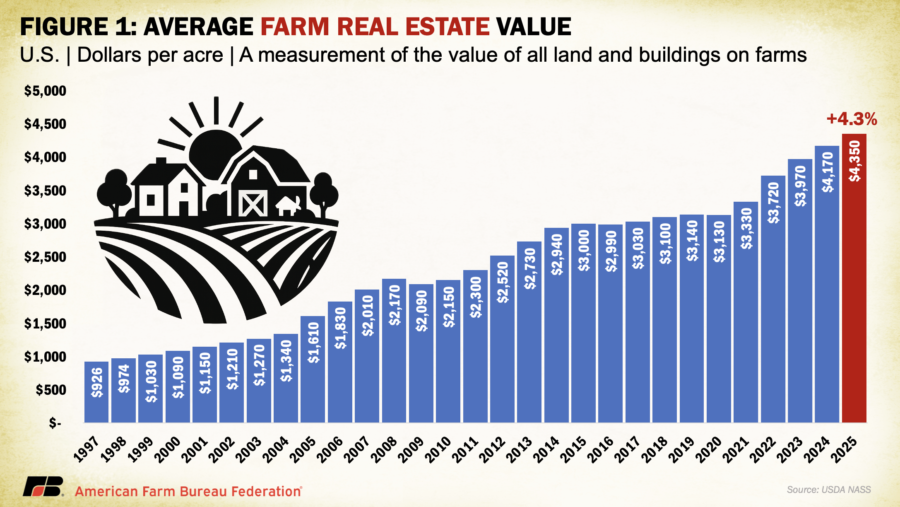
Figure: U.S. average farm real estate value per acre (land and buildings) from 1997 to 2025. Farmland values have climbed steadily in recent years, reaching a record average of $4,350 per acre in 2025. This reflects a broader national trend of rising land prices, though the rate of increase has started to cool since the double-digit growth seen in 2021–2022. Arizona’s agricultural land follows this pattern of sustained high values amid a gradual market leveling.
Another notable trend is urban and industrial land development.
In recent years, developers in Arizona have shifted focus toward large-scale commercial projects – for example, e-commerce warehouses and data centers – that require extensive land acreage.
During the pandemic, the boom in online shopping drove up demand for warehouse sites; now the latest wave involves massive data centers for tech companies, which need big land parcels with access to power infrastructure.
Arizona’s rural outskirts (especially near power stations or transmission lines) have seen increased interest for these uses, turning farmland on city edges into targets for conversion to industrial campuses.
Landowners whose properties meet criteria (proximity to utilities, highways, and workforce) may find corporate buyers willing to pay a premium. This trend is expected to continue into 2026 as the technology and logistics sectors grow.
Additionally, housing developers remain active in suburban fringes – as metropolitan areas sprawl outward, raw land is being acquired to build new subdivisions and master-planned communities.
For instance, suburban corridors around Phoenix (like Queen Creek, Buckeye, Casa Grande) are hotbeds of new construction, which keeps demand up for land in those areas.
At the high end of the market, Arizona witnessed soaring land prices in luxury enclaves over the past few years. In Greater Phoenix’s elite neighborhoods such as Paradise Valley and Arcadia, scarcity of vacant lots and an influx of wealth drove dramatic price jumps.
Small residential lots under 2.5 acres in Paradise Valley doubled in price from about $1.5 million in 2020 to $3.18 million in 2023, and their average days on market fell from 167 to just 113 days.
A headline-grabbing sale was a 27-acre Paradise Valley parcel that sold for $42 million (intended for luxury homes). This luxury land frenzy has pushed the cost of high-end home development even higher – what used to be a $5M land + build package now starts over $10M in those areas.
Heading into 2026, the luxury segment remains robust: affluent buyers often pay cash and are less sensitive to interest rates, so top-tier land in prestige locations should continue to see strong demand. Land sellers in upscale markets should be aware that wealth migration (buyers moving in from out-of-state) and limited lot availability have created a niche of very high land values.
In summary, 2026 outlook for Arizona land is broadly positive but varied by segment. Sellers of residential development lots and quality rural land can expect healthy buyer interest thanks to Arizona’s growth and the enduring appeal of land as an asset. Price appreciation will likely be moderate overall – a “slow and steady” climb rather than a spike – in line with a stabilizing post-boom market.
The exceptions could be special situations: areas with severely constrained supply (pushing quicker appreciation) or niche demand (e.g. luxury or specific commercial uses).
It’s a great time for sellers to capitalize on the groundwork laid in the past decade of growth, as long as they stay attuned to local market conditions.
Regional and County-Level Insights
Arizona is a large and diverse state, and land market conditions can differ substantially by region. Below is a breakdown of notable trends in key areas and counties:
Maricopa County (Phoenix & Surroundings)
Maricopa is Arizona’s population and economic center, and its land market is the most active. The Phoenix metro area continues to expand outward, driving demand for land for new housing, commercial centers, and industrial parks. Median home prices in greater Phoenix sit in the mid-$400,000s, and 2026 forecasts predict ~3–4% growth – indicative of a steady, not overheated, market.
For land, this means residential lots in established suburbs remain valuable, while peripheral areas (Buckeye, Queen Creek, etc.) see developers competing for large tracts to subdivide. Maricopa County had over 14,500 land listings on Land.com, though many of those are large-acreage and rural parcels on the county’s fringes.
Urban vacant lots are relatively scarce and pricey. Paradise Valley, within Maricopa, exemplifies the luxury end with multi-million-dollar lot sales. Meanwhile, the county is also focusing on policy reforms to accommodate growth: in late 2025, officials approved a modernized zoning ordinance to increase flexibility for housing projects and provide clearer guidelines for uses like data centers.
New rules allowing multiple accessory dwelling units (casitas) on residential lots and faster approvals for small multi-family projects aim to spur development on available land.
For land sellers, these changes could broaden the pool of potential buyers (e.g. a homeowner might buy an adjacent lot now that multiple guest houses are allowed).
Overall, Maricopa’s strong job market (median worker income ~$46k) and population growth keep land values strong, but sellers should be mindful of localized supply – some areas have plenty of desert land, others have virtually none left to build on.
Pima County (Tucson area)
Centered in Arizona's second-largest city, Pima County’s land market is also growing, though price points are lower than in Phoenix. Tucson’s median home price is in the mid-$300,000s, and forecasts see a slightly higher ~4–5% price growth for 2026, suggesting solid demand.
Tucson benefits from a stable base of employers (University of Arizona, Davis-Monthan AFB, healthcare and logistics firms) and is attracting some overflow from Phoenix’s growth.
Land in Pima ranges from urban infill lots in Tucson (where new home construction and even build-to-rent communities are expanding) to rural acreage in the surrounding Sonoran Desert and Catalina Mountain foothills. Pima had about 3,250 land listings online, indicating ample choice especially in outlying parts. Sellers in Pima can highlight the county’s expanding infrastructure and population – Tucson continues to draw new residents as a more affordable metro option.
Additionally, the Sun Corridor (the growing urban region between Phoenix and Tucson) is seeing significant investment – Pinal County (just north of Pima) has become a hotspot for electric vehicle manufacturing plants and master-planned communities, which raises interest in land along I-10. While Pinal and Pima are separate, their futures are linked by development along that corridor. For example, Casa Grande (Pinal) has a new electric car factory, and that kind of development can spill over with housing demand into southern Pinal/northern Pima.
Land sellers in greater Tucson should watch such trends, as they influence land desirability. Also worth noting: Santa Cruz County (south of Tucson, along the Mexico border) and Cochise County (to the east) are more rural but have niche demand – from ranches and vineyards (Sonoita/Elgin wine country in Santa Cruz) to small farms and retirement properties. Their markets are smaller, but any major changes (like border trade developments or military expansions at Fort Huachuca) can impact land demand locally.
Northern Arizona (Flagstaff, Coconino County & Navajo Nation areas)
Northern Arizona offers a very different landscape – high elevation forests, mountains, and a cooler climate.
Coconino County (which includes Flagstaff and much of the Grand Canyon area) has some of the state’s highest land prices per acre due to limited private land (large swaths are national forest or tribal land).
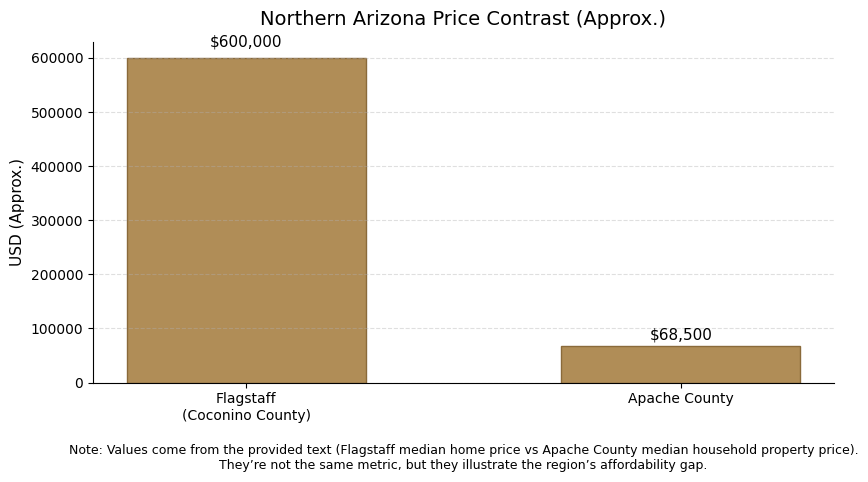
Flagstaff’s median home price is around $600,000, reflecting the desirability and tight supply (only so much buildable land surrounded by forest). Flagstaff and Sedona (in Yavapai County) also rely on tourism – short-term rental demand and second-home buyers often seek parcels here, albeit within strict zoning controls designed to protect the environment.
Apache County and Navajo County, farther east in the High Desert and reservation areas, present more affordable land opportunities. Apache County, for instance, is known for very cheap parcels and is popular for hunting land or off-grid living – the median household property price is only ~$68,500, making it one of the most affordable regions.
Land sellers in these northern counties often cater to buyers looking for recreation (camping, hunting, cabins) or looking to embrace rural life. It’s worth mentioning that much of the Navajo Nation and Hopi lands are in this region; those are not bought/sold on the open market, but they contribute to the low density and unique cultural context.
Sellers of private land in Northern Arizona can leverage the scenic allure (forest views, cooler weather) as a selling point. Keep in mind that development can be trickier (due to more regulatory layers like environmental protections, and sometimes lack of utilities). For example, getting water or sewer in remote areas can be a challenge – but if your land already has a well or is in a water district, it’s far more valuable to buyers eyeing northern AZ.
Western Arizona (Mohave & Yuma Counties)
Mohave County (northwest AZ) currently ranks as the #1 county in Arizona for land listings by search interest. This large county includes cities like Kingman, Lake Havasu, and Bullhead City.
Its appeal lies in a combination of scenic desert landscapes, relatively lax zoning in many unincorporated areas, and proximity to Las Vegas and the Colorado River.
You’ll find everything from $1,000 one-acre lots of dirt roads to multi-million-dollar riverfront development sites in Mohave. Investors frequently target Mohave for “cheap land” – the county has become known as one of the cheapest in Arizona per acre, especially the remote desert tracts.
Sellers here should be aware that while demand exists, it’s very price-sensitive; ensuring your parcel has some distinguishing feature (utility access, paved road, or proven buildability) can help it stand out among thousands of listings.
On the other hand, Yuma County (southwest AZ) is an agricultural powerhouse with a different dynamic. Centered around Yuma city, this county produces a large share of the nation’s winter vegetables thanks to irrigated Colorado River water.
The farming economy in Yuma keeps land values solid – average cropland in Yuma and similar areas goes for a premium (as noted, AZ cropland ~$8,600/acre). Yuma also has strategic locations near California and Mexico, which is attracting some industrial interest (logistics warehouses, border trade facilities). Land sellers in Yuma might be dealing with farmland sales (often acquired by farming companies or investors) or with residential lots in and around the growing city of Yuma.
Notably, Yuma is one of the sunniest places on Earth (300+ sunny days a year) and has relatively low land costs for a city its size, which makes it interesting for retirees and solar energy projects alike.
Other Regions
Arizona’s other counties each have their own niche. Yavapai County (Prescott, Cottonwood, Sedona’s other parts) has a mix of high-end retirement communities and rural ranch properties.
It’s popular for its mild climate (not as hot as Phoenix, not as snowy as Flagstaff) and has seen considerable growth in Prescott Valley and surrounding towns.
Pinal County (between Phoenix and Tucson) was mentioned – it’s rapidly developing with both housing and industry (look at Casa Grande, Maricopa city, etc.).
Cochise County (far southeast) offers affordable land and is known for farming (like wine grapes and pistachios near Willcox) and military/government land (Fort Huachuca).
Gila County (central, around Payson) and Mohave/La Paz (west along the Colorado River) cater to recreation – lakes, boating, winter visitor RV parks.
Finally, the “Four Corners” area in the northeast (Apache/Navajo counties) remains very rural; here land is cheap but one must account for lack of infrastructure. Sellers there often market to off-grid enthusiasts or ranchers expanding grazing land.
In all regions, it’s clear that land values correlate with a few key factors: closeness to cities or job centers, availability of water/utilities, and uniqueness of the locale (scenic or resource-rich).
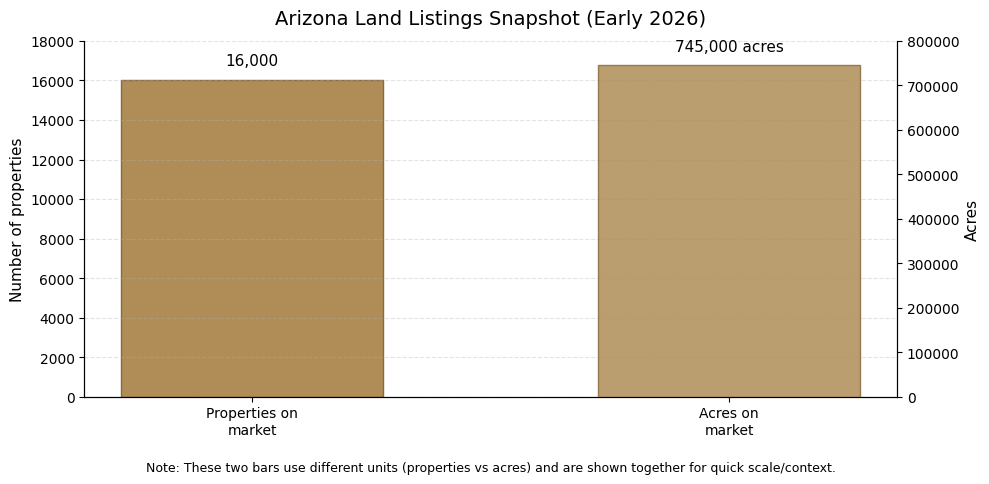
Arizona’s Southwestern United States location means vast deserts and public lands; land that is private and developable tends to be either in valley bottoms (good for farming or building) or around existing towns. County data shows thousands of listings across the state (over 16,000 properties and ~745,000 acres were on the market as of early 2026), but remember that not all land is equal.
Many listings are very large ranches or remote plots that cater to a limited buyer pool. As a seller, understanding what category your land falls into – luxury lot vs. starter home lot, working farm vs. raw acreage, etc. – will help you align with the right market segment.
Key Factors Influencing Arizona Land Value
Selling land successfully means knowing what drives value in the Arizona land market. Below are some of the most important factors and trends that landowners should consider when analyzing their property’s worth and appeal:
Location & Economic Growth
The old adage “location, location, location” holds true. Land in or near thriving cities and towns is generally worth more because of access to jobs, amenities, and services. For instance, land prices around Phoenix and Tucson have risen with the booming local economies and population influx.
Strong job markets pull in residents, which increases demand for housing and thus for residential land. Counties with diverse economies (Maricopa, Pima, Yavapai) see more stable land values, whereas very remote areas with little economic activity have lower demand.
That said, even rural land can jump in value if a major employer comes to town or a highway opens up new access. Always keep an eye on regional economic developments: e.g. a new factory, a mine reopening, or a tourist attraction being developed can suddenly make nearby land more desirable.
Zoning and Land Use Regulations
Zoning dictates what can be done on a piece of land (residential, commercial, agricultural, etc.) and thus heavily influences who will buy it and for how much.
In Arizona, zoning is mostly handled at the city or county level. Land that is zoned for higher-value uses (like dense residential or commercial) will typically fetch more than land zoned only for farming or rural residential use. For example, a parcel zoned for multi-family apartments in a city will be worth far more than an identical-sized parcel zoned for one house per 5 acres in the county.
Arizona has recently seen moves to loosen some zoning restrictions to address housing affordability – House Bill 2720 in 2024 legalized accessory dwelling units (guest houses) statewide in larger cities, and Maricopa County’s 2025 zoning update removed some hurdles for building additional homes. These changes can enhance land value by allowing more intensive use.
As a seller, you should know your land’s zoning and entitlements: what the buyer is allowed to build. If your land has flexible zoning or a mix of uses allowed (say, both commercial and residential potential), trumpet that in your marketing.
Conversely, if there are restrictions (like protected habitat, historical overlays, or HOA covenants), be upfront as those affect value too. In some cases, pursuing a rezoning or variance before selling can dramatically increase your land’s value (though it requires time and investment).
Always check with local planning departments to understand the highest and best use of your land under current rules.
Infrastructure & Utilities
Land that is “shovel-ready” – meaning it has infrastructure in place or nearby – is far more attractive to buyers.
Key utilities include road access, electricity, water, and sewer. In urban areas, being connected to city water/sewer and having paved street frontage is almost expected for top dollar land sales. In rural areas, even just having a graded road or power lines close by can boost value. Arizona’s rugged terrain means some parcels are isolated or landlocked; if your property lacks legal access or is very difficult to reach, its market is limited.
By contrast, if a county-maintained road or highway runs to your gate, you’ve got a big selling point. Water is perhaps the most critical utility in Arizona: if your land has a well, irrigation rights, or is within a water district, make that clear to buyers.
Properties in regions with new infrastructure projects (e.g. an extension of a freeway, a new interchange, or a broadband internet rollout) can see values climb as connectivity improves. The state has been investing in roads and power systems – a 2024 CNBC report noted Arizona has one of the nation’s most reliable power grids and a high share of renewables, which is a selling point for attracting industry.
If your land could easily tap into these networks, emphasize that. On the flip side, if selling an off-grid property, consider at least providing info on feasible options (like solar potential, perc test for septic, etc.) to show the land’s development viability even without city utilities.
Natural Features and Landscape
Arizona’s landscape ranges from desert to mountain, and natural features on your land can add value for certain buyers. A parcel with beautiful views, river/creek frontage, unique rock formations, or adjacency to public lands (like backing up to a national forest) often commands a premium in the recreational and luxury markets.
Similarly, land that is level and usable is generally more valuable than extremely steep or rocky terrain, unless that terrain has scenic value. Desert properties with saguaro cacti or interesting flora might appeal to those seeking a Southwest aesthetic. Forest properties with tall pines (like around Flagstaff or Show Low) attract buyers looking for a cool retreat.
If your land is suitable for specific uses – say it has grazing pasture for a ranch, or fertile soil for a crop farm, or cliffs for rock climbing tourism – those are attributes to highlight.
Be mindful of any environmental restrictions: some areas have protected species (like desert tortoise or specific plants) that could limit development. Checking for any floodplain (common near washes) or fire risk (in forested parts) is also wise, as savvy buyers will factor those in.
Market Data and Comparable Sales:
When setting a price, nothing is more persuasive than recent comparable sales. Land markets can be opaque (since each parcel is unique), but Arizona has decent data available through county records and land listing services. Look at what similar land parcels in your county have sold for in the last year or two.
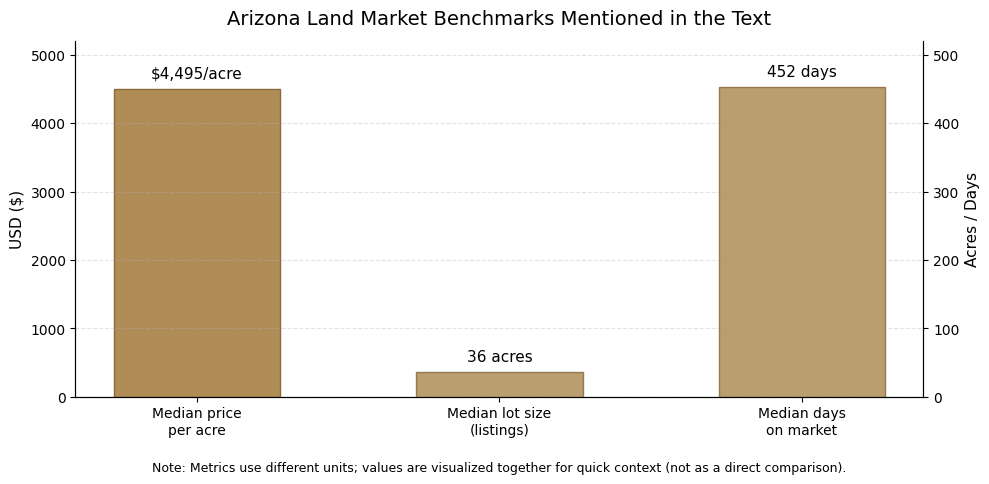
For example, if five 5-acre lots in your area all sold around $50,000 each, that’s a strong indicator of market value. Also note trends: median price per acre in Arizona was about $4,495 (land.com data for listings), but this varies wildly by location and parcel size.
Smaller lots in cities can go for hundreds of thousands per acre, while vast rural tracts might be only a few hundred per acre. If you have a large acreage, remember that price per acre drops as size increases (bulk discount). Utilize available analytics tools: the Land.com marketplace, for instance, publishes insights showing median lot sizes and days on market.
In Arizona, the median lot size of land listings is ~36 acres and median days on market is 452 days, which tells us that typical land deals (often larger tracts) can take well over a year to find the right buyer. Being armed with such data helps set realistic expectations – both for price and timeline.
Economic and Policy Environment
Broad economic conditions (interest rates, investor sentiment, agricultural commodity prices) also affect land. We touched on interest rates: higher rates can cool demand, especially for buyers who need loans (land loans are harder to get than home mortgages, so many land deals are cash or require creative financing).
In 2025, rates were elevated which slowed some land purchases, but if rates dip in 2026, it could bring more buyers back. For agricultural land, commodity prices (e.g. corn, cotton, hay, cattle) influence what farmers can pay – 2024–25 saw farm incomes tighten a bit, but government support and crop insurance helped.
Keep an eye on any state regulations or initiatives: Arizona has relatively low property taxes (around 0.52% effective rate statewide) and a business-friendly climate with a flat 2.5% income tax.
These factors attract investors and companies, supporting land demand. Environmental regulations (water usage rules, well drilling restrictions, etc.) can also impact land usability; for instance, areas of the state have imposed limits on new wells due to groundwater concerns.
As a seller, staying informed on such issues (e.g. Active Management Areas for water) is important – being able to answer a buyer’s questions about water or zoning regulations will build trust and ease the sale.
Tips for Selling Land in Arizona (2026 Seller’s Guide)
Selling land can be quite different from selling a house. Land buyers evaluate properties on potential and feasibility, and transactions often take longer. Here are actionable tips for landowners to improve their selling success:
Determine a Fair Price with Market Research
Price your land competitively by studying recent land sales and current listings in your area. Look for similar properties (in size, location, and use) to gauge the going rates. It may be worth hiring a professional appraiser to conduct a land appraisal or comparative market analysis, especially for higher-value land.
They can account for factors like assessed value versus true market value. Overpricing land is a common mistake – because land doesn’t have as many “comps” as houses, an unrealistic price can cause it to sit unsold for years. Aim for a price that reflects your land’s attributes but is in line with market reality to attract serious buyers relatively quickly.
Prepare Your Documents and Title
Before listing, get your paperwork in order. Locate your deed and ensure you have clear title ownership. If there are any liens (e.g. old mortgages, tax liens) or encumbrances (easements, HOA restrictions), address them if possible. Unpaid property taxes in Arizona can incur hefty penalties (16% annual penalty on delinquent taxes), and buyers will discover these issues during a title search.
It’s wise to preempt problems by running a title search yourself and possibly purchasing a title insurance policy to cover the sale. This gives buyers confidence that they won’t have title issues. Title insurance is typically handled at closing (often, sellers in AZ pay for the buyer’s title policy as an incentive), but having a recent title report in hand can speed up the deal.
Also, if your land is part of an estate or jointly owned, ensure all owners/heirs are on board and the legal right to sell is clear. Resolving boundary questions with a survey is also a good step – knowing the exact acreage and marked boundaries removes uncertainty for you and buyers.
Enhance Curb Appeal and Accessibility
First impressions matter even with vacant land. Clean up the property by removing trash, junk, or dilapidated structures. Trim overgrown vegetation and, if feasible, mow any areas that can be tidied. Not only does this make the land look more appealing, it helps buyers walk or drive the property more easily.
Consider small improvements that showcase potential uses: for example, mark cleared paths or home sites, install a simple gate or fence at the entrance, or even plant wildflower seeds for a pop of color.
According to land experts, basic landscaping and cleanup can increase perceived land value significantly (one source noted up to 20% in some cases). Also, mark your property boundaries or corners with flags or stakes – when a buyer visits, they can get a clear sense of the land’s layout. If access is an issue, try to improve it: grade the entry road or at least provide a map to the best route.
If you have a high-clearance vehicle or ATV, offer to tour the buyer around the land so they can fully experience it.
Highlight Utilities, Zoning, and Features
In your marketing, emphasize all the selling points of your land. Is there a water well, electricity hookup, or sewer connection available? Make that prominent, as “land with utilities” is far more attractive than raw land with none.
If no utilities, mention the options (e.g. “ideal for solar power and has good groundwater in the area for a well”). Describe the zoning designation and what it allows – many buyers might not know, so if your zoning permits multiple homes, agricultural use, or commercial structures, spell that out.
For instance, “Zoned RU-4: can build two residences or a home + guest casita, and okay for small farm or horses.” If your property could be re-zoned or subdivided for higher use, note that there is potential (some savvy buyers look for land they can entitle for profit).
Don’t forget to mention intangibles like views (“panoramic mountain views”), proximity to attractions (“15 minutes to Lake Havasu boating”), or any improvements you’ve made (fencing, grading, etc.).
Good photos from various angles – ground level and even drone shots – will help convey these features in your listings.
Consider using GIS maps or overlays to show lot lines, nearby development, or distances to utilities, as visual aids for buyers.
Use Multiple Marketing Channels
To reach the right buyers, cast a wide net. List your land on popular real estate platforms – not just the MLS (Multiple Listing Service) via a realtor, but specialty sites like Land.com, LandWatch, Zillow, or even Craigslist and Facebook groups for land/real estate.
Each platform taps different audiences: LandWatch, for example, reaches national land investors; Zillow might reach locals.
If your land has a niche appeal (hunting, ranching, off-grid), consider forums or groups related to those interests.
Quality signage on the property (if accessible) can also attract passersby or neighbors who may be interested.
If you’re not using a real estate agent, be prepared to field calls and questions promptly – responsiveness can make or break a deal in the making.
Alternatively, hiring a land-specialized real estate agent or broker can be very helpful; they often have a network of land buyers and know how to navigate land transactions (which can involve unique contracts, seller financing arrangements, etc.).
Whichever route, ensure your listing has clear information and evokes the possibilities your land offers.
Be Open to Creative Deal Structures
Land purchases sometimes require creativity because traditional bank financing is harder to obtain (banks are cautious about lending on land versus houses).
As a seller, you can make your land more attractive by offering or being open to seller financing – for example, you carry a note where the buyer pays you in installments over a few years.
This increases the buyer pool (especially for higher-priced land or for buyers who are investors). If you do offer terms, make sure to do credit/background checks and use a solid contract, possibly with a down payment to protect yourself.
Another avenue is auctions for certain lands; auctions can sometimes yield a fast sale at fair price if there’s competitive bidding (particularly for unique properties or when the market is hot).
There are also land investment companies that make cash offers (often below market) for a quick sale – as a seller you’d trade some price for speed and certainty. This can be an option if you need to liquidate fast.
In general, remain flexible in negotiations: if a buyer’s offer is close to your goal, weigh the carrying costs of holding out longer versus accepting a slightly lower price now.
Remember to factor in your expenses during the selling period (property taxes, maintenance, etc.). If you’ve properly accounted for these, you’ll have a clear bottom line and can negotiate confidently.
Patience and Persistence
Finally, recognize that selling land typically takes longer than selling a home.
The average time on market for Arizona land can be many months to over a year, so don’t be discouraged if you don’t get immediate bites. The key is to keep the property visible and keep it in good condition.
Revisit your marketing every few months – update listing photos to reflect different seasons, refresh the description, or adjust the price if needed based on feedback or market shifts.
Stay informed on any new developments nearby (for instance, if a new highway exit is planned near your land, that’s new info to advertise).
Engage with any interested parties professionally and provide any additional info they request (e.g. soil tests, permit info). Land buyers often do extensive due diligence, so be prepared for a potentially longer escrow while they verify everything.
Working with a reputable title company or real estate attorney can ensure the closing process goes smoothly once you have a buyer committed.
By following these tips, Arizona land sellers can improve their chances of a successful sale. The 2026 market conditions – stable growth, ongoing demand, and limited supply of quality land – create a favorable window for those looking to divest land holdings.
It comes down to presenting your land in the best light, pricing it right, and navigating the process diligently.
Conclusion
Arizona’s land market in 2026 presents a landscape of opportunities for sellers. The state’s robust economic growth and influx of people continue to drive demand for all types of land – from residential lots in booming suburbs, to fertile agricultural land in the river valleys, to expansive ranches and recreational tracts in the desert and high country.
While the frantic price surges of the early 2020s have given way to a calmer, more balanced market, land values are generally on a gentle rise, supported by Arizona’s popularity and the fundamental scarcity of land in key locations.
Sellers who understand their local market trends – be it county-level developments or the nuances of their land type – will be best positioned to capitalize on these conditions.
Importantly, selling land requires blending market insight with preparation. We’ve seen how factors like zoning flexibility, infrastructure, and water access can significantly boost land appeal and price. By highlighting these strengths and addressing any weaknesses (such as clearing the land or securing legal access), you can unlock greater value.
Additionally, leveraging data and references – such as recent sales and professional appraisals – lends credibility when justifying your asking price to buyers.
Arizona offers a dynamic environment where a piece of land could attract a wide range of buyers: a developer assembling lots for a new housing project, a farmer expanding operations, an investor betting on long-term appreciation, or an individual family seeking their slice of the Southwest dream.
As a seller, tailoring your approach to likely buyers and remaining flexible in negotiations (maybe offering financing or being patient through due diligence) can make the difference in sealing a deal.
In conclusion, 2026 is shaping up to be a promising year for those who want to sell land in Arizona. The state’s mix of economic vitality and natural allure – from the tech growth in Phoenix to the serene landscapes of its rural counties – ensures that demand for land remains healthy.
By staying informed (as with this guide) and proactive in your selling strategy, you can turn your Arizona land asset into a successful sale. Remember, every parcel has its story and potential; it’s your job to convey that to the right buyer.
With the right preparation and mindset, you’ll be well on your way to a smooth and rewarding land sale.