

Key Takeaways
Alaska’s land supply is constrained by ownership structure, so pricing is highly local and strongly tied to access and buildability.
Matanuska-Susitna Borough stands out as a growth area (2024–2025), supporting demand for buildable lots and road-access small acreage.
Out-of-state visitor volume rose slightly from 2023–24 to 2024–25, supporting accessible recreation and waterfront parcels where permitting is straightforward.
Conventional mortgage channels often won’t finance vacant land, reducing the financed buyer pool; sellers can offset this with strong documentation and clean access/title.
Mineral reservations and “split estate” issues are a core Alaska diligence topic; state-sold land commonly retains state mineral rights and reserved entry rights.
Public offerings (state, borough, and tax-foreclosure sales) create visible price anchors, but they come with “as-is” terms, limited inspection, and specific timelines.
Alaska’s land market behaves differently from most US states because private, sellable land is structurally limited. A widely cited estimate provided by the Alaska Department of Natural Resources (DNR) puts Alaska upland ownership at about 60.7% federal, 27.5% state, 11.6% ANCSA corporation land, and ~0.2% other private (including municipal and borough).
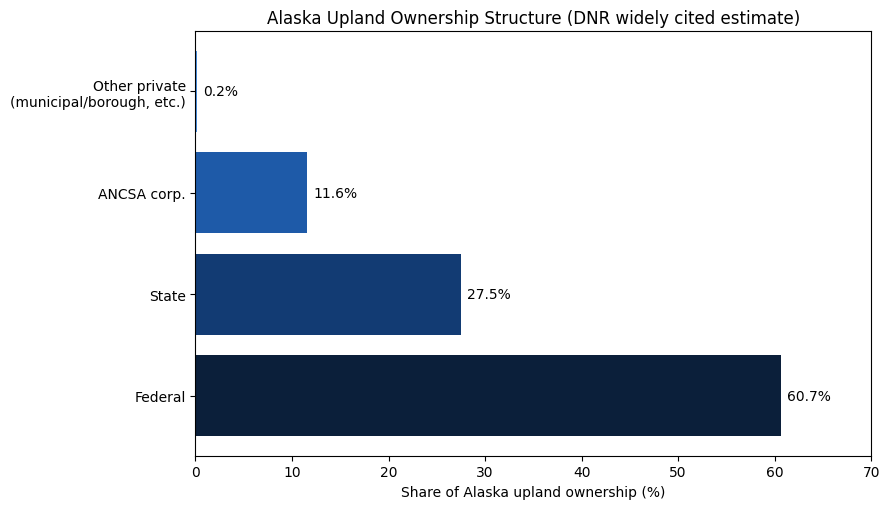
That ownership structure concentrates most buyer attention (and pricing power) into parcels with strong access and clear use feasibility, especially those near communities, roads, ports, and utilities.
From 2023 to 2026, land sellers will get the clearest trend signals from: (1) assessor/valuation reports in the biggest road-system markets (Anchorage is the most transparent statewide), (2) publicland programmes that show how government sellers price and disclose land, and (3) demand drivers such as population patterns, tourism/recreation, and credit conditions.
Demand fundamentals are mixed but workable for sellers who present land professionally. Statewide population has grown modestly since 2020, but growth is uneven: the Mat‑Su area gained population (notably +1.45% from July 2024 to July 2025), while the Anchorage municipality was slightly down across the same year (-0.04%).
Tourism is a real “pull factor” for recreational and waterfront land. Visitor-volume reporting estimates 3.079 million out-of-state visitors for the full year May 2024–Apr 2025, a +1.1% increase from the prior 12-month period. Cruise travel dominates summer visitor volume.
For everyone who wants to sell land, the single strongest 2026 theme is deal readiness. In Alaska, the fastest “yes” usually goes to the listing that quickly resolves: What am I buying? Can I access it? Can I build/use it? What risks am I inheriting? That means less guesswork, more documentation: access proof, survey/plat clarity, rights/reservations, and targeted disclosures.
Seller notes (to strengthen your listing in 2026):
To improve visibility and attract potential buyers, highlight unique property features that are clearly related to land value in Alaska, such as legal access type, proximity to utilities, shoreline conditions, views, soil/build feasibility, and seasonal road reliability. Strong market knowledge helps you explain why your parcel competes well against other listings, and it also helps buyers understand what factors affect land pricing in your micro-market.
Encourage buyers to conduct thorough due diligence by providing what they need up front (surveys, plats, easements, wetlands notes, permits, and disclosures), and show compliance with local laws and any borough or zoning requirements where applicable.
If your property is suitable for leasing (for storage, seasonal recreation, equipment staging, or a cabin pad), you can note how the land can generate passive income, but keep claims specific and realistic. Finally, address the basics of land maintenance (trail/driveway upkeep, snow access, brush clearing, shoreline erosion monitoring) so buyers feel confident about ownership costs and ongoing responsibilities.
Land Market context and demand drivers
Land ownership and why access multiplies value
Because most uplands aren’t privately owned, “supply” in the Alaskan land market is not just the number of listings you see. It also reflects how much undeveloped land is actually eligible for private sale. That’s why the DNR upland ownership estimate matters so much: legal access, practical access, and build feasibility can impact land values dramatically between otherwise similar parcels of land, and they can also amplify market fluctuations from one area to the next.
This same ownership reality helps explain why comparables (“comps”) can be hard to find. In thin markets, pricing requires thorough market research, and the quality of your documentation becomes part of your pricing power. A parcel with a recorded easement, recent survey, and a build-feasibility note can provide valuable insights for buyers and appraisers, and often performs better than a similar parcel with too many unknowns.
Demographics and where demand concentrates
Alaska Department of Labor and Workforce Development publishes population estimates showing modest statewide growth since the 2020 Census baseline. From April 2020 (Census) to July 2025, statewide population rose from 733,391 to 738,737.
The pattern that matters for sellers is where people are growing. The same source shows uneven change from July 2024 to July 2025 (selected areas):
Area (selected) | July 2024 | July 2025 | Change 2024–2025 | Growth 2024–2025 (%) |
|---|---|---|---|---|
Anchorage (Municipality) | 289,350 | 289,221 | -129 | -0.04 |
Mat‑Su Borough | 115,716 | 117,412 | +1,696 | +1.45 |
Kenai Peninsula Borough | 61,040 | 61,327 | +287 | +0.47 |
Fairbanks North Star Borough | 96,905 | 97,083 | +178 | +0.18 |
Juneau (City & Borough) | 31,283 | 31,182 | -101 | -0.32 |
Seller interpretation: growth areas tend to support consistent demand for buildable lots and road-access acreage; flat/declining areas can still sell, but sellers often need sharper pricing, better marketing, or more flexible buyer terms.
Tourism and recreation demand
Visitor volume is especially relevant for: recreational parcels, waterfront lots, remote cabin sites, and properties near tourism corridors. The Alaska Visitor Volume programme (prepared by McKinley Research Group for the Alaska Travel Industry Association) estimates:
Summer 2024 visitors (May–Sept): 2,702,900, with cruise visitors 1,785,000 (66%), air visitors 839,600 (31%), highway/ferry 78,300 (3%).
Full year 2024–25 visitors (May 2024–Apr 2025): 3,079,200, up +1.1% from full year 2023–24.
Seller implication: if you’re selling recreational or waterfront land, include a simple “recreation access note” in your listing package (boat/air/trail access realities, seasonal constraints, and what’s currently legal to build or use). Buyers do not reward vague claims like “great fishing” unless the listing also reduces diligence effort.
Because Alaska is home to diverse destinations and visitor types, tourism demand often shows up first in recreational land inquiries, especially where Alaska offers scenery, wildlife, and abundant natural resources that attract repeat visitors. In practice, selling well in Alaska involves utilizing clear, buyer-friendly proof points and firsthand insights (photos from different seasons, verified access notes, and realistic travel times).
Since Alaska includes remote corridors and weather-dependent access, make it explicit how the land can be used (camping, cabin site, shoreline access, storage, guided recreation staging) and where Alaska presents constraints that buyers must plan for.
Be specific about why environmental considerations are critical (wetlands, erosion, flood risk, permafrost, shoreline rules) and how those factors affect what’s legal and feasible to build. Finally, add a simple cost-and-logistics snapshot (travel, freight, maintenance, seasonal access) because that clarity is crucial for effective financial planning and helps buyers move forward faster with fewer follow-up questions.
Natural resource factors impacting land demand
For forest/timber parcels, Alaska’s state forestry reporting is a market signal that timber is actively managed and sold in multiple regions. The Alaska Division of Forestry & Fire Protection’s FY2024 summary includes tables for timber volume sold and revenue and discusses active operations and access road work.
Even when you’re selling private timberland, buyers often examine state sale activity as context for timber demand, logging feasibility, and risk.
Land market trends and regional differences
What we can measure statewide versus what is unspecified
Land-price “averages” for Alaska are often not published in a clean, statewide form.
When data is unavailable, that gap itself is a practical seller lesson: you usually win by building a defensible, local pricing story rather than chasing a statewide average that doesn’t exist (or doesn’t apply to your access/utility context).
As a broad benchmark, the 2024 REALTORS® Land Market Survey (a collaboration between Realtors Land Institute and the National Association of Realtors) reports that average land price-per-acre growth “adjusted to” about 1.5% in 2024, and that many land transactions close within 60 days (about 25% within 30 days). Alaska can be slower, especially off-road-system, but this is a useful baseline for explaining buyer behaviour in a higher-rate environment.
Anchorage value changes as a proxy for the road-system core
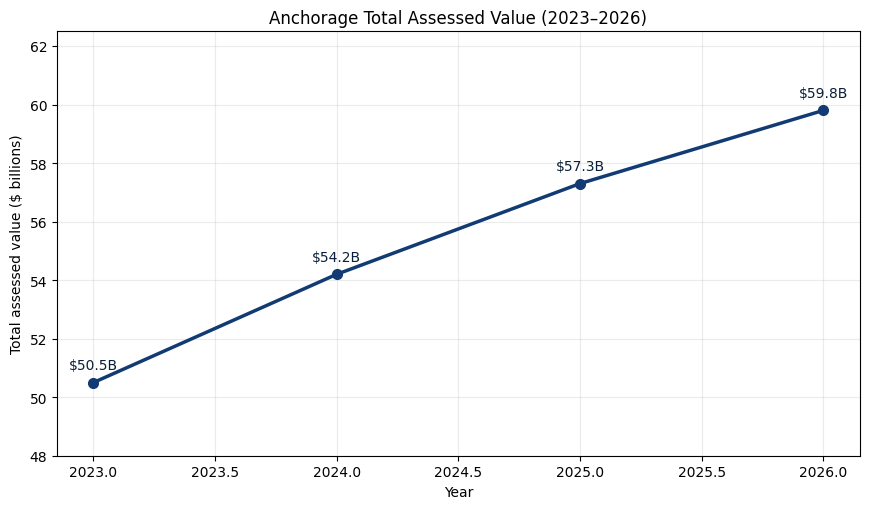
Municipality of Anchorage publishes annual valuation reports that provide consistent year-to-year totals and category changes. These reports show total assessed value rising:
2023: $50.5B total value (property summary).
2024: $54.2B total value; $39.5B taxable value.
2025: $57.3B total value; $42.3B taxable value.
2026: $59.8B total value; $44.8B taxable value.
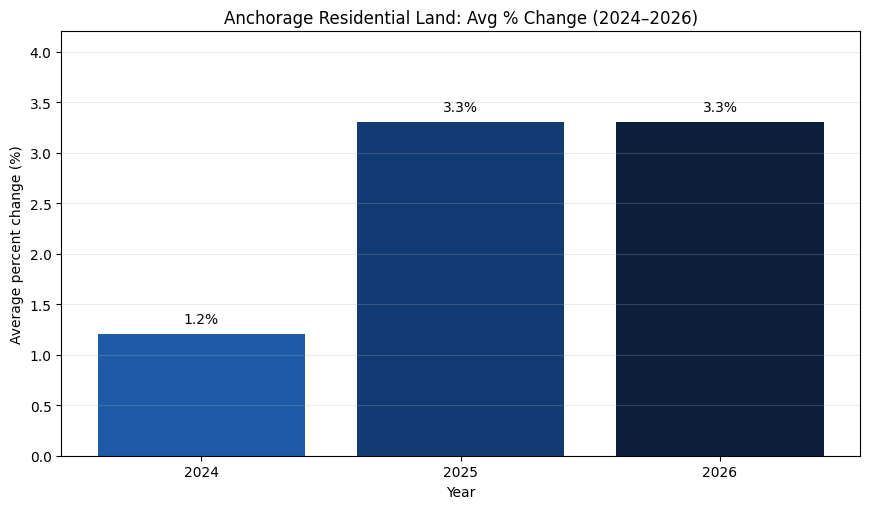
For land sellers specifically, Anchorage reports also publish “Residential Land” average percent changes (existing property analysis, excluding new construction): 1.2% (2024) and 3.3% (2025 and 2026).
Important limitation: Anchorage explicitly notes Alaska’s non-disclosure environment and uses sales inquiries/modelling; assessed value movement is best treated as directional, not a direct replacement for market sale data.
Borough and regional differences that sellers should understand
Mat‑Su Borough
Stronger population growth supports steady demand for buildable lots and road-access acreage; sellers reduce time-to-sell by documenting access and basic build feasibility.
Kenai Peninsula Borough
Demand blends local housing with recreation (fishing, cabin land) and seasonal tourism. The borough also sells land via multiple formats, which can influence buyer expectations in some areas.
Fairbanks North Star Borough
Interior parcels can be sensitive to seasonality and soils/permafrost diligence, and the borough’s foreclosure calendar is publicly stated (useful for understanding “distressed supply” timing).
Southeast Alaska
Tends to be micro-markets by community; public sales (including foreclosures) can create visible price anchors and strict “as-is” terms.
Land types and seller playbooks for land for sale in Alaska
Comparison table: land types, typical prices, and time-to-sell
This table is seller-facing. “Typical price range/average” is unspecified when primary/official sources do not provide reliable Alaska-wide statistics. Where available, it uses public “anchor” examples (not a statewide average).
Land type | Typical pricing anchor | Typical price range/average | Public anchors where available | Time-to-sell planning range |
|---|---|---|---|---|
Vacant residential lots (serviced) | Per lot; sometimes $/acre | Unspecified | Heritage Land Bank postings include a residential lot example with a stated minimum bid ($70,000 for ~7,173 sq ft in an R‑1 category posting). | ~1–3 months if priced well; winter slowdowns common |
Small-acre residential (road system) | $/acre + access/utilities adjustments | Unspecified | Unspecified | ~2–6 months (strongly location dependent) |
Recreational / cabin / wilderness | $/acre + “experience value” | Unspecified | State offerings are surveyed/appraised; pricing tied to appraisal and programme terms. | ~3–12+ months (often longer off-road-system) |
Waterfront (river/lake/ocean) | $/front-foot or per lot | Unspecified | Unspecified | ~3–9 months (location dependent) |
Commercial / industrial (urban) | $/acre + zoning/utilities | Public anchors only | Heritage Land Bank postings include examples like $575,000 minimum bid for 1.25-acre industrial parcels and $625,000 asking price for a ~1-acre commercial parcel. | ~3–12 months |
Agricultural | $/acre + productivity/water | Often unpublished/withheld | USDA NASS land value summary tables exclude Alaska for several published series (so treated as “unspecified”). | ~6–18 months |
Timber / forest land | $/acre + timber value | Unspecified | State forestry reporting shows active timber sales and revenue as context (not a private-land average). | ~6–18+ months |
Mineral/rights affected | Surface-use value + encumbrances | Unspecified | State retains mineral estate on state land sales; claims/records require diligence. | Often longer; diligence-driven |
Tax-foreclosure parcels | Rules-driven sale | Listing-specific | Juneau notice example: minimum bid $100,000; “as is”; limited inspection access. | Event-based (sale calendar + legal steps) |
DNR auction / OTC parcels | Appraised value base; OTC premiums | Programme terms, not market-wide | OTC pricing described as 30% above appraised value for first 2 weeks, then 15% above for 2 weeks, then at appraised value. | Programme-based |
Time-to-sell note: the national land survey indicates many land sales close within 60 days; Alaska-specific timelines can exceed this due to access, survey, title, and financing constraints.
Seller playbooks by land type
Vacant residential lots (serviced / near utilities)
What buyers ask: road maintenance status, utility distance, setbacks, drainage, septic feasibility, and whether the lot is truly buildable under local rules. Many deals stall because sellers describe “buildable” without evidence. Packaging a short “build feasibility note” (zoning, setbacks, utility distances, soils/septic info if known) reduces buyer friction.
Recreational and wilderness parcels
The number one pricing driver is often not acres; it’s access certainty. Be precise about legal vs practical access: recorded easement vs “people have always used this trail.” State land sale documents emphasise that land is offered without guarantees and that buyers should inspect before applying; private sellers benefit from the same mindset.
Waterfront parcels
Buyers will focus on erosion, flooding, wetlands, and shoreline setbacks. If you have surveys, flood information, prior permits, or setback sketches, include them. If you do not, state that clearly (don’t guess) and price accordingly.
Commercial/industrial land
Environmental history is frequently the gating issue. The Heritage Land Bank postings show that public sellers openly flag contamination contexts on some commercial parcels; private sellers should expect buyers and lenders to raise the same question.
Timber/forest land
Expect questions about timber value (“timber cruise”), access roads, and riparian buffers. State forestry reporting provides evidence of active timber sale activity and multi-region operations, reinforcing that timber value and access are real market inputs.
Agricultural land
Buyers commonly examine soil, drainage, water access/rights, and clearing cost. Some national farmland land-value datasets exclude Alaska, so sellers often must rely on local comps and appraisals rather than published statewide averages.
Mineral/right complications
This is an Alaska-specific high-impact topic. DNR’s title guidance notes that, under Alaska law, the state retains the mineral estate when it sells land and reserves rights to enter for mineral purposes. Buyers (and lenders) treat this as a risk/constraint they must understand. Additionally, mining claim records and mineral rights records can affect perceived title risk.
Tax-foreclosure parcels
Foreclosure sales can involve minimum bids, “as-is” conditions, and limited inspection access. Juneau’s notice explicitly warns that bidders may not be able to examine the home and that the city disclaims warranties. Sellers should understand these terms because these public sales influence buyer expectations (e.g., “why is your land more expensive than a foreclosure minimum bid?”).
DNR auction parcels and OTC parcels
DNR’s fact sheets matter as a “buying alternative” that sets expectations. It describes auctions, over-the-counter parcels, and RRCS (“stake-it-yourself”). It also describes the OTC pricing schedule above appraisal early in the offering, and notes that DNR can finance some purchases via land sale contracts, including a down payment requirement.
Documenting improvements that increase the value
Market value in Alaska property tax law
Alaska Statute AS 29.45.110 defines “full and true value” as the estimated price a property would bring in an open market sale between a willing seller and willing buyer, both informed about the property and general price levels, and it requires assessment at full and true value as of January 1 of the assessment year.
Seller implication: buyers and agents often use assessed values as a negotiation anchor. If your asking price differs materially, your listing should explain why with evidence (recent comps, access improvements, survey work, utilities, permitted improvements, or unique features).
Appraisal methods explained in plain English
Sales comparison approach (most common for vacant land): compare your parcel to similar sold parcels (“comps”), then adjust for differences (access, utilities, views, zoning, wetlands, topography, size).
Income approach (for commercial land): value is tied to expected net income (e.g., ground lease potential).
Cost approach (for site improvements): more common for improved property, but relevant for land when value is driven by costly site work (clearing, driveway/roadwork, well/septic).
DNR’s appraisal guidance explains how appraisals are used in state land sale programmes, including age requirements and that land is not sold below appraised market value. It also notes typical appraisal cost and timeframe ranges.
Practical seller strategy: if your land is unusual (remote, waterfront risk, rights complications), a credible local appraisal can prevent months of overpricing or protect you from underpricing.
How to use this as a seller (and why it matters in Alaska):
In Alaska, appraisal quality often shapes buyer confidence because many land purchases happen with limited “perfect comps” and changing market conditions. A strong appraisal and supporting documentation can give buyers and agents real insights into the Alaskan land, especially when you clearly explain access, seasonal constraints, and build feasibility. Since land in Alaska requires more diligence than many states, pricing well usually involves utilizing market reports (borough assessments, local listings, DNR disclosures, and recent closed sales) to confirm market demand in your specific submarket. If you have improvements or feasibility work (survey, driveway plan, septic suitability, utility confirmation), include them because they can enhance land value in the eyes of people purchasing land and reduce negotiation friction during due diligence.
Taxes, financing, compliance, and transaction readiness
Property tax basics for sellers
Property tax is primarily local in Alaska (boroughs/municipalities). AS 29.45.110 underpins how “market value” is defined for assessment, so sellers should expect assessment values to arise in negotiations.
Seller checklist item: Confirm property tax status early and resolve delinquencies. Delinquent taxes can trigger foreclosure timelines that are multi-year and sale-calendar driven.
Tax foreclosure as a “real market channel” in 2026
Fairbanks North Star Borough describes tax foreclosure as a three-year process and notes foreclosure sales are held at least once every two years; it lists a planned sale date of Aug 28, 2026 and specific added fees tied to steps in the process.
A City and Borough of Juneau foreclosure notice for 520 6th Street provides a seller-relevant template of “distressed-sale terms”: minimum bid $100,000, as-is disclaimers, and limited inspection access because it is a foreclosure sale.
Financing and credit realities for buyers
This is a major 2026 seller issue: many buyers cannot use conventional mortgages for vacant land.
Freddie Mac’s guide says it does not purchase mortgages secured by vacant/undeveloped land.
Fannie Mae’s selling guide similarly lists vacant land/land development properties as ineligible.
Seller actions that reduce financing friction (practical and non-investment):
Provide a clean legal description and (if available) a survey/plat.
Document legal access clearly (recorded easement / ROW details).
Clarify whether the lot meets typical road and utility standards for construction lending (when relevant).
Prefer offers with land-appropriate proof of funds or lending prequalification (not just a standard home mortgage prequal).
Public programmes illustrate alternative buyer financing patterns. DNR’s land programme fact sheet describes land sale contracts and down payment requirements, and USDA’s farm ownership programmes describe down payment structures for farm purchasing and publish current interest rates for programmes.
Environmental due diligence and regulatory compliance
For commercial/industrial parcels, former service sites, or unknown history land, buyers often require Phase I Environmental Site Assessments aligned with All Appropriate Inquiries (AAI). U.S. Environmental Protection Agency provides AAI guidance and references reporting requirements under 40 CFR Part 312 (and commonly used ASTM standards).
ASTM International’s ASTM E1527‑21 is the Phase I ESA standard commonly used as a “good commercial practice” reference in this context.
Wetlands and fill/development feasibility are also central. Alaska Department of Environmental Conservation notes that Section 404 of the Clean Water Act requires permits (Army Corps) for activities in waters of the U.S. in Alaska, with state involvement in certification. Sellers benefit by flagging likely wetlands early (maps + site visit) instead of letting this appear late in due diligence.
If a buyer’s project depends on federal permits/funding, NEPA-type review processes may apply. Council on Environmental Quality documents recent rulemaking changes affecting the NEPA regulatory environment; sellers should treat NEPA questions as project-specific and encourage professional guidance when federal actions are involved.
Seller checklist and workflow
Seller checklist (practical actions):
Confirm what you are selling (legal description, boundaries, included rights).
Prove access (legal and practical).
Order a preliminary title report early; cure issues before listing.
Disclose mineral reservations and recorded rights as best you can (especially if state-sold origin is possible).
Prepare survey/plat, zoning, utilities, and tax status info.
Screen for environmental/wetlands issues if relevant.
Price using defensible comps/appraisal logic; don’t rely solely on assessed value.
Market with maps, photos, and a one-page factsheet.
Prefer offers with proof of funds or land-appropriate lending.
Use clear due diligence timelines; plan for seasonality/logistics.
Seller notes (to connect the dots for 2026):
This comprehensive guide aims to help sellers understand why transaction readiness matters so much in Alaska’s local market, where the demand for land can shift quickly based on access, permitting complexity, and lending constraints. Since property tax is set locally, it’s smart to keep a simple summary of local tax rates and obligations, and be ready to explain how assessments relate to negotiations.
Alaska has no state income tax, but sellers should still budget for closing costs and any fees associated with land transfers, recording, and title work. Many deals also hinge on land use regulations (zoning, setbacks, coastal rules, wetlands considerations), so showing compliance with local regulations and having permit-related documentation available can improve buyer confidence and reduce delays.
For buyers using public programs or needing permits, understanding the application process (for land contracts, farm programs, or wetlands/404 permitting) helps you set realistic timelines and provides insights into market trends like where financing is easiest and where permitting tends to slow closings. When questions get technical, legal professionals can help with easements, title defects, mineral reservations, and disclosure language so you can move from offer to closing with fewer surprises.
Conclusion
Selling land in Alaska in 2026 goes more smoothly when you treat your property like a “ready-to-sell” package and remove as many unknowns as possible for buyers. Since pricing and demand can swing based on access, buildability, and how easy it is to verify the land’s details, your advantage is documentation and clarity: confirm legal access (not just “it looks like a trail”), organize any survey/plat info you have, be upfront about utilities (power, well/septic feasibility), and clearly note any restrictions, easements, or special considerations like wetlands, flood risk, permafrost, or seasonal road conditions.
Alaska’s size and seasonality also matter, so strong maps, GPS coordinates, and photos taken in the right season can significantly improve buyer confidence. If you price using local comps where available and market to the right buyer type (recreational, off-grid, homestead, or development-ready), you will attract more qualified inquiries, shorten negotiation time, and increase the odds of a clean closing.
Remember that land offers different value depending on how clearly you can prove access, feasibility, and use, so treat your listing like a buyer-ready file. One of the most serious common mistakes to avoid is being vague about access: easements grant others the right to cross or use part of a property, so you should identify what easements exist (and where), whether they are recorded, and how they affect building or privacy.
If your parcel has land development potential, include only what you can support (zoning, utilities, driveway/road standards, and any preliminary feasibility work), rather than relying on assumptions. Even if you’re a total land geek, buyers still need simple proof points they can verify quickly, and the right resources can enhance knowledge, think borough maps, recorded documents, survey notes, and a one-page factsheet that summarizes everything in plain English.