

Key Takeaways
Highland values: Rhode Island land prices remain strong, especially for farmland. USDA data show RI cropland averaged $32,900 per acre in 2025 and all farm real estate (land plus buildings) $22,500/acre, among the highest in the country.
Scarce farmland: RI’s farmland area has shrunk dramatically (from 264,734 acres in 1945 to about 61,223 acres today). Preserved or farmable land is rare, boosting its value.
Location matters: Sellers should highlight proximity to cities (e.g. Providence), roads or public transport, since easy access and nearby amenities increase land demand and livability.
Costs and taxes: RI’s effective property tax rate is high (~1.32%). Sellers must account for taxes, loan payoffs, and other expenses (survey, appraisal) when pricing land.
Financing climate: Current 30-year mortgage rates are ~6%. Higher borrowing costs can slow some buyers, so realistic pricing and flexible terms (e.g. seller financing or lease-purchase) can help close deals.
Selling strategies: Prepare clear ownership documents, get a professional real estate appraisal, and market the land’s best features (soil quality, utilities, views, easements). For farmland, consider conservation easements or farmland preservation programs for tax breaks (though state funding is limited).
Rhode Island Land Market Overview
Rhode Island is the smallest U.S. state, but its land market is surprisingly diverse. Sellers offer coastal parcels, woodlots, farmland, vacant residential lots, commercial/industrial sites, and even plots for conservation. Despite limited acreage, Rhode Island has active agriculture niches (vegetables, nurseries, small farms) and high urban demand (for housing or development).All land sales are shaped by the local economy and landscape. For example, Providence’s economy and moderate incomes (median household ~$61K) attract residential development, while Western RI’s rural towns rely more on farming and open space. Online tools (even a quick Google search or GIS map) can help sellers identify local zoning, soil type, or utility access. (Note: some official sites may require passing a CAPTCHA to download maps or tax data.)According to listing services, the typical Rhode Island land parcel is large. Land.com reports average RI land listings of ~43 acres at ~$1.76 million (median price $734K, or $27,855/acre). Smaller vacant lots skew higher per-acre, however. For example, a LandSearch summary shows 145 undeveloped RI lots averaging 9.2 acres: median $325K, average $798K (≈$86,194/acre). These figures underline that land – especially near coasts or cities, commands premium prices.
Land Price Trends
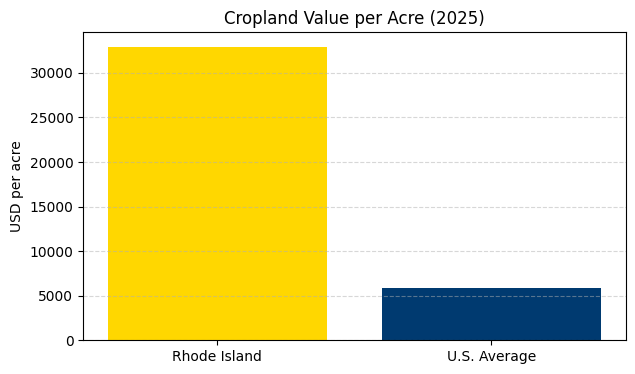
Recent years saw broadly rising land values, though growth has moderated. USDA reports that U.S. farm land values climbed until 2024 (5% annual rise in 2024) and slowed in 2025 (4.3%). Rhode Island land is especially pricey due to limited space. A chart of U.S. farmland values (not shown) would place RI at the top. In fact, RI’s cropland values are far above the U.S. average (RI $32,900 vs. US $5,830 in 2025).
Beyond farmland, vacant residential and development land also saw high prices. For example, in 2023-2025 RI housing prices rose (median home ~$340K) but sales cooled as inventory remained tight. Vacant lots in high-demand towns (Providence suburbs, coastal areas) saw multiple offers. Overall, sellers have the upper hand in many RI locales, though well-priced land still moves in months rather than days.
Regional variation: Land in Providence and Kent counties tends to fetch more due to proximity to the metro area, while more rural counties (Washington, Newport) sell for agricultural value. (Note: as of 2017, top farmland areas were Washington County ~19,866 acres and Providence ~16,328 acres, reflecting where farmland remains.)

Agricultural land is a big part of the story. Rhode Island farms contribute to the agriculture sector: in 2017, RI had 1,043 farms on 56,864 acres. (This was an 18% drop in 5 years.) Farms vary in size: over 70% have <50 acres, but key production is concentrated. Top farmland counties are Washington (≈19,866 ac) and Providence (16,328 ac). Use of that land includes crops (40,909 ac), pasture (17,079 ac), woodlands (25,535 ac).
Farmland values: RI farmland is extremely costly. USDA shows five states averaging ≥$10,000/acre; RI leads by far at $22,500/acre (farm real estate). For perspective, this is ~5 times the U.S. average of $4,350. High demand (from developers and conservation) drives this. RI farmland competes with residential uses, pushing up value. (A related figure: cash rent for RI cropland is ~$161/acre, reflecting strong farm returns.)
Farmland scarcity: In 1945 RI had 264,734 acres of farmland; today about 61,223 acres remain. That steep decline (over 75% lost) highlights scarcity. Organizations note RI is among the most threatened states for farmland. Sellers of farmland benefit from this demand, but also bear responsibility. If land is under easement (e.g. a state conservation easement), it cannot be developed, which lowers sale price but may yield tax credits. Many farms lease land to others: rental (passive) income from leases can be a selling point or alternative to selling outright.
Agricultural programs: Rhode Island has a Farmland Preservation Program (started 1981) that buys development rights. Over 8,000 acres are protected so far. However, funding has dropped recently, and many approved farms await protection. Sellers with farmland near development might check if preservation easements (sometimes funded by grants) are available, as selling the development rights (while keeping ownership) can give a one-time payment and tax break.
Marketing farmland: When selling farm acreage, emphasize productive aspects: good soil, water rights (wells or irrigation), barns or fencing, and proximity to markets. Also highlight any existing farm income (crops, livestock) or non-farm uses (e.g., potential solar leases). If the farm has rented-out acreage, disclose lease terms, this land tenure (who rents/owns what) is critical for buyers. In short, show how the farmland fits into agriculture: crops grown (e.g. vegetables, hay, nursery stock) and any specialized enterprises.
Tax, Mortgage, and Financial Factors
Financial aspects heavily influence land sales. Rhode Island’s property tax is higher than most states: effective rates average ~1.32% of assessed value. Sellers should research their local tax rates (they vary by city/town). When listing, note any tax abatements or current use programs (some towns assess farmland at its farm use value, which can be much lower than market value). Buyers will consider annual tax, so presenting this information up front avoids surprises.
Mortgages and loans: Vacant land is typically financed differently than homes. Buyers might use agricultural loans, commercial loans, or large down payments. As of early 2026, 30-year mortgage rates are around 6.0%. This is lower than in 2023–24 (around 7%), but still limits buyer budgets. Sellers may find buyers who can pay cash, or they can offer seller financing (a loan from seller to buyer) or owner-carry options. Highlight if the land qualifies for special loans (e.g. USDA farm loans, or loans for undeveloped property), since higher interest (from banks) may deter some buyers.
Existing loans on the land must be handled at closing. If you have a mortgage, the lender will require payoff. Any remaining loan balance plus closing fees (recording, attorney) comes out of the sale proceeds. Sellers should get a payoff quote ahead of listing. Also, budget for capital gains taxes on profit (land sale gains are taxed at capital gains rates). Many small sellers are exempt (e.g. if they profit under certain limits), but professional help or a tax advisor is wise.
Expenses vs. Passive Income: Holding land has costs: taxes, insurance, maintenance (fencing, clearing brush). On the plus side, land can generate passive income by leasing (to farmers, hunters, etc.) while on the market. Mention any current rental income in your listing (e.g. “$X/year hay lease”).
Buyers like knowing a property can earn money. Even commercial leases (billboards, cellular towers) can add value. List all current income sources and recurring expenses so buyers see the net value.
Market Value by Region: What Rhode Island Buyers Pay for Different Property Types
In Rhode Island, pricing can shift significantly by region, especially between urban areas and places shaped by island living and a slower lifestyle. A buyer will typically pay more when properties near major routes feel convenient, when lot size fits local housing demand, and when key detail is easy to verify (access, utilities, and permitted use). These market trends in the real estate market often reflect what local land buyers and an investor base seek most: clear buildability, lower unknowns, and a clean path to purchase.
Land tied to the agricultural sector can hold a higher market value when agricultural use is clear, and the land supports a working farmer or lease demand. In contrast, a parcel with lack of access, unclear transfer history, or higher maintenance expectations may need strategic pricing to qualify serious interest.
A simple map package plus a few valuable insights on what makes the parcel distinct, helps buyers compare it to nearby options and understand the true value.
Real Estate Agent vs. Selling Direct: Which Approach Brings Better Value for Landowners
For a landowner, selling direct can work if you can price confidently, manage inquiries, and handle support tasks like disclosures, scheduling, and buyer questions. But when the parcel has complications (access, use limits, or tax rates that change net proceeds), a real estate agent can add value by bringing expert guidance, helping you verify buyer qualifications, and positioning the property around the strongest opportunity in the local real estate market.
A strong agent also brings a network you can’t easily recreate: connections to organization partners (surveyors, title, attorneys), builders, and specialized land buyers. That kind of collaboration can shorten the timeline by keeping the deal moving from first showing to contract to closing. If your parcel aligns with business demand or commercial properties activity, an agent can also help utilize targeted channels to promote it to the right buyers instead of relying only on general listings.
Environmental Due Diligence in Rhode Island: Wetlands, Coastal Limits, and Long-Term Risk
Environmental items are where deals most often slow down, because they affect feasibility and long-term risk. In Rhode Island, buyers often seek properties where they can quickly verify wetlands concerns, coastal constraints, drainage, or soil limitations before committing. If Rhode Island may impose added review for sensitive areas, sellers who gather key documentation early provide clearer insight and reduce last-minute renegotiation.
This is especially important for parcels tied to the agricultural side of the market. If the land has an agricultural use history, note it clearly, and be ready to share any relevant records that help a buyer understand ongoing use, site conditions, and upkeep expectations (including maintenance needs).
When buyers can evaluate risk quickly, the property becomes more attractive, and the path to purchase is smoother.
Prospect Quality: How to Attract Serious Buyers and Reduce Low-Intent Inquiries
Better prospect quality comes from clarity. Serious land buyers want fast answers: access, zoning, utilities, constraints, and what exists on-site today.
To improve prospect quality, focus on the details below:
Add a clear map and basic detail (boundaries, road frontage, lot size) so land buyers can compare options by region.
State what buyers can verify quickly: access, utilities, zoning, and any known limits like lack of access.
Mention tax rates and expected maintenance so the buyer can estimate true carrying costs.
Call out the strongest opportunity (housing fit, agricultural use, or commercial properties) based on local market trends.
Use strong photos and a short description that reflects the lifestyle or setting (urban convenience or island living feel).
Screen early: ask prospects if they qualify (cash, loan, or planned purchase timeline) before scheduling site visits.
If you work with an agent or real estate agent, leverage their network and support to connect with qualified buyers faster.
Long-Term Benefit vs. Quick Sale: Timing the Market Without Guessing
A quick sale usually favors simplicity: clean access, easy due diligence, and a price aligned with current market trends. A higher price can be realistic, but it often requires a stronger package, more documentation, clearer use positioning, and patience, because buyers will compare options across the real estate market. Rhode Island offers strong demand pockets, but the speed of sale often depends on how quickly a buyer can get comfortable with risk, cost, and feasibility.
For a landowner, the best move is to explore your local demand drivers and decide what outcome you want to retain: speed, price, or fewer contingencies. If your parcel fits investment interest or business use, your timeline may be different than a standard homesite lot because buyers may run deeper evaluations (including labor and development feasibility). Being clear on your goal helps you choose the right approach and avoid reacting to short-term noise in Rhode Island’s real estate headlines.
Selling Strategies and Tips
To sell land successfully in Rhode Island, follow these steps:
Prepare documentation: Gather deeds, surveys, tax records, and info on any easements or rights-of-way. Online searches (such as on the county assessor’s site) can be done, though sites sometimes require a CAPTCHA to view. A clear title is critical: make sure ownership names match, and there are no unresolved liens. If the land was inherited or in trust, clarify how ownership is held.
Professional appraisal: Hire a real estate appraiser experienced in land. They can estimate value by comparing similar sales (comps). This avoids over or under pricing. As a ballpark, current market data shows median RI land price per acre in the tens of thousands, but final price depends on location, size, and use.
Set a realistic price: Use the appraisal and broker advice. In hot markets (Providence suburbs, near highways) you may price higher; in remote areas, price per acre is lower. Check site listings: e.g. LandSearch reports average vacant land ~$86K/acre, while Land.com (for larger parcels) shows ~$27,855/acre. Also consider recent sales (check county deed records for actual sale prices). Avoid pricing too far above market, vacant land can sit unsold if overpriced.
Highlight key features: In your listings, emphasise positives: road frontage, utilities (electricity, water available), good soil, clearance (timbered vs. cleared), and views. Mention proximity to public transport (e.g. bus routes or commuter rail) if applicable, as this adds development value. If selling farmland, note crop history or agricultural soil ratings. If near a city, mention schools or city services (improving livability). Make clear any zoning or permitted uses.
Target the right buyers: Market farmland to farmers or land investors (farm bureaus, agricultural auctions, online farm sites). Market residential lots to home builders or developers. Use specialized platforms: Zillow and Realtor.com list land, but also consider sites like Land.com, LandSearch, or local farm listings. Working with a real estate agent who knows RI land is highly recommended. Agents with experience in land transactions can reach niche buyers and navigate regulations.
Presentation: Clean and secure the property. Remove debris or fallen trees, fix fences, mow access paths. Take high-quality photos (wide views, aerial/drone if possible). Post “For Sale” signs on the property with contact info. Be flexible to showings – land buyers often like to inspect on weekends.
Be patient and negotiable: Unlike homes, land can take months to sell (median ~200+ days on market). Expect buyers to ask for contingencies (e.g. soil tests, survey updates) and to negotiate price. You may offer to split some costs (survey, closing) to close the deal. Stay responsive to inquiries. If interest is slow, consider slight price adjustments or marketing pushes in high seasons (spring/fall).
Closing prep: Work with an attorney or title company to prepare closing documents. Ensure all requirements (like soil erosion permits if farmland will be tilled) are discussed. In Rhode Island, sellers usually pay deed recording fees; clarify this cost with your attorney. Also prepare to sign release of easements or mortgages at closing. Having financing lined up (for the buyer) ahead of time can speed closing.
By following these steps and staying informed about local trends, land sellers in Rhode Island can navigate the market effectively. Remember that external factors, such as state or federal funding for conservation, or changes in interest rates, can affect buyer interest. In 2026, sellers should leverage Rhode Island’s robust land values and unique features, while being mindful of costs (taxes, fees, and any outstanding loans). Well-prepared listings backed by data and clear information will attract serious buyers and lead to successful sales.
Conclusion
Rhode Island’s land market in 2026 is defined by scarcity, strong pricing, and buyers who want fewer surprises. Whether you’re listing a coastal parcel, a buildable residential lot, or high-value farmland, your best advantage is preparation: clear title, current survey and zoning details, honest notes about utilities and access, and a price backed by real comps and a land-savvy appraisal.
Since higher taxes and financing costs can slow decision-making, sellers who package their property with solid documentation, highlight location benefits (access to Providence, major roads, nearby amenities), and stay flexible during inspections and negotiations are the ones who move from “interest” to “offer” faster.
If your goal is to sell land in Rhode Island, treat your listing like a buyer-ready file, market to the right audience, and let strong facts and a clean presentation do the heavy lifting all the way to a smooth closing.