

Alabama land prices hit record highs by late 2025, averaging about $3,645 per acre (up ~5% year over year). Strong demand and tight supply kept values steady to rising, even as sales activity rebounded in 2025.
Location drives price: urban/high-growth land can sell for up to 5× more per acre than rural land (about $25,500/acre near Birmingham/Huntsville vs $4,950/acre in rural counties). Demand is hottest in Baldwin County (~300% turnover) and slowest in remote Black Belt counties (<15%).
Higher interest rates in 2025 cooled some land purchases, but Alabama’s low unemployment and growth kept buyer interest steady. If rates fall in 2026, buyer demand could jump (especially for tracts under $500k), while higher rates or a recession could slow sales and extend time on market.
Recreational land and timberland lead sales by acreage, with strong demand for tracts offering timber value, wildlife habitat, and hunting potential. But weak lumber prices and mill closures mean most buyers want mixed-use benefits, not timberland as a stand-alone investment.
Agricultural land remains in demand, especially in the Black Belt and Wiregrass, where fertile soils and multi-use potential attract buyers. Despite profit pressure from flat commodity prices, farm-hunting combos and metro-area growth have helped keep farm values firm.
Sellers should match their strategy to the local market: hot areas like Baldwin or Madison can draw multiple offers quickly, while rural Black Belt counties may take 12–36 months and require sharper pricing. A knowledgeable land agent and strong marketing of key features (timber, water, location, etc.) can improve your odds of a successful sale.
Selling land in Alabama can be a rewarding venture, but it requires understanding the market forces at play. Alabama offers a diverse land market – from timber-rich forests and fertile farmlands to hunting retreats and prime development parcels. As we head into 2026, landowners should be aware of current market trends, pricing dynamics, and regional differences that affect how quickly land sells and at what price.
This guide provides an overview of Alabama’s land market in 2026, backed by recent data and analysis, and offers practical tips for anyone looking to sell land in the state. We’ll cover economic factors (like interest rates and demand), break down trends by land type and region, and highlight strategies to help you make the most of your land sale.
A pastoral view of rural land in Alabama. Various types of land – from agricultural fields to timberland – have seen stable values due to strong demand and limited supply. Sellers should understand what makes their land valuable in today’s market.
Alabama Land Market Trends in 2026
Overall Market Strength
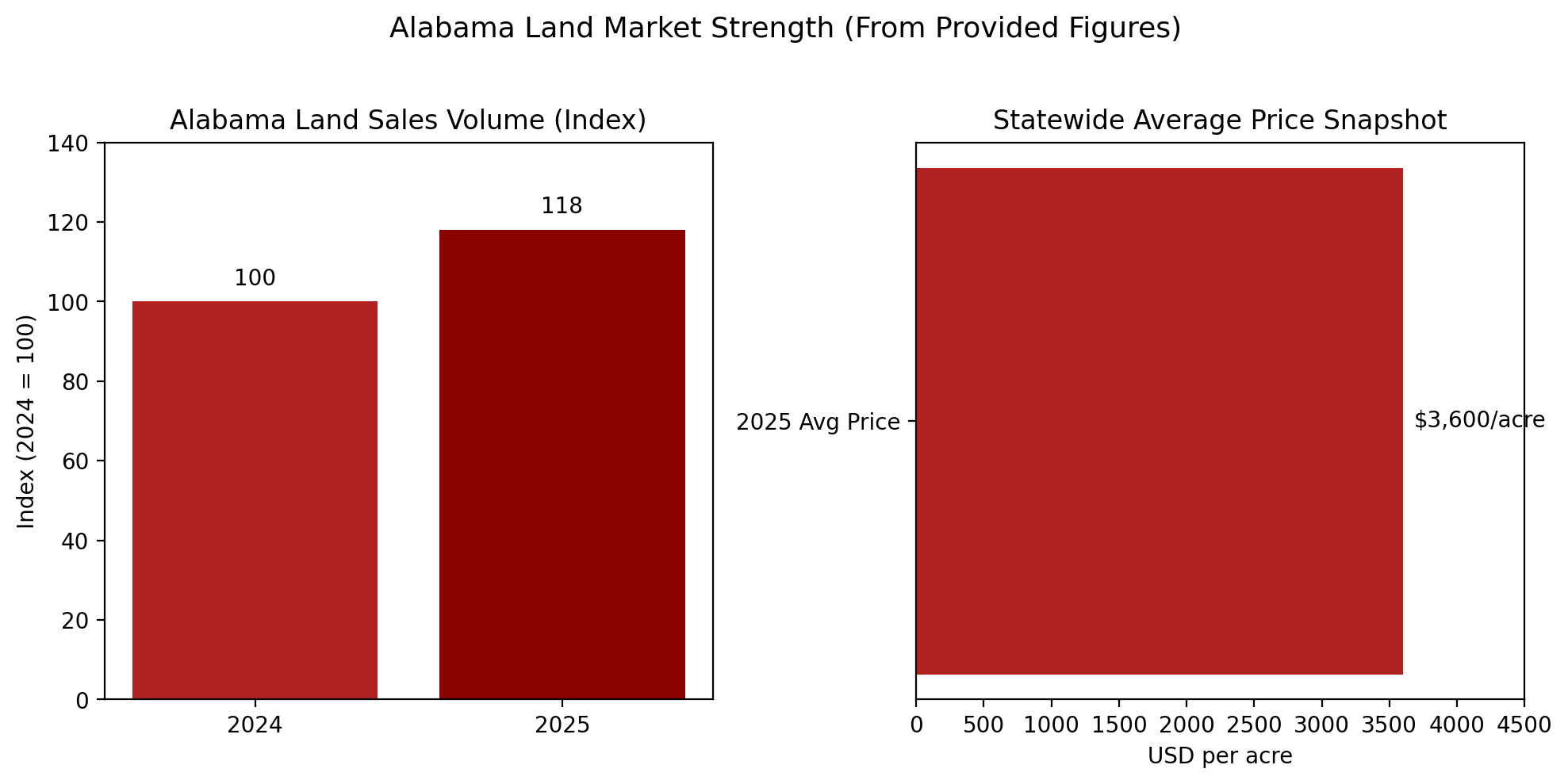
Alabama’s land market data has shown resilience through recent economic ups and downs. According to market analysis, despite a slowdown in transaction volume in 2024, 2025 saw land sales bounce back nearly 18% and prices hit new highs.
The statewide average price for land is now around $3,600 per acre, continuing a steady upward trend. This growth reflects the lasting appeal of land as a stable investment and resource – many buyers view Alabama land as a long-term asset for farming, recreation, or development.
Importantly, the rise in per-acre values has outpaced inflation in recent years, indicating genuine increased demand rather than just currency changes.
Demand vs. Supply
The market’s strength is largely driven by the basics of supply and demand. On the demand side, interest in Alabama land remains high for multiple uses – from rural homesteads and hunting tracts to commercial development sites.
On the supply side, land is finite; there’s only so much available, and not all owners are willing to sell. This limited inventory creates upward pressure on prices. Even as new listings come up, they are generally keeping pace with sales rather than flooding the market. In other words, Alabama currently has a “healthy, rotating inventory” – properties are being bought and sold at a steady clip, but there isn’t an excess glut of land for sale.
For sellers, this market dynamics is generally good news: less competition from other listings can mean better pricing power, assuming your land is priced right for its market.
Role of Interest Rates in Alabama Land Pricing
One external factor tempering the market is the level of interest rates. Over 2024–2025, interest rates climbed significantly (as part of national efforts to curb inflation), making mortgages and land loans more expensive for buyers. Higher interest rates can soften demand somewhat – buyers either need more cash or have to pay higher monthly costs, which might shrink the pool of qualified buyers.
Alabama’s land market “held strong” through these rate hikes, but the pace of sales slowed at times, especially for higher-priced properties that typically require financing.
Looking ahead, if interest rates begin to drop in 2026, we could see a notable uptick in buyer activity. In fact, land analysts predict that lower rates would particularly boost demand for smaller and mid-priced tracts (those under roughly $500,000), as more buyers could afford loans for those purchases.
On the flip side, if rates rise further or credit tightens, sellers might encounter longer marketing times and possibly more pressure to adjust pricing. It’s wise for sellers to keep an eye on interest rate trends, because borrowing costs directly influence how many people can bid on your land and how much they can pay.
Economic Climate
Alabama’s economy entering 2026 is relatively robust. The state has enjoyed low unemployment (around 2.7%-3%) – a historically low level – indicating a strong job market and steady incomes.
This kind of economic growth underpins the real estate market and impact land values: when more people are employed and optimistic, there tend to be more buyers for both homes and land. Key industries in Alabama (like automotive manufacturing in Huntsville, aerospace, agriculture, and tourism on the Gulf Coast) have been expanding, bringing investments and population growth to certain areas.
Population growth, while modest statewide, is notable in specific regions (for example, the Huntsville area has been one of the fastest-growing in the state). Expanding populations and industries create higher demand for land – whether it’s land for new housing developments, new factories, or even increased recreation (parks, hunting land leases, etc.) for a growing workforce.
That said, sellers should be mindful of broader economic uncertainties. If a recession were to occur nationally, Alabama wouldn’t be immune – demand for recreational or investment land might dip if people turn cautious.
Farmland values, however, often prove resilient in downturns because they are tied to food production (a necessity) and tend to be held by long-term owners. In the last few years, even as some feared recession, farmland and rural land values kept climbing modestly across the Southeast. Alabama land has shown it can weather economic storms better than many other assets, but a severe recession could still slow the market. So far, though, Alabama has bucked any major downturn, with 2025 actually seeing growth in land transactions and values.
In summary, the 2026 market for land in Alabama is steady and seller-friendly in many areas. Prices are high and stable, demand is broad, and supply is limited. The main things to watch going forward are interest rates (a drop could open the floodgates to more buyers, whereas a spike might cool things) and the general economic health of the region (continued growth will keep land in demand, whereas a significant downturn could temporarily slow the pace).
Next, we’ll dive into specific types of land and how each segment is performing, since not all land is alike.
Types of Sellable Land in Alabama
Alabama’s land market isn’t monolithic – it consists of several sub-markets for different land types, each with its own trends. Whether you’re selling a farm in the Black Belt or wooded acreage in North Alabama, it helps to understand what drives buyers in that segment and how values are trending.
Here we cover the major categories: agricultural land, timberland, recreational/hunting land, and development land. Many properties are a blend of these (for instance, a farm that also has timber and is used for hunting), but we’ll discuss them separately for clarity.
Agricultural Land (Farms and Pasture)
Agricultural land – including row-crop farms, pastures, and ranch land – makes up a large portion of Alabama’s rural real estate. The state has a rich agricultural heritage, with commodities like cotton, soybeans, peanuts (especially in the Wiregrass region), poultry, and cattle. If you’re selling farmland, there are a few key trends to note in 2026:
Stable to Rising Farmland Values
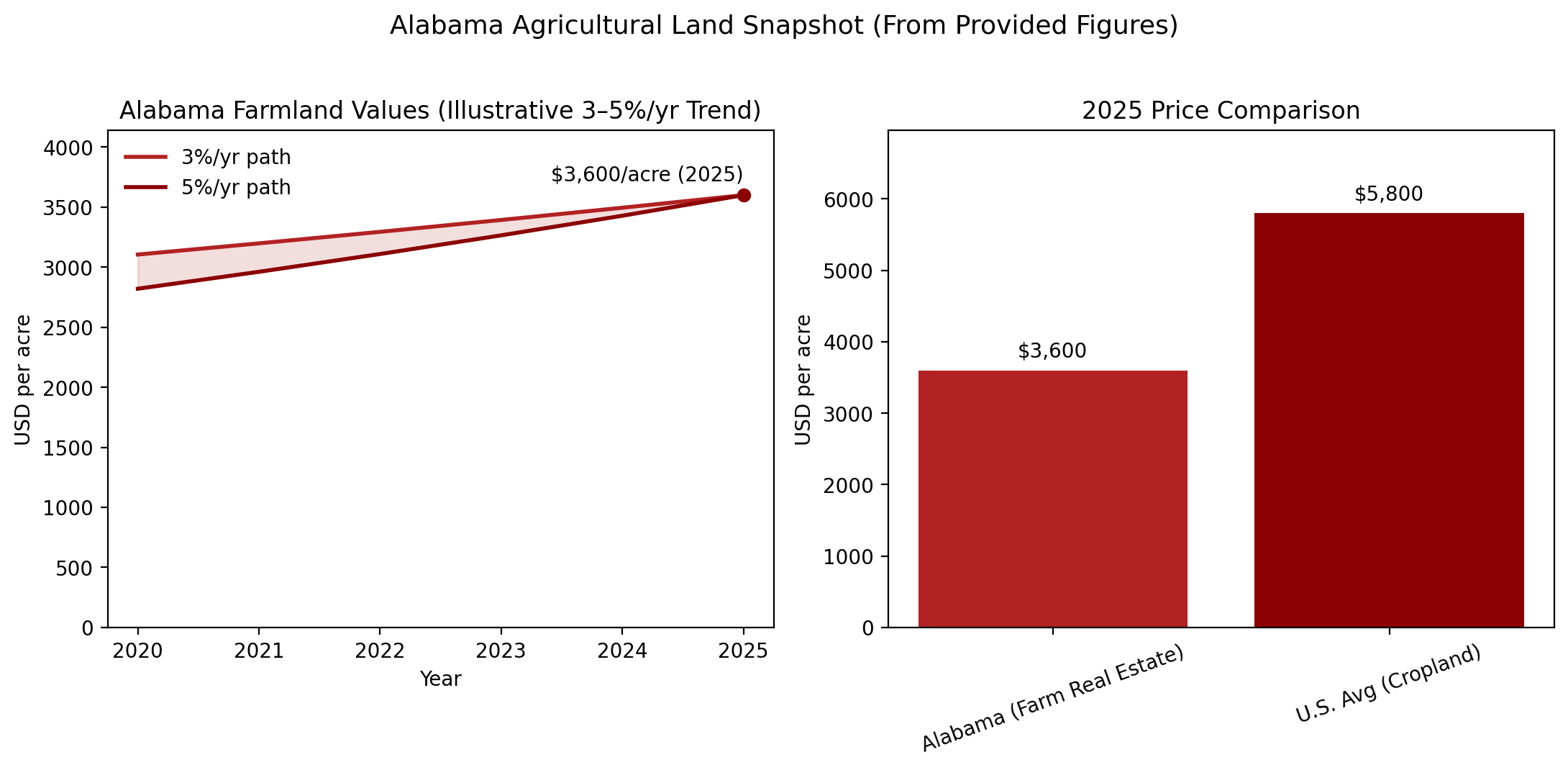
Farmland in Alabama has generally appreciated steadily over the past five years. Even as commodity prices (like corn or soy) have had ups and downs, land values kept a consistent upward trajectory, roughly 3-5% per year on average.
As of 2025, Alabama farm real estate (land and its improvements) averaged around $3,600 per acre, a record high. This is still below the U.S. average for cropland (which topped $5,800/acre in 2025), indicating Alabama land is relatively affordable farmland by national standards.
That affordability, combined with good soil in many counties, attracts out-of-state buyers and investors as well, helping support prices.
Regional Hotspots
The Black Belt region and parts of the Wiregrass region see the strongest farmland market activity in Alabama. The Black Belt’s dark, fertile soils are excellent for pasture and certain crops, and large farm tracts there continue to change hands (often doubling as hunting land).
In the Wiregrass (southeastern Alabama, around Dothan and counties like Coffee, Geneva, and Houston), agriculture is a mainstay of the economy, so land there remains in demand for farming and homesteads.
Even smaller pastureland tracts in Central and North Alabama are selling well, often bought by folks looking for a hobby farm or a rural weekend retreat with some cows or horses.
Essentially, anywhere that offers income-producing land coupled with recreational or aesthetic appeal is finding buyers in today’s market.
Farmer Challenges and Land Supply
It’s important to acknowledge that many farmers faced profit pressure in recent years – costs for fuel, fertilizer, and other inputs rose, while crop prices didn’t rise as much. This squeeze means some farmers are cash-tight, which could lead them to sell land (in whole or part) to raise capital. In such cases, land value becomes a “flexible variable” – essentially a financial buffer for farmers.
So far, creativity (like leasing land for hunting or diversifying farm income) and continued interest from recreational buyers have kept farm property values from falling.
But as a seller, if you’re a farmer, you should still aim to showcase any value-add your land has (like timber stands, hunting opportunities, or development potential) to attract the widest range of buyers, not just traditional farmers.
Outlook
The outlook for Alabama farmland in 2026 is cautiously positive. Unless commodity markets collapse drastically, farmland values are expected to hold or gently rise.
Alabama’s population growth is modest but ongoing; every new subdivision on former farmland (near cities) also means slightly less agricultural acreage available, putting gentle upward pressure on prices of remaining farm land. Additionally, some investors see farmland as a safe asset (an inflation hedge and a tangible resource), which continues to provide a pool of buyers beyond just farmers.
Sellers of ag land should be prepared to furnish data on crop yields, soil quality, and any farm income to justify their asking price – and remember to mention features like a creek, pond, or woods on the farm, since many buyers are not purely farming for income but also for lifestyle.
Timberland
Alabama is one of the most forested states in the U.S., with millions of acres of timberland. Timberland – land primarily valued for its trees (pines or hardwoods) that can be harvested for lumber and paper – is a significant segment of the land market.
Here’s what’s happening in this sector:
Shift from Pure Investment to Mixed Use
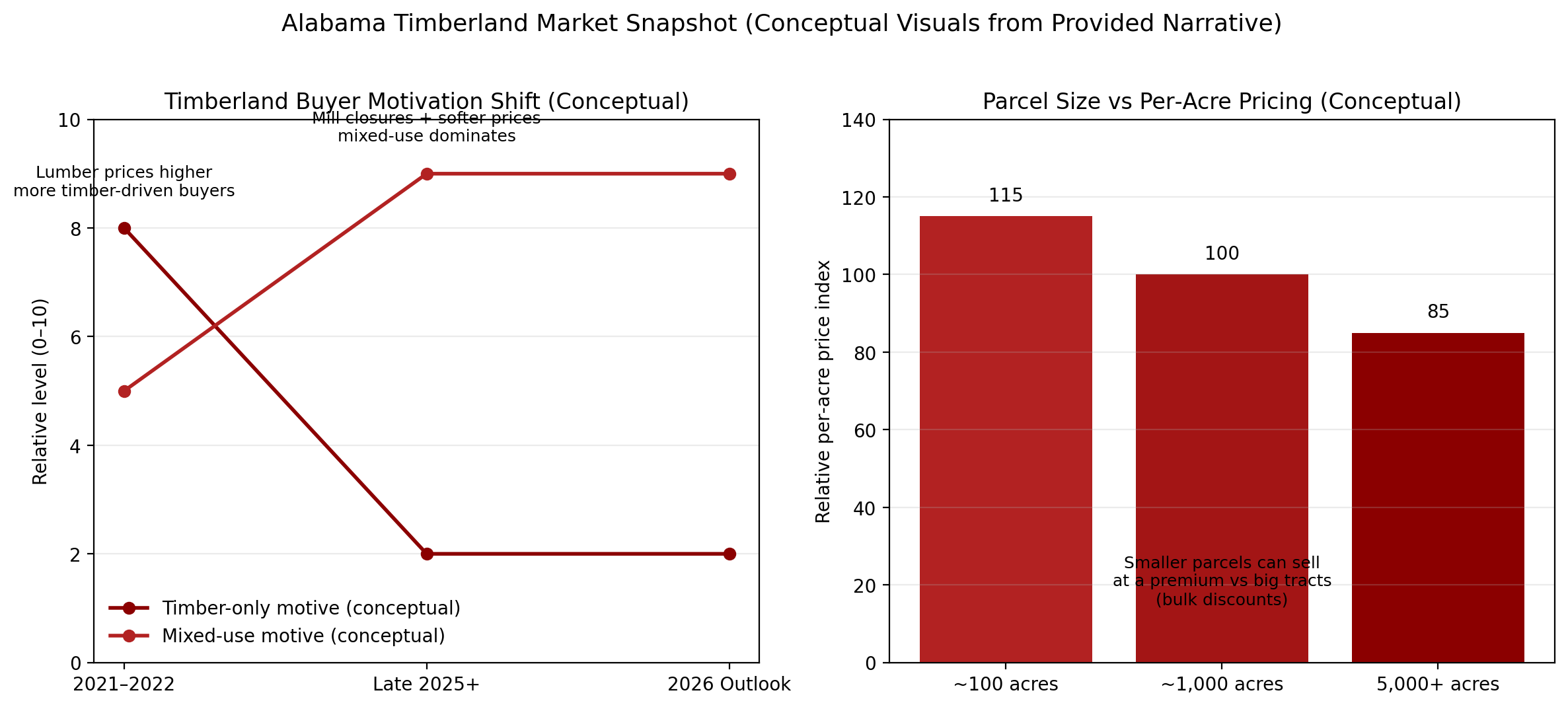
A few years ago, higher lumber prices and strong wood demand had many investors eagerly buying timberland for profit. However, recent challenges like mill closures and softer timber prices have changed the picture.
By late 2025, buying land solely for timber investment had become rare. Many sawmills in the Southeast have consolidated or temporarily closed due to market conditions, meaning fewer local buyers for raw timber in some areas. As a result, most buyers now look at timberland with a recreational lens: they certainly appreciate the timber value on the property, but they’re primarily interested in using the land for hunting, wildlife habitat, and recreation, with any timber income seen as a bonus.
If you’re selling timberland, you should be aware of this shift – emphasize not just the timber volumes, but also the land’s other attractions (like trails, water features, game presence). That said, well-managed stands of valuable timber do add to sale value; just know that the pool of buyers whose sole goal is to maximize timber yield is smaller now.
Timber Prices and Valuation
The timber market is cyclical. Southern pine sawtimber prices spiked around 2021 (due to a nationwide lumber shortage) but have since moderated. By 2024–2025, stumpage prices (the price for trees on the stump) for pine in Alabama were stable to slightly down, whereas some hardwood prices hit record highs (e.g., certain hardwood sawtimber). What this means for sellers: if you have mature pine plantations, buyers will evaluate how soon they can cut and sell that timber.
Timberland is often valued in two parts – the land itself, and the timber on it (based on a timber cruise estimate). If timber markets are down, a buyer might value the standing timber lower, affecting the total sale price.
On the other hand, if your land has a young plantation or was recently cut, buyers may value it more for recreation and future potential than immediate timber cash. Keep in mind property tax incentives: Alabama has “current use” valuation for timberland, which keeps taxes low, a selling point for holding timberland long-term.
Also, sustainable forestry certifications or practices can be a bonus selling point if a buyer is conscientious about sustainability or planning a long-term investment.
Continued Demand for Timberland
Despite the headwinds in the timber industry, timberland tracts are still selling well in Alabama, largely because of their overlap with the recreational market. Recreational and timberland tracts together led Alabama’s land market in total acreage sold in recent quarters, meaning a lot of land changing hands had trees and hunting appeal.
Many buyers specifically seek land that “has it all” – some woods for hunting, maybe a field or two, and maybe even the possibility of some timber income down the line.
If your land fits that description, you’re in a good position. For large institutional timberland owners thinking of selling: smaller parcels carved out of big tracts might fetch premium per-acre prices, since local buyers often pay more for 100 acres than an institution would pay for 5,000 acres (bulk discounts).
Conversely, selling a very large acreage (5000+ acres) in one go might mean marketing to institutional investors or timber companies who will be very price-conscious. In 2026, we expect ongoing interest from hunters, hunting clubs, and individual investors in timberland, even if the purely financial timber returns are secondary.
Recreational and Hunting Land
One of the most vibrant parts of Alabama’s land market is recreational land – properties purchased primarily for the enjoyment of the outdoors.
This includes hunting land, fishing properties, and general rural retreats for camping, ATVs, or building a cabin. Alabama’s rich wildlife (deer, turkey, ducks, etc.), along with its rivers and lakes, make it a popular state for outdoor enthusiasts. Here’s what to know:
High Demand for Multi-Use Recreation Tracts
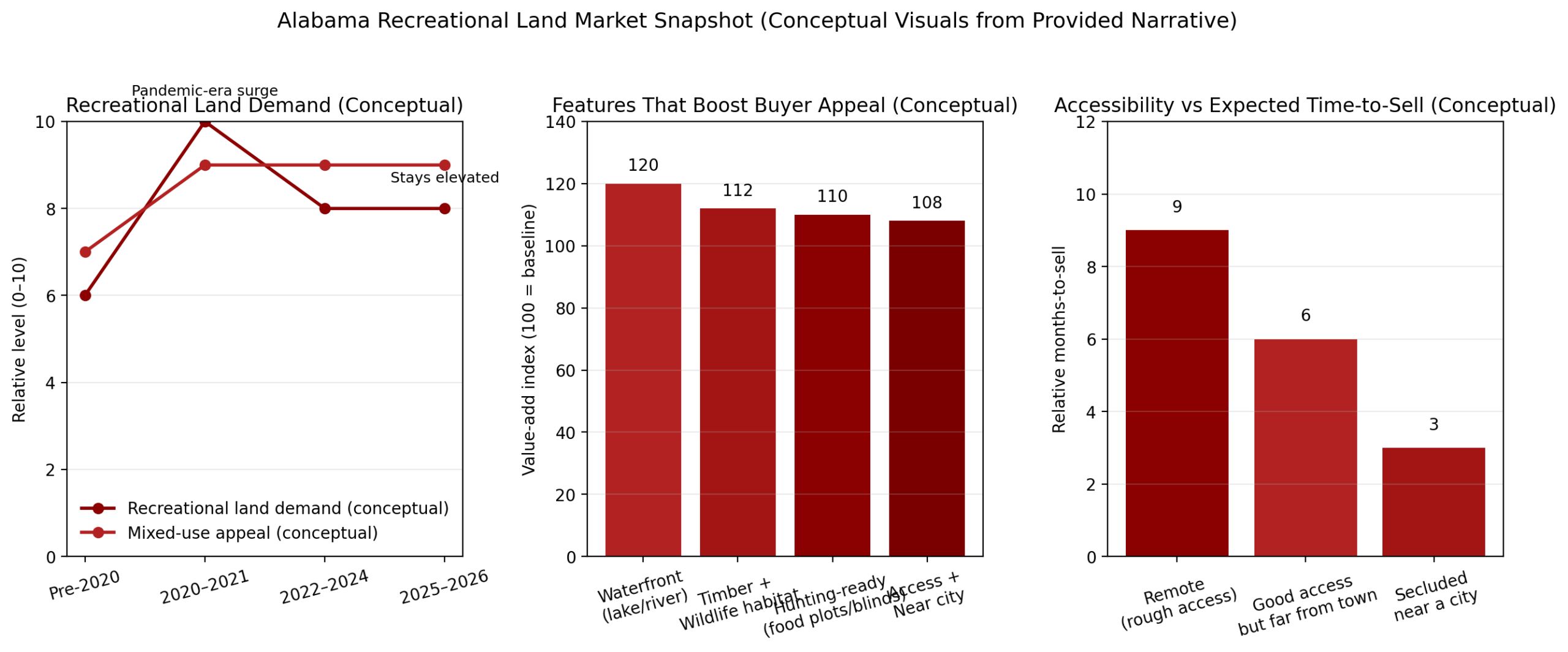
Recreational land has been in high demand, especially since 2020 when the pandemic sparked more interest in rural getaways.
Even as things normalized, many families and investors retained an appetite for weekend getaway land.
In Alabama, a “recreational tract” often doubles as a timber investment and sometimes as a small farm – these mixed-use lands are very appealing. It’s no surprise that recreational & timberland tracts lead in total acreage sold recently.
Buyers love properties that offer “a mix of timber value, wildlife habitat, and recreational appeal” – essentially, land that can grow trees (and maybe income), support healthy deer/turkey populations, and provide a beautiful setting for hiking or building a rural home.
Hunting Culture Drives Sales
Alabama has a strong hunting culture. Both local buyers and out-of-state sportsmen look for hunting land here. Leases for hunting are common, and some buyers purchase land to have a private hunting spot or even to lease out to hunters for income.
Deer hunting is especially popular (the Black Belt is famed for trophy bucks thanks to its fertile soil), as is turkey hunting in spring. If you’re selling land suited for hunting – e.g., it has woods, water sources, and food plot clearings – make sure to highlight those features.
Mention wildlife seen on the property, existing stands or blinds, and any game management you’ve done. Such land often sells at a premium to pure pasture, because it taps into lifestyle and recreation demand, not just economic value.
Lakes, Rivers, and Waterfront
Recreational land with water access is another hot ticket. Alabama has several large lakes (Guntersville, Martin, Eufaula, etc.) and extensive river systems.
Land that borders a lake or river can attract buyers for fishing and boating, or even those looking to develop vacation cabins. For example, Tallapoosa County (Lake Martin area) and Marshall County (Lake Guntersville) have shown above-average land demand.
Waterfront tracts, even if not on big lakes, often command higher prices per acre than similar land without water. When selling such property, emphasize the waterfront footage, dock potential, or existing ponds/creeks on the land.
Accessibility and Amenities
Recreational land buyers usually care about accessibility – is there a good road to the property? Can a truck get in? Proximity to a town for supplies?
If your land is remote, it might take longer to sell and fetch a bit lower price unless it’s priced to reflect that. Conversely, land that offers a feeling of seclusion but is within an hour of a city (like Birmingham, Montgomery, or Mobile) might attract a lot of interest.
An emerging trend is buyers looking for “family legacy” properties where multiple generations can gather for outdoor fun. These buyers often appreciate if the land has amenities like an existing cabin or barn, a prepared homesite, or at least utility access and a good internal trail network.
Recreation as Value-Add
If your land has primarily been a working farm or timber tract, consider modest improvements to boost its recreational appeal. Simple trails cut through a forest, a small pond built for fishing, or planting a few wildlife food plots can make a property much more marketable to recreation buyers (and these don’t usually cost too much).
However, always weigh costs – many buyers also enjoy improving the land themselves, so you don’t need to overdo it. The key is to communicate the potential: e.g., “Open fields could easily be converted into dove fields or horse pasture,” or “Creek on site provides a great spot for fishing and could be a water source for wildlife.”
Development and Urban-Edge Land
The last category is land for development – parcels that might be turned into residential subdivisions, commercial sites, industrial parks, or other built uses. This often overlaps with land on the urban fringe, where cities and towns are expanding (urban sprawl).
Alabama’s rapid growth areas offer significant opportunities (and high prices) for development land:
Urban vs. Rural Price Gap
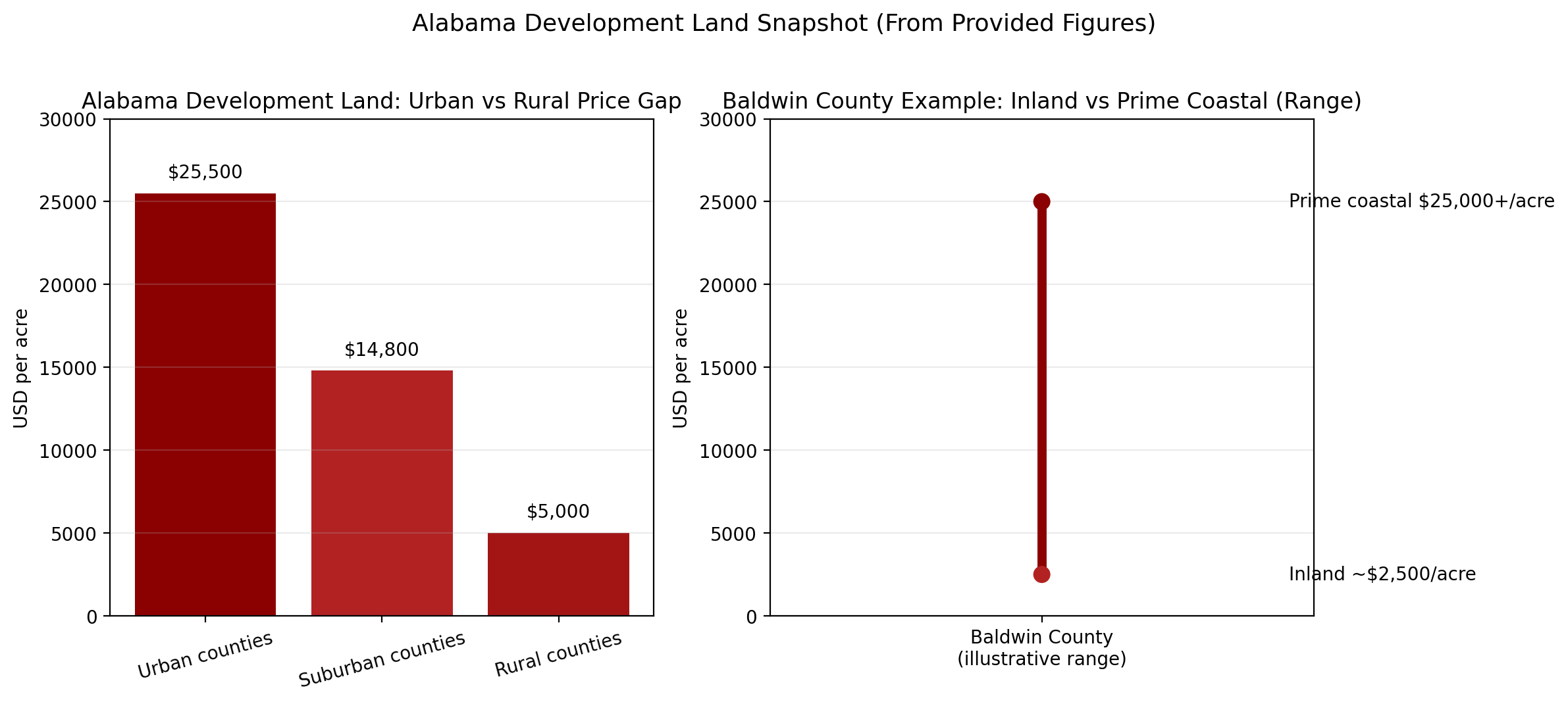
There’s a striking price divide between land in or near cities and land in rural areas. In Alabama, urban county land averages about $25,500 per acre, whereas rural county land averages around $5,000 per acre. Suburban “in-between” counties average around $14,800/acre. This is a huge difference driven by development potential – land that can host homes, businesses, or industry is simply worth more.
For example, Jefferson County (Birmingham), Madison County (Huntsville), and Mobile County have some of the highest land values because they contain Alabama’s largest cities. If you own acreage near city limits or along major highways, you may find developers or investors very interested in your property. Urban sprawl – such as Huntsville’s growth into Limestone County or Birmingham’s spread into Shelby County – has turned former farm fields into prime real estate for new neighborhoods.
High-Growth Corridors
Specific high-growth areas include North Alabama’s Huntsville region (often cited as an economic boom zone due to tech and aerospace jobs) and the Birmingham metro, as well as the Eastern Shore of Mobile Bay (Baldwin County). Baldwin County, in particular, has been an “investment hotspot” with a phenomenal turnover ratio (properties selling almost as fast as they’re listed).
Baldwin’s coastal appeal (beaches, tourism, retirees) combined with job growth in places like Daphne and Foley means land there sells at a premium.
In fact, Baldwin saw land price appreciation over 40% in recent years in some areas, and prices ranging from ~$2,500/acre inland to $25,000+ per acre in prime coastal spots.
For land sellers in these areas, it’s truly a seller’s market – you hold something in scarce supply and high demand. That said, developers will carefully consider zoning, infrastructure, and annexation possibilities, so be prepared to provide info on utilities and roads for your land.
Infrastructure and Utilities
A key factor for development land value is infrastructure. Does the land have access to public water, sewer, electricity, and good roads? If yes, the development potential (and price) is much higher. If not, that doesn’t mean it won’t sell – but likely to someone who’s willing to invest in bringing utilities or someone who will use it in the interim for farming until the city expands further. Keep an eye on city and county plans: if a new highway, school, or factory is planned near your land, it can significantly increase its value.
For instance, rumors of a new plant or a highway connector can spur developers to start buying land nearby.
Alabama has ongoing improvements like new interstate connectors and industrial megasites; as a seller, being aware of these can help you time your sale or market your land’s future potential. In marketing, phrases like “minutes from new Toyota-Mazda plant” or “along the future I-XX corridor” can attract the right buyers who have vision.
Zoning and Usage
If your land is within a jurisdiction, zoning will dictate what can be built (residential, commercial, agricultural only, etc.). Agricultural land just outside city limits often gets rezoned to residential as the city grows.
Sellers can sometimes increase land value by handling some of the pre-development work: for example, getting a property rezoned or platted for a subdivision, or securing road access approvals. Even a survey and a clear title are crucial for sales to developers.
However, undertaking development steps requires time and maybe investment (engineering, legal fees), so it’s a trade-off. Many sellers choose to sell “as-is” and let the buyer handle those steps, but they price accordingly. Real estate agents who specialize in land can advise if any “entitlement” steps would significantly bump your sale price or if it’s better to sell quickly without them.
Balancing Patience and Price
Development land can sometimes command top dollar, but it might also attract fewer (but wealthier) buyers. It’s not unusual for such properties to be marketed for many months or even a couple of years until the right buyer with deep pockets comes along.
For instance, large tracts in the path of urban sprawl might sit unsold until a national builder or investor decides the time is right. This is a different scenario from recreational or small farm tracts, which usually have a broader pool of individual buyers actively looking.
So if you own a large acreage near an urban area, be prepared that you might get unsolicited offers below your expectations (land flippers trying to get a bargain), and that waiting for the ideal price might take longer. In contrast, if you price it competitively for the current market, you could attract multiple offers – especially if you quietly market it to developers who are already building nearby.
It’s often a good strategy to consult an appraiser or land broker who knows development land to determine the best pricing strategy (for example, whether to sell as one big piece or subdivide into smaller parcels).
Regional Market Variations Across Alabama
Real estate is all about location, and this is especially true for land. Alabama’s land market in 2026 varies widely from one region to another. We’ll look at a few key regions: North Alabama, the Coastal region, the Black Belt, and the Wiregrass (southeast). Each has unique economic drivers and land demand. Understanding these can help you, as a seller, position your property smartly in the marketplace.
North Alabama and Urban Growth Areas
orth Alabama – roughly the upper third of the state – includes booming metro areas like Huntsville (Madison County) and Decatur, as well as growing suburbs of Birmingham (in Jefferson, Shelby, and Blount counties) and the scenic Tennessee River valley. This region is characterized by stronger economic growth and population gains than much of the state, which translates into a hot land market in many counties.
Huntsville & Surroundings
Huntsville has been a star performer, recently becoming Alabama’s most populous city. Fueled by the tech, defense, and aerospace industries (NASA, U.S. Army’s Redstone Arsenal, and many private companies), Huntsville’s expansion drives land demand both for housing and industry.
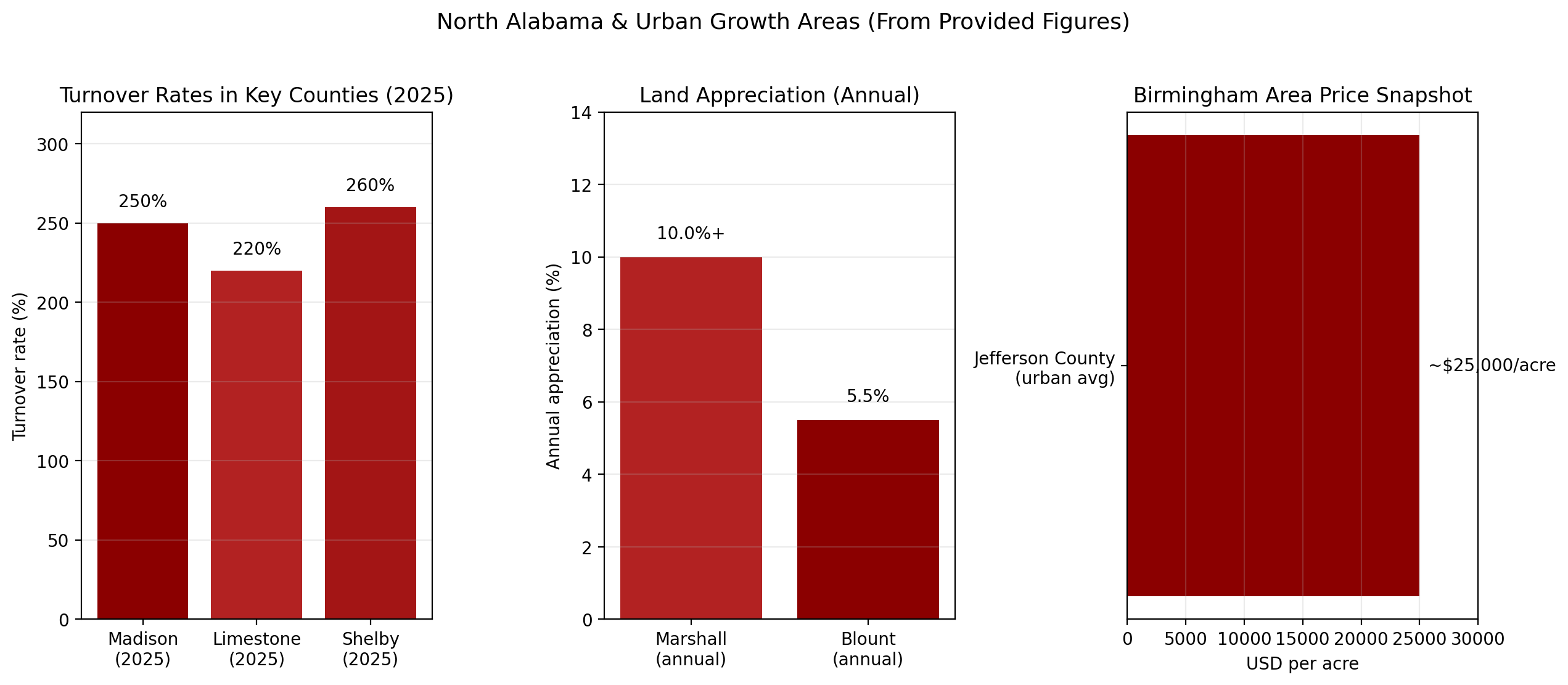
Land in Madison County and adjacent Limestone County has been selling quickly and at rising prices. In fact, Madison County’s turnover rate of ~250% and Limestone’s ~220% in 2025 show how high demand outstrips supply there. Farmland that used to be cotton fields in these counties is now eyed for subdivisions or industrial parks.
Sellers here often find themselves “in the driver’s seat,” as one report put it – meaning if you have land to sell in the Huntsville area, you can often command a strong price and expect a relatively quick sale, assuming no major issues with the land.
Additionally, Marshall County (just southeast, home to Lake Guntersville) showed the highest land appreciation rate in the state at over 10% annually, thanks to a combo of Huntsville’s economic spillover and the recreation appeal of the lake.
Birmingham Metro
The Birmingham area (Central Alabama) is more mature and not growing as fast as Huntsville, but it’s still a sizable market. Jefferson County (Birmingham) land prices are among the highest in the state (urban average ~$25k/acre), and nearby Shelby County (to the south, with suburbs like Hoover, Alabaster) is a very active market too – Shelby had a turnover around 260%, one of the highest.
What this means: land in Birmingham’s suburban counties sells briskly, especially if it’s positioned for new homes or commercial projects. To the north of Birmingham, Blount County offers a mix of rural and commutable land and has seen steady appreciation (~5.5% annually).
A lot of people who work in the city look for acreage in these surrounding counties for personal homesteads, so there’s a strong “mini-farm” market.
Economic Drivers
North Alabama also has other economic drivers: automotive plants (e.g., the Toyota-Mazda plant in Limestone County), logistics hubs, and universities (UA Huntsville, etc.) contribute to land development.
There’s also significant infrastructure in the works, like highway improvements, that increase land accessibility. For example, completion of corridors like the Northern Beltline around Birmingham or expansions of I-565/I-65 around Huntsville can suddenly make certain rural areas much more attractive for development.
Landowners who stay informed about such projects can time their sales for when land becomes “prime.”
Recreation in North AL
It’s not all development – North Alabama also has mountains, rivers, and lakes that make for excellent recreational land. Counties like Cullman, DeKalb, and Jackson (with the Appalachians and river canyons) attract buyers for mountain retreats, hunting (especially turkey and deer), and fishing.
The Tennessee River running through the region creates wonderful waterfront properties. These recreation tracts in the north benefit from being within a couple of hours of major cities (Huntsville, Birmingham, even Nashville) – so demand is pretty healthy.
In short, North Alabama’s land market is generally strong, whether for growth or getaways. If selling here, emphasize how your land connects to these positive regional trends: e.g., “30 minutes from Huntsville’s Research Park” or “Overlooks the Tennessee River – quick drive from city conveniences.”
Coastal Alabama (Gulf Coast and Tourism Areas)
Moving down to the southern coast, Alabama’s Gulf Coast region – primarily Baldwin County and to a lesser extent Mobile County – is a world of its own in the land market. Baldwin County (which includes Gulf Shores, Orange Beach, Foley, Daphne, etc.) has been arguably the hottest real estate market in the state in recent years.
Baldwin County Boom
Baldwin County combines beaches, a booming tourist economy, retirees relocating for the warm climate, and spillover growth from Mobile and even nearby Pensacola, FL. The result: land in Baldwin moves exceptionally fast and at high prices.
Reports showed Baldwin’s land turnover at an astonishing 300% – meaning properties are selling three times faster than new ones come up.
In practical terms, good land listings in Baldwin often receive multiple inquiries or offers in a matter of weeks. Prices per acre vary widely – inland rural Baldwin might be a few thousand dollars per acre, but near the coast or bay, they can soar above $20,000 or even $30,000 per acre.
For example, small parcels near beach communities or along Mobile Bay can fetch a premium due to potential for vacation rentals or waterfront homes. If you’re a land seller in Baldwin, this is great news: you likely have a valuable property in a seller’s market.
Still, don’t let that lead to overpricing – buyers are savvy and will know comparables. But you can be a bit more aggressive with pricing here than in other regions, given the demand.
Mobile County
Mobile County (which includes the city of Mobile) also sees strong land activity, though it’s more industrial in some parts. The port of Mobile and related industries (shipbuilding, Airbus manufacturing) mean there’s demand for industrial land and housing subdivisions in certain areas.
However, Mobile’s population growth has been slower than Baldwin’s. Still, Mobile County had over 1,100 land transactions in a year, with hundreds of sales, indicating a vibrant market. Land on Mobile’s western side remains fairly rural (good for hunting land), while the eastern shore demand spilled into Baldwin. Sellers in Mobile County should be aware of zoning and any environmental factors (some areas are wetlands or flood-prone near the delta).
Tourism and Recreation
The Gulf Coast’s tourism also means land has potential for recreational businesses – RV parks, fishing camps, ecotourism, etc. If your land is near a high-traffic tourist area, think creatively about potential uses that might entice buyers. Perhaps it could be a new RV campground or a boat storage facility for fishermen. Sometimes marketing land in Baldwin involves pitching these possibilities.
Also, note that tourism and retirement trends mean a lot of out-of-town buyers. As a seller, you might encounter more out-of-state buyers (Florida, Georgia, etc.) looking at your land than you would if you were selling farmland in the Black Belt. These buyers might have different concerns – for instance, they might value proximity to the beach or a golf course more than soil productivity.
Infrastructure and Access
Baldwin’s growth has led to congested roads in some areas; there are ongoing efforts to build new bridges and highways (like the proposed I-10 Bayway project) which, if completed, could further unlock land value by improving access.
Keep an ear out for such developments. Owning land near a new highway interchange, for example, can multiply its worth if rezoned for commercial use. Conversely, if your land is tucked away down a long, unpaved road, highlight any plans for road paving or developments that might bring utilities closer.
In summary, Coastal Alabama’s land market is extremely active – probably the fastest-moving in the state. Sellers there enjoy strong demand but also face sophisticated buyers expecting a lot for their money.
The key is to leverage the location (coastal, tourism, growth corridor) as a selling point while ensuring you’ve addressed any due diligence issues (survey, clear title, etc.), since high-end buyers will be diligent.
Black Belt Region (Central Alabama Rural Core)
The Black Belt is a band of counties across central Alabama known historically for their dark, fertile soil and cotton plantations (hence the name). In modern times, the Black Belt is characterized by rural landscapes, agriculture, and unfortunately, less economic growth than other parts of Alabama.
This region includes counties like Dallas, Lowndes, Wilcox, Perry, Greene, Marengo, Sumter, etc. Land in the Black Belt has a different market profile:
Slower Market, Lower Prices
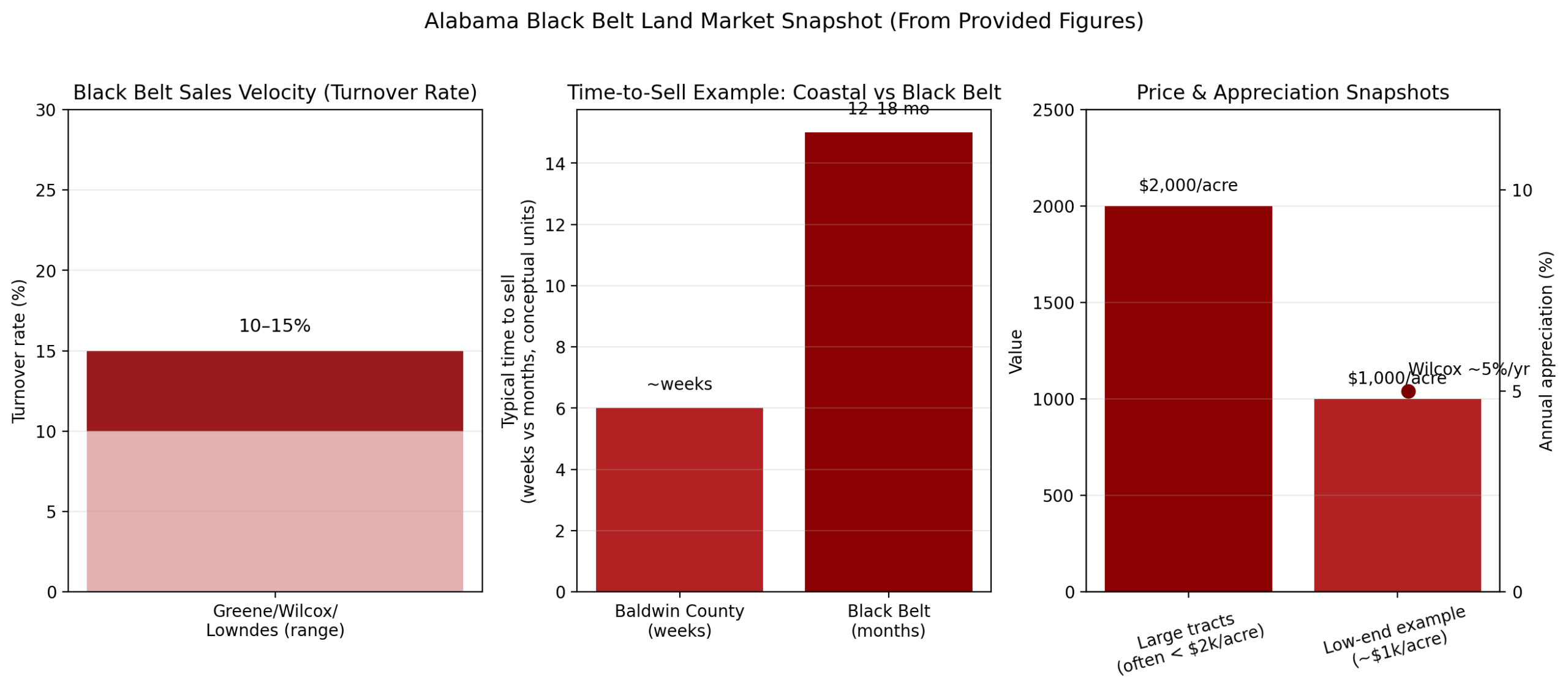
The Black Belt counties consistently rank among the slowest markets in Alabama. Data shows counties like Greene, Wilcox, Lowndes with extremely low turnover rates (~10–15%). That means in a given year, only a small fraction of listed properties sell; land can sit on the market for a long time here.
Indeed, the days-on-market (DOM) for listings in some Black Belt counties can exceed a year on average. One analysis noted that similar quality land that would sell in weeks in Baldwin County might take 12–18 months in the Black Belt to find the right buyer.
For sellers, this means patience is key. It also underscores the importance of competitive pricing – if you price too high thinking “land is hot everywhere,” you’ll likely get little interest in these areas.
Buyers in the Black Belt know it’s more of a buyer’s market due to fewer people actively looking.
That said, land prices in the Black Belt are among the lowest in the state, reflecting the lower demand. It’s not uncommon to see large tracts selling for under $2,000/acre (sometimes even ~$1,000/acre or less for cutover timberland or marshy ground), whereas that would be unheard of near a city. As a seller, you must align expectations with this reality – the urban-rural divide is stark.
Opportunities and Appeal
Why would someone buy land in the Black Belt? Several reasons: affordability (you get a lot of acres for the money), agriculture (the soil is good for pasture, cattle, hay, and some crops), and top-notch hunting.
In fact, the Black Belt is famed for deer hunting; many hunting lodges and outfitters operate there. Also, timber companies have large holdings there (thanks to all those acres of forest), and occasionally those come up for sale or lease. So while the pool of buyers is smaller, it includes timber investors, hunting enthusiasts, conservation groups (interested in preserving land), and farmers/ranchers expanding their operations.
There have been instances of value increases even in slow markets – for example, Wilcox County saw around 5% appreciation in land values despite its low sales velocity. That suggests that when land does sell, it might still fetch a bit more than it did a year or two prior, thanks to those niche interests.
Challenges
Many Black Belt counties struggle with limited economic drivers – they might be far from big job centers, have declining populations, and limited infrastructure. This lack of local economic activity is why land doesn’t move fast; fewer people are relocating there or starting businesses there.
Also, financing can be trickier – a bank might be cautious lending on land in an area with few comparable sales and a stagnant economy. Sellers might occasionally encounter offers that involve owner financing or installment sales if buyers can’t get conventional loans.
Also, land parcels in these areas may have heir ownership or title complications due to long family histories – getting all paperwork in order is crucial to avoid scaring off the rare interested buyer.
Seller Strategies
If you’re selling in the Black Belt, the conventional wisdom is: price it right and market it widely. Since local demand is low, you want to reach out-of-area buyers – hunters from Birmingham or Montgomery, investors from out of state, etc.
Listing online on land-specific platforms, using drone photos to show the land’s beauty, and highlighting features like “rich soil suitable for cattle” or “prime hunting land with established food plots” can help.
Also, consider specialist agents: agents who regularly deal in rural land are better equipped to find buyers and know how to navigate issues like surveying large tracts or handling contracts for thousands of acres.
According to experts, in slow rural markets, it’s “essential” to work with agents who have proven marketing strategies for challenging properties.
Lastly, as mentioned, be prepared for a long timeline. It’s wise to “reset your expectations on timing” – instead of 3-6 months, think in terms of a year or more. If you need to sell faster, you’ll likely have to accept a lower price to entice bargain hunters who are always watching for a deal.
Wiregrass Region (Southeast Alabama)
The Wiregrass region refers to the corner of southeast Alabama (and it extends into adjacent Florida and Georgia). It’s named after the native wiregrass and includes counties like Houston, Coffee, Dale, Geneva, Covington, Barbour, and surrounding areas, with Dothan being the largest city.
This area is known for peanut farming, among other agricultural activities, and has a mix of small towns and rural land. In terms of the land market:
Agricultural Backbone
The Wiregrass is heavily agricultural. Farmland and timberland dominate land use here. Land prices in the Wiregrass tend to be moderate – not as high as North Alabama or coastal areas, but generally a bit higher than Black Belt because there’s a bit more local economy and slightly denser population.
For instance, in Coffee County, recent sales ranged roughly $2,000 to $6,000 per acre, depending on location and land quality. Those figures are lower than, say, Baldwin, but higher than some Black Belt examples, reflecting a middle-ground market.
Sellers of farmland here will likely find interest from local farmers (especially if the land is prime and contiguous to their existing farms) and also from recreational buyers who like the gently rolling terrain and mix of woods and fields.
Regional Economy
Dothan (Houston County) is a regional hub, and nearby Enterprise/Ozark has a military presence (Fort Novosel, formerly Fort Rucker, is in Dale County). These provide some economic stability and demand for rural residential tracts – e.g., someone might want a few acres outside Dothan for a home while working in the city.
Geneva County, bordering Florida, has shown some surprising land value strength (about 4% annual appreciation recently), possibly because of its proximity to the Florida Panhandle (with higher prices across the state line, Alabama land can look like a bargain).
Also, retirees traveling to Florida sometimes stop in the Wiregrass; a few even settle just north of the state line to stretch retirement dollars. Tourism is not huge here, but Lake Eufaula (on the Chattahoochee River in Barbour County) attracts anglers and has led to some lakefront developments.
Market Characteristics
The Wiregrass doesn’t have the feeding frenzy of Baldwin or Huntsville, but it’s steady. Land might stay on the market a few months longer than in hot markets, but generally, properties do sell within a year if priced reasonably.
The turnover isn’t as slow as the Black Belt’s worst counties. For example, a study noted Geneva County had positive appreciation, implying there’s demand there.
One reason is relative affordability – someone who can’t afford $5,000/acre in a suburb of Atlanta or the Florida coast might be very happy to pay $3,000/acre in Alabama’s Wiregrass for a similar rural homestead or farm.
Sellers Tips
In the Wiregrass, make sure to mention any current farm income (like if the land is leased for peanuts or cotton, or has CRP income) because buyers often value that.
Also highlight proximity to Dothan (for shopping, healthcare) or to Florida attractions (Panama City Beach is a couple of hours away; some might base here and vacation there).
If your land has pine timber, note the distance to the nearest sawmills or wood yards – southeast Alabama still has a timber industry presence, and a tract with planted pines could interest timberland buyers (especially if prices are a bit lower than in Georgia, for example).
Recreational uses like hunting are popular here too – deer and turkey hunting is good in this region, plus some folks enjoy wild hog hunting. If your property has evidence of game (or even established hunting stands), it can widen the appeal beyond just farmers.
In summary, the Wiregrass is a middle-of-the-road market: not the fastest, not the slowest, with moderate prices and a mix of ag and rec demand. Sellers here should find a decent number of prospects if they price according to land type (e.g., don’t price dryland farm acres like they are irrigated, or pine plantation like it’s development land).
We’ve now seen how different Alabama regions have different market conditions. Knowing your region’s context is crucial – it helps you set a realistic price and timeline. Next, let’s consider the market outlook and then some concrete selling tips.
Market Outlook for Land Values in Alabama in 2026
What can land sellers expect through 2026? Based on current trends and expert insights, the outlook for Alabama’s land market is generally positive but with a few caution flags:
Steady to Strong Values
Barring any major shocks, land values should hold strong or even see modest gains statewide. The fundamentals (limited land supply and sustained demand) are in place.
As long as Alabama’s population and economy keep inching up, there will be buyers for land. Farmland and timberland, in particular, are often seen as long-term holds, so even if sales volume dips, owners are rarely desperate to sell at a big discount. This tends to put a floor under prices.
Interest Rate Wildcard
As discussed, a drop in interest rates could boost buyer activity noticeably. Many buyers have been sidelined by the high cost of financing. If 30-year mortgage or land loan rates come down in 2026 (for instance, from ~7% down to 5-6%), expect a surge of those buyers re-entering the market.
More buyers can mean more competitive offers and possibly slight price increases, especially for smaller tracts and mid-priced land that average folks buy. Conversely, if inflation flares up and rates rise further, some buyers will bow out, which might slow sales.
Even then, because supply is so tight, we’d likely see a drop in transactions more than a drop in per-acre prices. Worst case, there could be “modest price adjustments” downward in certain segments, but not a crash. Well-capitalized buyers (cash buyers) would seize that moment to negotiate deals, so sellers might face tougher negotiations if their buyer pool shrinks.
Economic Factors
If Alabama’s economy stays strong – low unemployment, new industries – it will keep land demand robust. Notably, large projects like new factories or infrastructure (e.g., a new Hyundai plant or a major road) would directly spike land interest in their vicinity. On the other hand, a national recession could temporarily reduce demand for recreational land (as those are discretionary purchases) and development land (developers pull back if the real estate market softens).
Farmland might be least affected, unless commodity prices also drop sharply at the same time. One metric to watch is commodity prices (corn, soy, timber). If they improve, farmers and timber growers have more cash and confidence – good for land markets.
If they worsen, there might be an uptick in land for sale from financially stressed owners, which could gently increase supply on the market.
Land Use Trends
There’s a growing awareness of sustainable land use and conservation. In Alabama, this might manifest as more conservation easements (where owners sell development rights to preserve land), or increased interest in lands with recreational or ecological value.
While not mainstream, a subset of buyers in 2026 will pay a premium for land that has unique conservation features (like habitat for certain wildlife) or for farmland that is organic/sustainably managed.
Sellers might not need to actively pursue this, but if your land has any special ecological value, it could attract non-profits or government programs in addition to regular buyers. This probably won’t move market averages but is something to be aware of.
Inventory and Listings
We expect Alabama’s land inventory to remain relatively low. There’s no sign of a mass sell-off; if anything, owners are holding onto land because it’s performing well as an asset. New listings will likely just match the pace of sales.
For sellers, that means competition from other sellers stays limited – a good thing. However, in the event of an economic shock, you might see more listings pop up (people liquidating land for cash).
Right now, though, nothing indicates a flood of inventory; indeed, some rural land agents lament they need more listings to satisfy buyer inquiries.
In conclusion, 2026 looks to continue many of the patterns of 2025: a relatively balanced market leaning towards sellers in many areas.
Prices are at or near all-time highs, but they are supported by real demand, not just speculation. Sellers who price realistically should find success, and buyers with patience (or improved financing conditions) will continue to participate.
The key advice is to stay informed – conditions can vary by quarter, so paying attention to interest rate changes, local developments, and agricultural news will help you adapt your selling strategy if needed.
Now, let’s turn to actionable tips to help you actually get your land sold.
Tips for Selling Land in Alabama (2026)
Selling land requires a different approach than selling a home. Land buyers are looking for potential – whether it’s farming, building, hunting, or investment – and often need more information to evaluate a property. Here are some actionable tips for land sellers in Alabama:
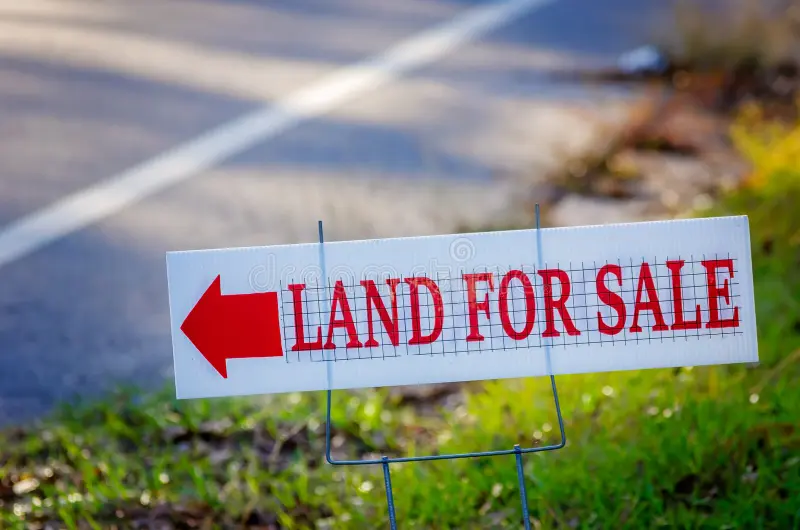
A “Land for Sale” sign posted in rural Alabama (Grand Bay, AL). Effective marketing – including signage, online listings, and networking with agents – is crucial when selling land. Patience may be required in slower rural markets, but highlighting the land’s best features and pricing it right will attract the right buyer.
Get the Land “Show-Ready”
First impressions count, even for raw land. Before listing, do some basic cleanup if needed: bush-hog overgrown fields, clear around gate entrances, and mark property lines or trails so visitors can explore safely. If your land is large or wooded, consider providing a simple trail or path (even if just by ATV) so potential buyers can see the interior. A property that is easily walkable or drivable will sell faster than one that’s impenetrable. Also, secure easy access – if there’s a locked gate, give the agent an access code or key. You might even put a sign on the property (as allowed) because passersby or local hunters might be buyers too.
Know Your Land’s Value (and Price it Right)
Accurate pricing is arguably the most important factor. Research recent sales of similar land in your county (your agent or an appraiser can provide comparable sales). Be realistic about any limitations your land has (e.g., no road access, floodplain, steep terrain) and factor those in. In Alabama, the per-acre price can vary hugely even within one county. If you price far above market, your land could sit unsold indefinitely, especially in areas with low demand. Consider getting a professional land appraisal or at least a broker’s price opinion for a second opinion on value. Remember the regional patterns: if you’re in a Black Belt county, a competitive price is essential to attract the few buyers around, whereas in Baldwin or Madison, you might be able to push the price toward the higher end of the range due to strong demand. The goal is to align with local market comps – as one source says, urban sellers shouldn’t expect rural prices and vice versa.
Highlight Key Features and Uses
Marketing land means painting a picture of its potential. Create a list of the property’s features: acreage, location, type of terrain (flat, hilly), water features (streams, ponds, wetlands), timber details (species, age), pasture or tillable acreage, fencing or structures, road frontage, etc. Then think of uses: farming, hunting, fishing, atv riding, building a home, etc. In your listings or conversations, mention these: e.g., “40 acres of mature pines ready to harvest in 5 years” or “Ideal home site on a hill overlooking a creek – power at road.” Explaining any jargon or specifics can help – for instance, if you say “in conservation easement” or “in Opportunity Zone,” explain what that means for a buyer. Alabama buyers also appreciate knowing practical info like soil type (for farmland), or that the property has been percolation tested for a septic system (if a home might be built). If you have a survey or timber cruise report, have those ready – they build confidence in what you’re selling.
Leverage Local Expertise (Agents and Websites)
While some land does sell by owner, using a real estate agent specialized in land can be a big advantage. Land transactions have quirks – mineral rights, easements, land-use restrictions – that an experienced land agent will navigate. They also have networks of buyers. Particularly in rural markets, as noted, it helps to have an agent with proven marketing strategies for land. They might advertise in hunting forums, reach out to farm buyers, or list on land-specific sites (like LandWatch, Lands of America, etc.) that typical home agents might overlook. If your land is in a slow market region, an agent can target the niche groups (timber companies, hunting clubs, etc.).Make sure any agent you choose is knowledgeable about the type of land you have and isn’t just a residential agent dabbling in land. Additionally, ensure your property is listed on major online platforms – many out-of-state buyers search these websites for Alabama land. Good photographs (drone shots are fantastic for showing acreage) and even short videos can set your listing apart.
Patience and Timing
As we discussed, land can take longer to sell than a house. Don’t be discouraged if months pass with only a few calls – in some areas, that is normal. However, keep communication open with your agent about feedback from showings. If all prospects cite the price as an issue, you may need a price reduction. Consider the time of year, too: land buying can be seasonal. For example, recreational buyers often look right after hunting season or in spring to get ready for the next season. Listing your hunting land in the middle of deer season might actually be smart (when people have hunting on their mind) or just after the season ends (when they’ve decided they want their own land next year). Farmland buyers might plan around planting or harvest times. There’s also typically a New Year uptick – people often make land purchases in Q1. Aligning with these patterns can sometimes reduce days on market.
Prepare Property Documents
Having the right documentation ready can speed up a sale. Gather your deed, past surveys, titles, and any easements or covenants on the land. If you’re aware of any boundary dispute or unclear easement (like a shared driveway), try to resolve it or at least disclose it up front. For agricultural land, have info on past crop yields or lease terms if it’s rented out. For timberland, a timber inventory or estimate of value is helpful. If the land was appraised recently, having that report available (or at least sharing key points) can back up your price to skeptical buyers. Basically, anticipate questions and have answers: property taxes, zoning, availability of utilities, school district, etc. The smoother you make the due diligence process for a buyer, the more likely the deal will close without hiccups.
Marketing Strategy
Think about who your target buyer is and market accordingly. If you have 5 acres on the edge of town, your likely buyer might be someone wanting to build a house, so highlight the perc test, nice building sites, proximity to town utilities. If you have 200 acres of timberland, your buyer could be an investor or hunting group – emphasize timber value, hunting stands, maybe offer seller financing to widen the pool. Use multiple channels: online listings, social media (there are Facebook groups for land sales/hunting land in Alabama), local newspapers or farm publications, and signage, as mentioned. Also, word of mouth in rural areas is powerful – let neighbors and local feed stores know the land’s for sale; sometimes the best buyer is literally the farmer next door or someone in the community. For higher-end properties, consider auctions as a method – Alabama has land auction companies that sometimes get premium prices if there’s strong interest. But auctions can be risky if interest is low, so talk to a professional about whether that format suits your land.
Negotiation and Closing
When you do get offers, be prepared for some negotiation. Land buyers might include contingencies like a timber cruise, a soil test, or even a survey if one doesn’t exist. These are normal – work with them, and don’t take it as a slight; the buyer just wants assurance of what they’re getting. Negotiate not just price but terms: if a buyer offers full price but needs 90 days to close for due diligence, that might be fine; if another offers slightly less but all-cash closing in 30 days, weigh which is more important to you. Be especially cautious with offers that hinge on some future rezoning or permit (e.g., “I’ll buy your land if I get approval for a 50-lot subdivision”). Those can drag on – you may insist on a shorter timeline or a non-refundable deposit after a certain point, so you’re not in limbo forever. Once under contract, make sure to fulfill any obligations on your side (providing a clear title, etc.). Working with a title company or attorney experienced in land deals is essential to handle things like mineral rights reservations, which are common in Alabama – if you don’t own the mineral rights, disclose that. A smooth closing is achieved by diligent prep work and cooperation on both sides.
By following these tips, you greatly increase the odds of a successful land sale. Selling land can feel like a lot of work upfront – more so than selling a house in some cases – but once you find the right buyer, it pays off. Alabama’s 2026 market is favorable to sellers who do their homework and present their property in the best light.
Conclusion
Alabama’s land market in 2026 offers a landscape of opportunities for sellers across all types of land – whether it’s a sprawling farm in the Black Belt, a timber tract in the Talladega woods, a hunting paradise in the Black Belt, or a strategic parcel on the edge of Huntsville’s expansion. Market trends are generally on your side: land values are high and stable, demand is present in every category (even if concentrated in certain regions), and the state’s economic and population indicators support a healthy real estate environment. However, success in selling land comes down to understanding your specific market segment and region.
By leveraging current insights – such as knowing that interest rates might shift buyer behavior, or that urban fringe land commands premium pricing while deep rural land needs patience – you can make informed decisions on pricing and marketing. Always substantiate your claims with data or references (today’s buyers are often well-researched), and don’t hesitate to cite Alabama’s recent land trends to bolster your position (for instance, pointing out “land prices in this county grew X% last year” in negotiations).
Finally, keep in mind that selling land for cash in Alabama is not just a transaction; it’s also about the stewardship of a resource. Many buyers care about what they will do with the land – farming sustainably, managing timber, building a family home, etc. If you can connect with those aspirations (for example, by illustrating how fertile and ready a pasture is for cattle, or how secluded and pristine a wooded hollow is for a cabin), you’re not just selling dirt and trees – you’re selling a vision. In Alabama, land carries legacy and promise. Approach your sale with that mindset, backed by the practical guidance from this guide, and you’ll be well on your way to a rewarding sale in 2026.