

Key Takeaways
Listing data for 10+ acre tracts (excluding commercial) shows a median list price of about $27,007 per acre and Median ~130 days on market, so seller pricing and patience matter in 2026.
USDA National Agricultural Statistics Service reports Maryland’s 2025 average farm real estate value at about $9,750 per acre (land and buildings on farms), showing Agriculture land remains high-value in this state.
Maryland Department of Planning farm-value estimates show large county-to-county gaps (development pressure is not even), so one statewide “Average” rarely prices a parcel correctly.
Maryland REALTORS® reports that buyer demand is still present in early 2026 (pending sales up year-on-year), even while inventory and new listings are down, conditions that can support buildable-lot demand where zoning/utility access allow new homes.
Waterfront parcels near Chesapeake Bay can sell at a premium, but Critical Area and flood-risk rules often add delays and paperwork. Sellers who reduce uncertainty (survey, access, zoning, soil/septic feasibility) make it easier for buyers to move forward and reduce late-stage deal fallout.
Market Snapshot for 2026
Maryland’s land market is really a group of markets. A 0.5-acre infill lot, a 25-acre hobby farm, a 200-acre forested tract, and a waterfront parcel are all “sellable land,” but they attract different buyers, different due diligence, and different timelines. That’s why a good seller's market analysis starts with the land’s legal and physical use, and what the buyer can actually do with the property.
A key 2026 reality is time-lag in official datasets. The most reliable statewide numbers come from sources like USDA surveys (annual) and the Census of Agriculture (every five years). To build a practical 2026 view, you usually blend (1) government benchmarks, (2) listing-based indicators, and (3) local “pressure gauges” like building permits.
Demand-side conditions matter for sellers even though this is not an investment guide (and it is not Real estate investing advice). In the market (economics), land demand is closely connected to household formation, housing supply, and local employment/income strength. Recent Maryland indicators show:
Statewide home sales slowed in January 2026, but pending sales rose year-on-year, signalling buyers are still active.
Maryland’s unemployment rate was reported around 4.2% in December 2025 in the state labour report, a useful context signal for household confidence and housing demand.
Per-capita personal income for 2025 is reported at $76,273 in a BEA/FRED series, reflecting Maryland’s generally high-income profile (important for buildable-lot affordability and “move-up” homebuilding).
Logistics is a major driver of industrial land interest. A January 29, 2026 governor’s office release reported record 2025 performance at the state’s flagship port, including 1,113,309 TEUs through the Seagirt Marine Terminal and 2,223 cargo vessel visits, and referenced expected growth from the CSX Howard Street Tunnel Project.
Pricing and Market Signals Sellers Should Watch
Listing indicators for 10+ acre land
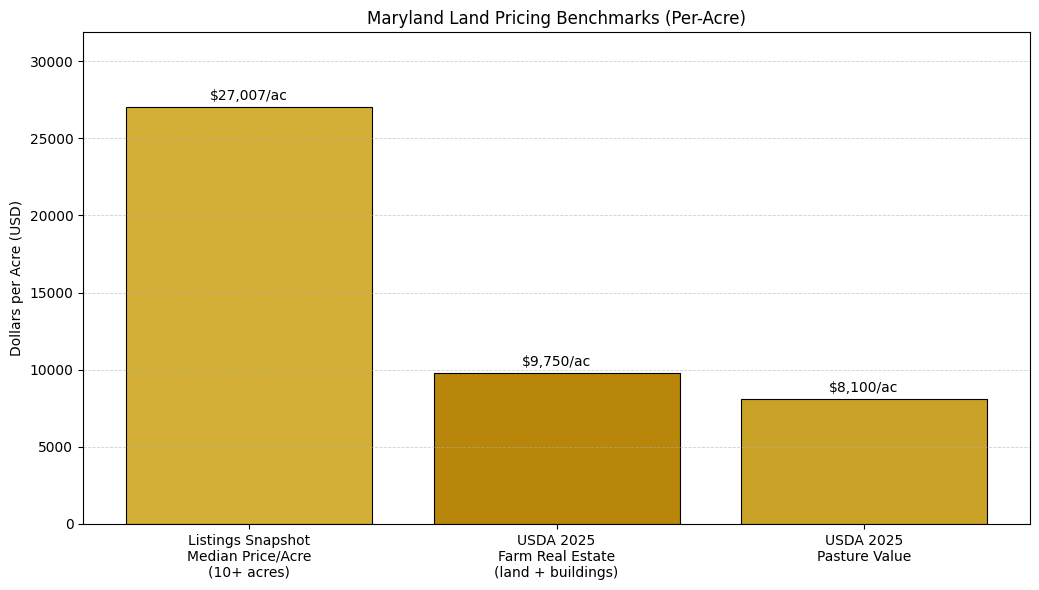
A current listing-based snapshot (important: 10+ acres and excluding commercial listings) reports roughly 3,477 properties for sale, about 29,186 acres advertised, a Median lot size of 28.4 acres, and a Median list price of $950,000. It also reports a Median Price per Acre of $27,007/ac and Median days on market of 130 days.
For sellers, the practical interpretation is that many buyers take time. Land transactions often involve surveys, access confirmation, soil checks, percolation (“perc”) testing, zoning verification, and sometimes environmental review, especially near tidal waters. A longer marketing window is normal compared with typical home sales.
Also, according to the Maryland-level indicators referenced throughout this guide, market demand for quality acreage remains active even when buyers move more slowly due to due diligence. When your parcel aligns with Maryland housing growth patterns, utilities, and zoning, you are more likely to see steady demand and stronger buyer confidence.
Use these listing benchmarks as an acrevalue reality check, then explain why your property’s price is supported by long-term value drivers like access, buildability, and location. Land is often viewed as a solid long-term asset, but buyers will still factor in carrying costs (taxes, maintenance, insurance, and holding time) while they verify feasibility, so reducing uncertainty early can keep negotiations on track and protect perceived long-term value.
USDA benchmarks for farm and pasture value
USDA’s 2025 land values highlight that Maryland is among the higher-value states for agricultural land categories, reporting:
Farm real estate value (land + buildings on farms): $9,750 per acre in 2025.
Pasture value: $8,100 per acre in 2025.
These are not the same thing as “vacant residential lots,” but they matter for sellers of farms, cropland, and mixed-use tracts because they provide a widely recognised state-level reference point.
County differences
The Census of Agriculture-based table prepared by the Maryland Department of Planning (values expressed in constant 2022 dollars) shows substantial variation in the estimated average market value of land and buildings per acre across counties. Examples include higher values in some central counties (e.g., Howard, Baltimore County, Anne Arundel) versus lower values in western counties (e.g., Garrett, Allegany).
What this means for sellers: county context (and sometimes sub-county context) is not a “nice to have.” It is fundamental to pricing and marketing.
A development-pressure signal: building permits
Building permits are a useful “pressure gauge” for finished-lot and small-subdivision demand because they reflect planned housing production. A FRED/U.S. Census Bureau series for seasonally adjusted housing units authorised by building permits in Maryland shows month-to-month variability and provides a way to compare recent years.
From January 2024 through October 2025, the same series shows a higher monthly level in much of 2024 and a lower average level in the January–October 2025 period (note: this comparison uses unequal time windows and should be treated as directional, not definitive).
Average vs median vs weighted arithmetic mean
Sellers often hear “average price per acre,” but land prices are usually skewed by outliers (small high-priced lots or premium waterfront).
The average (mean) is sensitive to extremes.
Median is often a better “typical” number for land.
A Weighted arithmetic mean is useful when you want parcel size to count properly. A standard acreage-weighted price per acre is:(total sale prices) ÷ (total acres).
That approach stops a tiny, expensive lot from dominating your sense of the market when you’re comparing against larger tracts.
As a seller, expect a slower, due-diligence-heavy market for 10+ acre tracts: roughly 3,477 listings show a $950,000 median list price, $27,007 per acre, and about 130 days on market. Use these benchmarks as a reality check, then justify your price with what buyers care about most (access, buildability/perc, zoning, and county-specific demand) to reduce uncertainty and keep negotiations on track.
Regional and Land-Type Patterns Across the State
Central Maryland: buildable-lot pressure and commuter demand
The most consistent “buildable-lot” pressure tends to cluster where jobs, infrastructure, and commuting patterns line up, especially the Baltimore–Washington corridor and the Washington metro influence. A key seller concept here is jurisdiction: zoning, utilities, and local approval timelines differ widely by county and municipality, and they directly shape buyer willingness to pay.
A useful example is Prince George's County, Maryland, which appears frequently in land searches because it borders Washington and contains a wide range of zoning and infrastructure contexts.
This corridor stays attractive for commuters because it connects major employment centers across northern and central Maryland and the broader region. For sellers, that means your pricing and marketing should clearly tie the parcel’s intended use (buildable lot, small subdivision, or redevelopment-ready tract) to the specific jurisdiction’s requirements and infrastructure realities, since those factors often matter more than acreage alone in commuter-driven submarkets.
Coastal and tidal areas: waterfront premiums with regulatory complexity
Maryland’s tidal geography creates high-value waterfront and recreation demand, but it also increases the importance of overlays and environmental constraints. The Critical Area programme defines the Critical Area as land within 1,000 feet of tidal waters/tidal wetlands and emphasises protected buffers (commonly at least 100 feet adjacent to tidal waters/tributaries).
For sellers, the “actionable” implication is not to gamble on assumptions. Instead, proactively confirm whether the parcel is within the Critical Area and prepare to explain what that means for clearing, building footprints, and mitigation, because buyers will ask.
Eastern Shore of Maryland: agriculture, larger tracts, and flood questions
The Eastern Shore is often associated with agriculture and larger acreage, plus a strong interest in hunting/fishing and other recreational use. Because many areas are low-lying, buyers frequently ask about floodplain mapping and future sea-level exposure.
In many Eastern Shore counties, conservation programs can shape what buyers can do with a property, so it helps to clarify any easements, buffer rules, or enrollment status early. At the same time, pockets of demand for housing can emerge near towns, schools, and job nodes, especially where roads, broadband, and utilities improve through infrastructure investment. Sellers who explain both the opportunities and the constraints (flood maps, elevation, shoreline conditions, and applicable programs) make it easier for buyers to evaluate the land without guessing.
Western Maryland: forests, slopes, and access
Western Maryland tends to feature more rugged terrain, making Forest and recreation uses common buyer objectives. In these settings, the basics, road access, driveway feasibility, slopes, and utilities often matter more than broad statewide price talk.
The role of physiographic regions and soils
Maryland spans multiple physiographic provinces (including the Coastal Plain and the Piedmont (United States)), which affects soil depth, drainage, groundwater conditions, and construction costs. Sellers don’t need to be geologists, but they should expect soils and water questions to be more intense in areas reliant on wells and septic systems.
Seller Playbook for 2026
Build a buyer-ready “information pack”
Land buyers buy information as much as acreage. A strong pack typically includes:
A recent survey/plat (or at minimum, a clear map and legal description).
Proof of legal access (road frontage or recorded easement).
Zoning and overlay notes, plus any known deed restrictions or easements.
Utility availability (power, broadband, public water/sewer if applicable).
Selling land is often lost in the gaps: a buyer walks away when they cannot confirm access, septic feasibility, or allowable use early enough.
Confirm buildability early: zoning, access, and septic
If the parcel is not in a public sewer, septic feasibility is usually the first hurdle. Maryland regulations for on-site sewage disposal permits require detailed site plans and soil evaluations, and you generally cannot build/alter an on-site system without a permit from the approving authority.A “perc test” is a component of a broader site evaluation that checks soil permeability and limiting factors (like high groundwater or restrictive layers). Sellers who can provide recent, transferable documentation reduce buyer uncertainty and shorten timelines.
In higher-pressure areas along major employment corridors and fast-moving market cycles, buyers tend to prioritize parcels where sellers can confirm zoning and show clear feasibility up front. This is especially true in places like Anne Arundel County, where zoning and infrastructure capacity (public sewer availability, utility proximity, road standards, and stormwater requirements) can materially affect timelines and price.
According to the Maryland-focused permitting framework, approvals hinge on documentation, so sellers who emphasize understanding local zoning and access and proactively address local zoning and access issues (recorded ingress/egress, frontage, and any easements) usually reduce back-and-forth during due diligence and keep offers from stalling.
Pricing: explain the logic, not just the number
A persuasive seller pricing story usually combines:
Nearby land sales (closed sales are best, ask a land-specialist agent to pull comps).
Competing active listings (your direct competition).
A per-acre reference as a reality check, while acknowledging that per-acre varies heavily by parcel size and features.
When buyers see that your list price is tied to actual constraints and benefits (zoning, access, soils, approvals), negotiation becomes more about facts and less about hunches.
Marketing: match the land to the right buyer
Different land types sell to different buyers, and listing language should match:
Farm buyers often care about soils, field layout, drainage, and existing improvements.
Forest and timberland buyers care about access, boundaries, topography, and the condition of the stand.
Recreation buyers care about privacy, access, and usable terrain.
Waterfront buyers care about shoreline conditions and restrictions (Critical Area, flood zones).
Taxes and closing items sellers should flag early
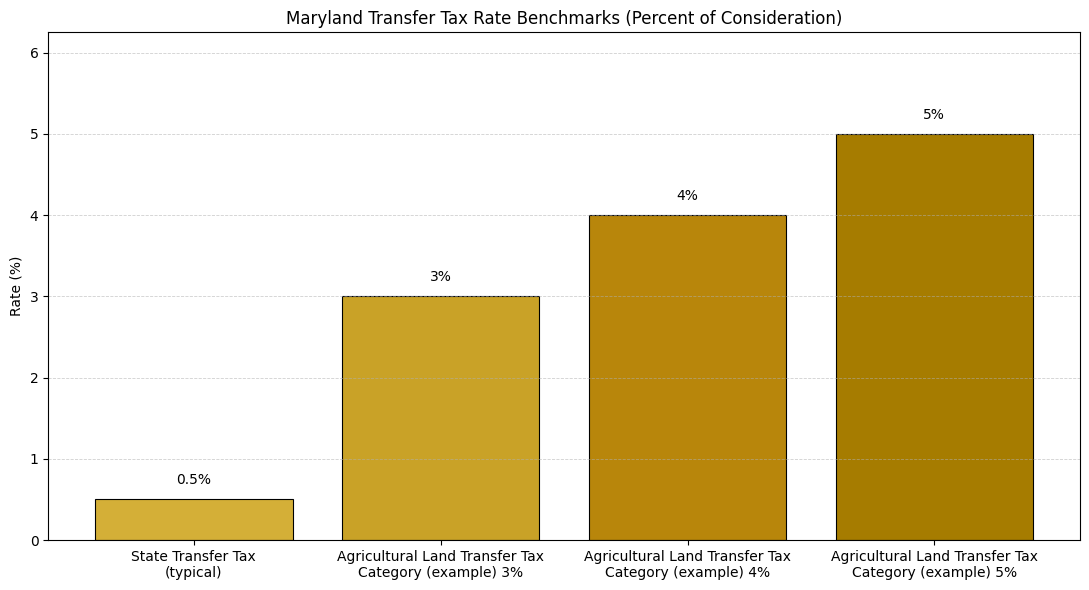
Maryland’s state transfer tax rate is described in legislative fiscal notes as 0.5% of consideration (with a reduced rate for first-time Maryland homebuyers, which may be irrelevant for vacant land deals). Local transfer taxes can also apply, depending on jurisdiction.
For agricultural parcels, the Agricultural Land Transfer Tax can apply if land is removed from agricultural use assessment, with rates tied to acreage and improvements (e.g., 3%, 4%, or 5% categories described in state code summaries). This can be a major cost driver in farm-to-development or farm-to-nonfarm transactions, so it should be discussed before contract signing.
These closing costs can vary by county, so it helps to flag them early when reviewing recent sales and building a realistic net sheet. In places like Washington County, buyers may be comparing land deals against local employment and housing demand, and unexpected taxes can change their numbers quickly.
While a listing may highlight what Maryland offers in terms of location and use options, buyers still look closely at ongoing property tax obligations and total transaction costs, so being transparent about transfer taxes and any agricultural-use implications can prevent last-minute renegotiations or deal fallout.
Maryland Land Market Conditions: How Land Use, Housing Demand, and Local Approvals Shape Value in 2026
Maryland’s market conditions in 2026 are best understood as a set of local micro-markets where land use rules, infrastructure, and the broader housing market combine to determine what buyers will pay and how long a parcel takes to sell. A “good deal” on paper can stall if zoning, access, or septic feasibility does not line up with what the buyer wants to build, while a smaller lot in a high-demand corridor can move quickly if it is clearly developable and properly documented.
For sellers, the biggest driver is the property’s highest realistic use. In some areas, demand is tied to redevelopment and infill opportunities, where buyers focus on utilities, setbacks, and permitting timelines. In other areas, farmland and larger acreage attract buyers looking for working land, hobby farms, or mixed-use tracts, where soils, drainage, and agricultural assessments can matter as much as location.
A major 2026 storyline is subdivision potential. Parcels that can support small subdivisions often draw steady interest, but feasibility is rarely obvious from acreage alone. Buyers want clarity on minimum lot sizes, frontage requirements, road standards, stormwater rules, and whether public water/sewer is available or the site relies on wells and septic. If you can show what’s possible and what it takes to get there, you reduce the friction that slows down offers and due diligence.
Finally, today’s land-buying environment rewards certainty. Serious buyers are comparing parcels side-by-side and will sometimes spot undervalued parcels when a listing is vague, missing documents, or incorrectly positioned for its best use. Sellers who clearly explain access, zoning, utility options, and any constraints tend to stand out, earn more trust, and convert interest into contracts faster.
Redevelopment vs. Rural Acreage: Where the Maryland Land Market Is Moving
In 2026, the Maryland land market is increasingly split between redevelopment-friendly sites and rural acreage that attracts lifestyle, farm, and recreation buyers. According to the Maryland indicators discussed in this guide, demand tends to concentrate where infrastructure and approvals are clearer, especially in the Baltimore and Washington corridor.
Parcels near major roads, utilities, and job hubs often draw faster interest because buyers can better predict timelines and costs. County context matters too, since county population growth and housing pressure can shift what buyers consider feasible and valuable. That is why submarket patterns in places like Howard County can make redevelopment-oriented parcels feel like a smart land investment compared with more remote tracts that require heavier due diligence.
Maryland Housing Market Impact on Land Market Conditions
Maryland’s land market conditions in 2026 are tightly linked to the pace and pricing of the housing market, because many land buyers are ultimately planning a long-term investment like a home build, a small subdivision, or a redevelopment project. When housing inventory is tight or buyers remain active, buildable lots with clear access, utilities, and approvals tend to draw stronger attention and hold value better than parcels with unclear feasibility.
This connection is especially visible across Maryland real estate market hotspots where commuting patterns and local job growth keep demand steady, even when buyers take longer to complete due diligence. For sellers and real estate professionals, the practical takeaway is simple: the more clearly your land supports a realistic housing outcome (zoning, septic or sewer, road standards), the more competitive it becomes in today’s market conditions.
Regulations, Constraints, and Risk Management
Critical Area considerations near tidal waters
The Critical Area programme defines the covered area broadly (within 1,000 feet of tidal waters/tidal wetlands) and describes the importance of the buffer directly adjacent to tidal waters/streams for water-quality protection. Sellers should verify Critical Area status and disclose it, because it affects what buyers can clear and build.
Flood mapping and coastal change
For flood risk, the official starting point is the Federal Emergency Management Agency Flood Map Service Center (MSC), which provides flood hazard mapping products and mapping status.Sea-level rise is a growing consideration for coastal/low-lying property. Maryland has published sea-level rise projection guidance (including an MDE projections document and later updates) and NOAA provides a sea-level rise viewer used by planners to visualise potential impacts.The seller's takeaway is practical: if your parcel is low-lying or shoreline-adjacent, expect buyers to ask about flood elevations, nuisance flooding, and erosion-management obligations.
Forest constraints and clearing expectations
Maryland reports substantial forest coverage statewide (with official pages noting roughly ~39% forest cover, and higher when including certain tree canopy categories).
That matters because wooded parcels often carry additional rules around clearing, replanting, or conservation, especially in sensitive areas. Sellers should be ready to document any easements or restrictions and, where possible, point buyers to the local permitting office for clearing/building questions.
Infrastructure, planning areas, and “where growth is expected”
Maryland’s growth-management approach includes Priority Funding Areas (PFAs), described by the state planning agency as designated existing communities where the state targets certain growth-related spending. While PFAs do not automatically make land “buildable,” they can shape buyer expectations about infrastructure and long-term planning context.
A seller’s risk checklist
A short, high-impact checklist for sellers to manage risk (not exhaustive):
Confirm legal access and recorded easements; unclear access kills deals late.
If not on public sewer, treat septic feasibility as a first-order item (buyers will).
Identify zoning and any overlay rules early (Critical Area, conservation easements, floodplain).
For coastal/low-lying parcels, proactively reference flood mapping and be honest about known flooding history (where disclosure rules apply).
Conclusion
In 2026, the smartest way to sell land in Maryland is to treat your property like a “buyer-ready” package, not just a listing. Maryland isn’t one market, so your best results come from matching pricing and marketing to your land type (buildable lot, farm, forest, or waterfront) and your county’s local conditions.
Expect longer timelines than home sales, especially when surveys, access confirmation, zoning checks, and septic feasibility are involved. If your parcel is near tidal waters, Critical Area, and flood-risk requirements can add extra steps, so proactive documentation and clear disclosures matter. The sellers who reduce uncertainty early and explain their price with facts usually attract stronger buyers, negotiate faster, and close with fewer surprises.