

Key Takeaways
Massachusetts has only ~10,000 sq mi of land but over 7.15 million people (2025 est.), making it one of the most densely populated states (~901 people/sq mi). This limited supply, combined with housing permits down ~44% since 2021, means available land often attracts multiple bids.
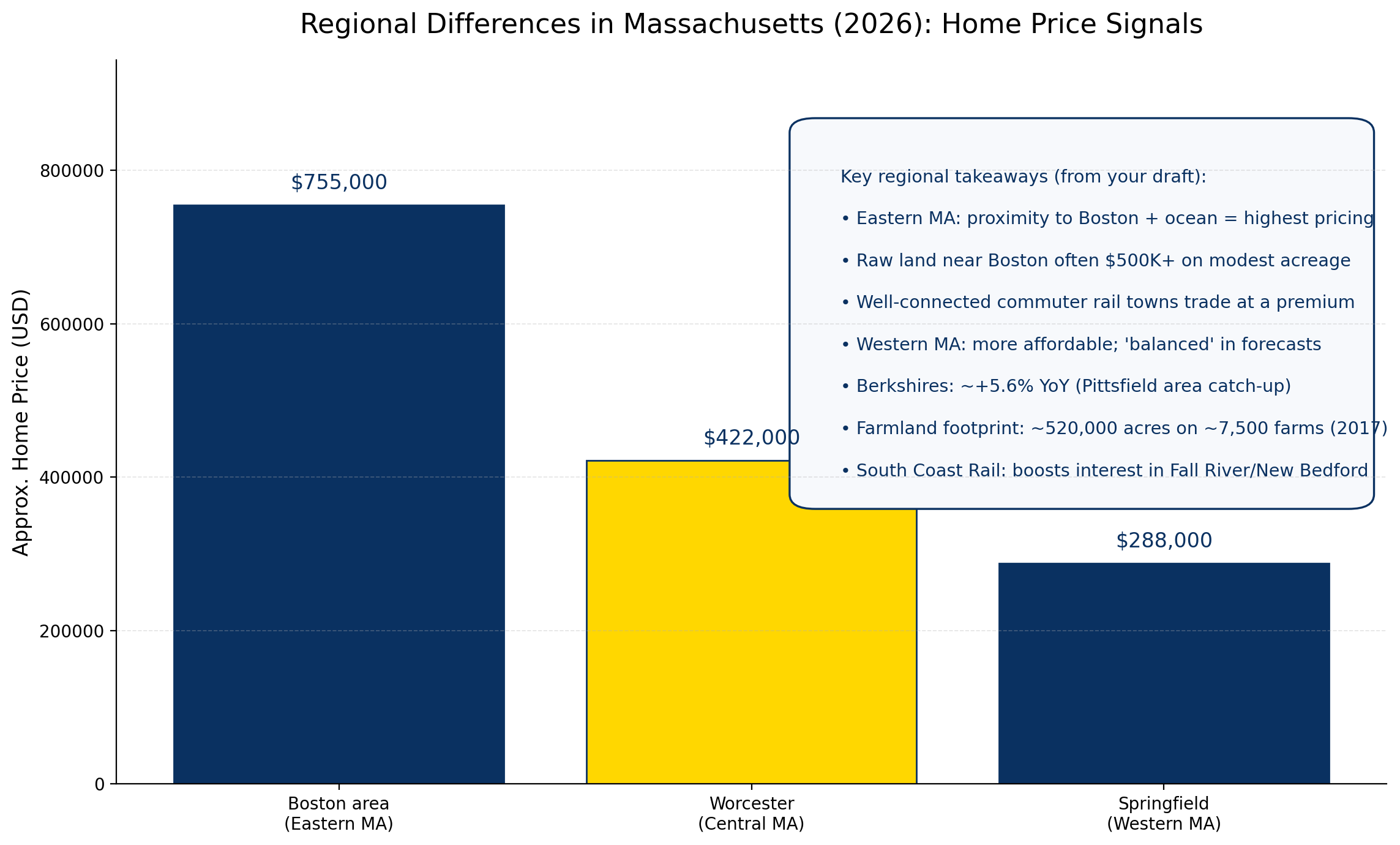
Land values are high, especially near Boston. The Greater Boston area sees median home prices around $755K (2026), whereas Western MA (e.g. Springfield ~$288K) is far cheaper. Central and suburban areas (e.g. Worcester, Pittsfield) are mid-range and rising (Pittsfield +5.6% YOY).
Inventory is very tight: only ~10,546 homes were for sale statewide in Jan 2026 (down 10.4% YOY), roughly a 2-month supply. With such low inventory, sellers often see fast sales. Average land listings in MA show a median price per acre of about $23,700.
Economic fundamentals remain solid. Massachusetts’s low unemployment (~4.8% as of late 2025) and high incomes support land demand. However, higher mortgage rates (~6.0% 30-yr, Feb 2026) have cooled some buyers, making cash and investor purchases more common.
Sellers should price competitively (using a current appraisal and local comps) and highlight key features (road access, utilities, views, waterfront, etc.). Offering flexible terms (like owner financing or subdividing a tract) can attract more buyers.
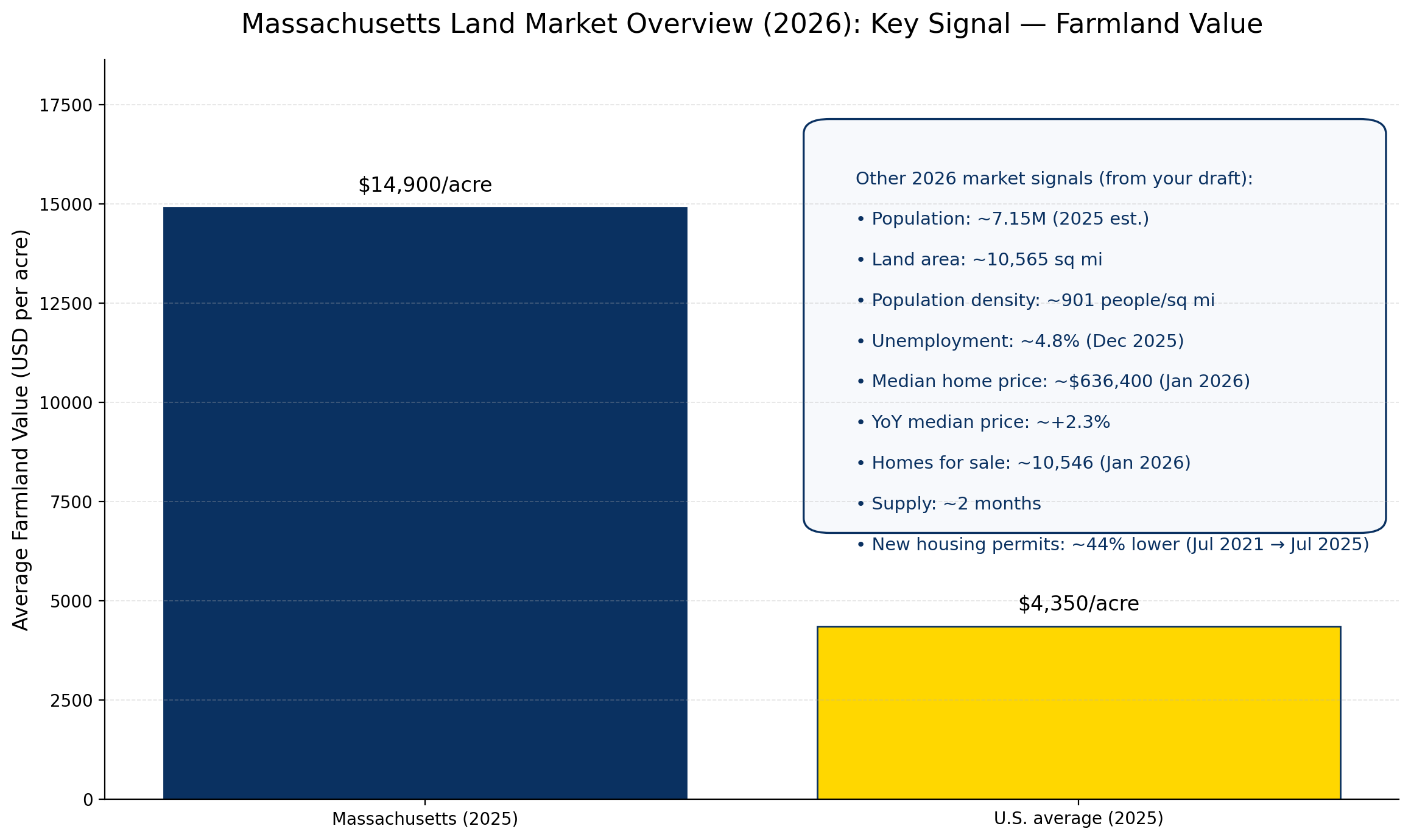
Massachusetts’s land supply is very limited compared to its population. With ~7.15 million people in 10,565 sq mi (2025 est.), the state’s density is about 901 people per sq mi, among the highest in the U.S. The economy is strong (tech, biotech, education, healthcare) and unemployment low (~4.8% Dec 2025), so many buyers are ready to purchase land despite higher interest rates.
Overall, housing is in a seller’s market. In Jan 2026 the statewide median home price was ~$636,400 (up ~2.3% YOY), but sales volume and new listings have fallen (~9–10% YOY decline)[16]. There were only ~10,546 homes on the market (down 10.4% YOY), roughly a 2-month supply. Builders issued 44% fewer new housing permits (July 2021 vs. July 2025), so little new supply will emerge immediately.
In this environment, even raw land for sale commands strong interest. Vacant lots near cities or public utilities (water, sewer, power) will attract competition, especially if they are ready for development. Rural land has steady demand too, from hobby farmers and investors. For example, Massachusetts farmland values averaged about $14,900/acre in 2025 (far above the US average of $4,350/acre).
Price Trends and Inventory
Demand is outpacing supply for both residential lots and large land tracts. Recent data show modest price gains but shrinking inventory: Redfin reports Massachusetts home prices up ~2–3% in early 2026 while active listings fell over 10% YOY. Roughly one-third of homes still sell above list price, reflecting strong buyer competition.
Similarly, land listing prices are high. A national land marketplace notes the median listed price per acre in Massachusetts is around $23,700 (median parcel ~23 acres, listing price ~$882K). However, prices vary: a small waterfront lot in Cape Cod can go for millions, while remote farmland sells for much less per acre. Sellers should examine local comparables (recent sales of similar acreage) to set a realistic price.
Mass housing markets are unequally affected: some areas like Fall River/New Bedford saw big home price jumps (+19.8% YOY), which hints at rising land values there too. Even with higher mortgage rates, investor and cash purchases keep land values firm. Overall, Massachusetts land prices are well above levels in nearby states; for instance, Rhode Island ($22,500/acre) and New Jersey ($16,600/acre) also lead the nation in farmland prices.
Regional Differences: East vs. West
Eastern Massachusetts
Proximity to Boston and the ocean drives the highest prices. Greater Boston suburbs, North Shore and South Shore, and Cape Cod have scarce developable land. The average Boston-area home price is around $755K, and raw land (e.g. for a new home) typically costs $500K+ even on modest acreage. Example: the city of Worcester (Central MA) has a median sale of ~$422K, but costs rise the closer you get to Route 128 or the seacoast. Well-connected suburbs (commuter rail towns) trade at a premium.
Central & Western Massachusetts
These regions are more affordable. In Springfield (Pioneer Valley) the average home is only ~$288K, and land is correspondingly cheaper. The Berkshires (Pittsfield area) saw home prices rise ~5.6%, indicating some catch-up. Lots of farmland exists here, about 520,000 acres on 7,500 farms statewide (circa 2017), so large tracts are available, though buyers are often fewer (market liquidity is lower).
Forecasts see Western MA as one of the last “balanced” markets in the state. Infrastructure projects help too: the South Coast Rail has boosted interest in Fall River/New Bedford (closer to Boston). Sellers should highlight regional strengths: for example, large lots in the Berkshires might appeal to buyers seeking privacy, recreation or farmland.
Market Drivers and Outlook
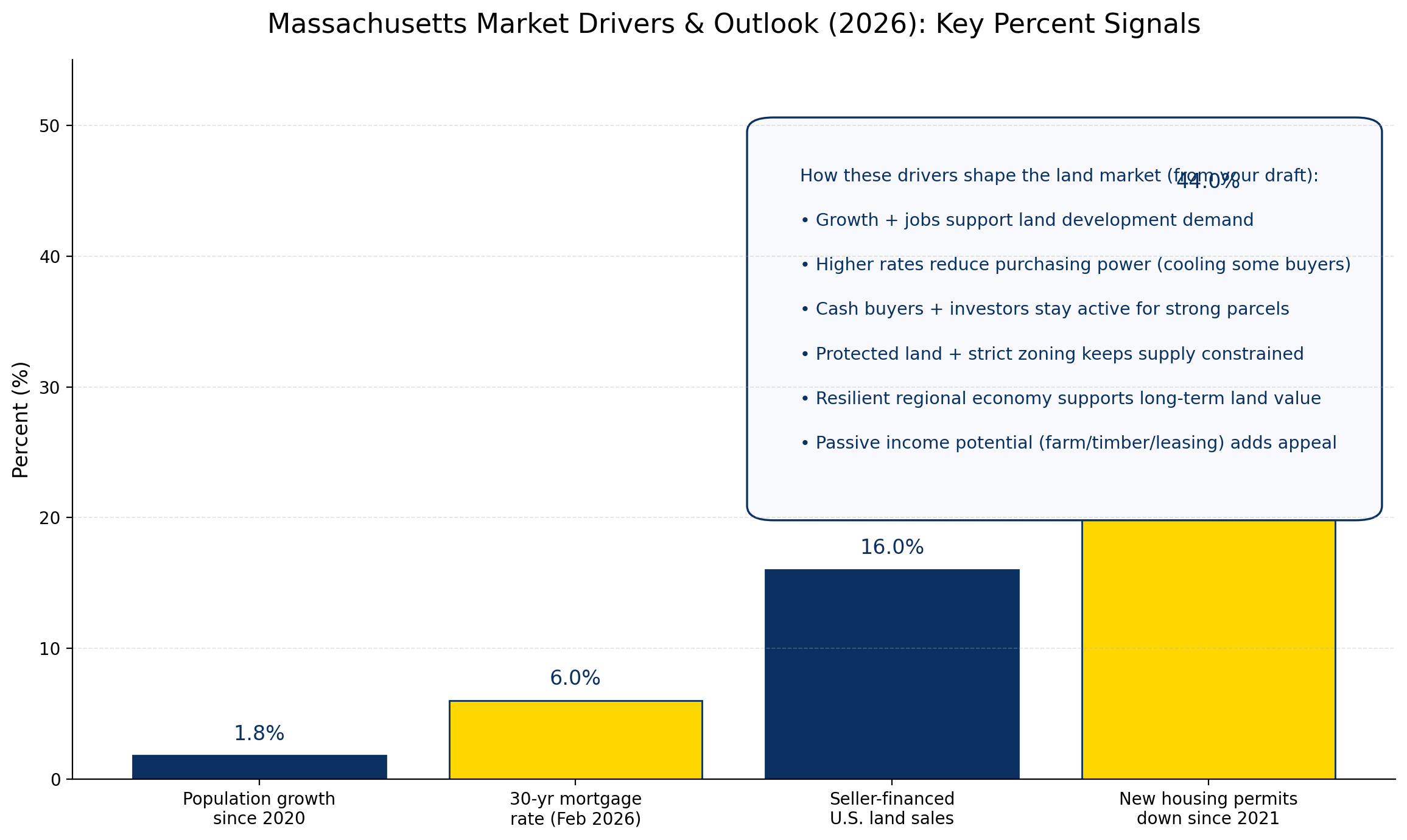
Several factors shape the 2026 land market:
Population Growth & Employment
Massachusetts’s population keeps growing (~1.8% since 2020), concentrated in urban/suburban areas. Strong employment (tech, education, healthcare) supports high demand for homes and businesses, hence land development.
Interest Rates & Financing
With 30-year mortgage rates around 6.0% (Feb 2026), many buyers have lower purchasing power. This cools some demand, but not entirely. Wealthy buyers (stock market gains, pensions) often make cash offers. Roughly 16% of U.S. land sales are seller-financed, so creative terms help overcome tight credit. Land investors and developers with cash are still active, especially for well-located parcels.
Supply Constraints
Land is fixed in quantity. Under zoning laws, much land is protected (parks, reservoirs, agricultural zones). The lack of new housing permits (down 44% since 2021) means competition for buildable land remains fierce. Even commercial and retail land (zoned for business) is scarce in high-demand areas. Massachusetts’s strict zoning means many sellers (especially landowners) can demand higher prices, knowing buyers have limited alternatives.
Economic Cycles
The Northeast economy has been relatively resilient post-pandemic. There are no immediate signs of a downturn large enough to crash land values.Sellers should note that land is a long-term asset; short-term market shifts (e.g. a mild recession) might slow sales but not erase demand. High property values and potential passive income (farming, timber, leasing) make MA land attractive as an investment, despite some market cycles.
Market Value Insights: How to Evaluate Land Value and Market Value in 2026
Strong land market insights and pricing come from combining comps with constraints. In 2026, the Massachusetts market is still shaped by demand and limited supply, but higher financing costs make buyers more careful—so your pricing has to be defensible. The goal is to evaluate the land like an appraiser would: identify what drives market value, then adjust for feasibility, location, and development complexity.
Start with a reality check: many parcels in Massachusetts are marketed in terms of “acres and are priced around” a statewide range, but the true pricing lever is buildability and location (especially land near utilities and employment corridors). A 10-acre parcel with heavy wetland constraints may underperform a smaller, cleaner lot with utilities.
How to assess land value (simple process):
Pull true comps (recent sales) in the same town and similar zoning—then compare on buildability, not just acres.
Adjust for utility availability (public sewer/water vs. septic/well feasibility).
Factor in constraints (wetlands, flood zone, slope/ledge, access limits) that can reduce value or delay approval.
Price by buyer type: end-user home site vs. developer vs. long-term land investment buyer.
Use market conditions and demographics: commuting demand, school pull, local job growth, and “move-in” pressure.
Quick “pricing logic” bullet points to include in the section:
More buildable area + easier approval = more marketability
Utilities + road frontage = advantageous for faster buyer decisions
Constraints + mitigation + permitting time = pricing discount
Lifestyle appeal + amenity access = premium (especially coastal and scenic areas)
To stay current on market insights, revisit comps monthly while you’re listed, Massachusetts can move quickly in hot submarkets, while rural areas may need more time and a sharper pricing strategy.
Sale in Massachusetts: County-Level Market Conditions That Impact Days on Market
A sale in Massachusetts doesn’t move at one speed statewide. Massachusetts counties differ in buyer depth, buildable inventory, and permitting complexity, so days on market can change dramatically based on where the parcel sits. Even when the state shows demand and limited supply, the practical outcome depends on market conditions, nearby amenities, and the local buyer pool.
County-level performance is often driven by:
Demographics and household income
Proximity to employers, universities, and healthcare hubs
Zoning strictness and the pace of approval
Utility expansion and infrastructure constraints
Competition: number of similar lots currently listed (excluding commercial properties)
Why some counties move faster than others (what influences land):
Parcels land near commuter routes, jobs, and public utilities usually see stronger demand.
Areas with tighter supply and higher population density often have more bidding pressure.
Regions with slower permitting, heavier constraints, or fewer buyers can take longer—even with attractive acreage.
This is where your strategy becomes more surgical: instead of saying “Massachusetts is hot,” show how your parcel fits the local buyer reality. That’s the kind of expert analysis buyers trust, and it helps you set expectations while keeping your pricing credible.
Massachusetts Regions Breakdown: Where Available Land Is Tightest (and Why)
When readers look for Massachusetts regions' insights, they’re usually asking one question: “Where is available land truly scarce?” In 2026, scarcity is most noticeable in coastal and high-commuter markets, where zoning, conservation priorities, and infrastructure limits keep buildable supply tight. Massachusetts offers strong upside in these areas because buyer demand stays high, but competition also pushes buyers to filter harder.
Regional snapshot (useful bullets for quick scanning):
Eastern / Greater Boston + coastal markets: Highest competition; utilities and proximity to jobs create premium pricing. Coastal constraints can affect feasibility and require mitigation.
Central Massachusetts: Often a balance of price and access; some towns benefit from spillover demand as buyers seek value.
Western Massachusetts: More acreage and rural options; buyer pools can be thinner, but parcels with clear buildability and lifestyle appeal can still perform very well.
What impact does this have on sellers?
In tight regions, clean, buildable lots can command top pricing, especially those close to utilities and amenities. In less dense regions, your edge is documentation, realistic pricing, and showcasing long-term value and lifestyle appeal.
Land Development in the Massachusetts Market
Land development value in the Massachusetts market is fundamentally an “approval + feasibility” story. Buyers and investors don’t just buy acreage—they buy clarity on what can realistically be built, how long it will take, and what constraints must be managed. That’s why sellers who pre-package development answers often get better returns and smoother negotiations.
Development confidence usually depends on:
Understanding local zoning and subdivision rules
Wetland buffers and Conservation Commission review (where applicable)
Driveway/access standards
Soil/septic feasibility (if no sewer)
Utility availability and extension costs
Slope/ledge conditions that affect build costs
Seller actions that improve marketability (and reduce renegotiations):
Provide a survey/plan and highlight buildable area
Summarize zoning and setbacks in plain language
Note wetlands/flood zone status and any known mitigation needs
Clarify utilities (available now vs. possible extension)
If the parcel has agricultural potential, describe the current use and soil/field condition
The “development-ready” framing is advantageous because it turns uncertainty into a plan, exactly what serious buyers must have before they commit.
Rural Land Parcel Strategy
For rural land, the pricing and marketing playbook changes. Larger parcels can have strong long-term growth potential, but they often require a different buyer story: recreation, privacy, agricultural land, timber/lease potential, or a long-term land investment hold. Rural parcels can also vary widely in feasibility, access, and utilities, so clarity matters even more.
Rural listing strategy (bullet format works great here):
Lead with access (public road frontage vs. private road vs. deeded easement).
Be direct about utilities and realistic alternatives (power distance, well/septic feasibility).
Address constraints early (wetlands, slope, seasonal access) to avoid wasted showings.
Sell the experience: privacy, trails, views, hunting, water features, and lifestyle appeal.
If applicable, highlight agricultural potential: pasture, hay fields, farm leasing, or current use.
Rural land can perform extremely well when the parcel is “easy to understand” and priced based on what’s usable, not just acreage. That’s how you protect your market value while attracting the right land buyers.
Unbiased Market Research: Where to Verify Market Value Before You List
If you want unbiased pricing confidence, you need more than a guess—you need proof. This section should show sellers how to do market research that supports pricing and reduces friction during negotiation. It also helps readers stay current on market insights while the listing is live.
Where to verify market value (and support market value insights):
Town assessor + property record cards: baseline info, maps, and prior assessments (not a true sale price, but useful context).
Registry of Deeds / recorded sales: confirms real transactions and easements.
Zoning maps + local zoning bylaws: verifies what’s legally allowed and what needs approval.
Wetlands/flood maps + local Conservation guidance: flags feasibility and mitigation risk.
USDA resources (for agricultural land): helpful context for agricultural potential and land-use framing.
If you include this “verification stack,” your guide becomes more actionable and trustworthy, because it teaches readers how to evaluate and assess value using sources that buyers recognize.
Tips for Selling Land
Set the Right Price
Obtain a professional real estate appraisal if possible. Otherwise, research local comparable sales: land transactions are less transparent, but MLS or county records can help. Take note of the recent $/acre in your area. Land.com data suggests around $23.7K/acre statewide, but adjust for location: a wooded lot far from roads is far cheaper than a subdividable suburban parcel. Price competitively to generate interest; significantly underpricing may waste potential profit, but overpricing can stall a sale.
Highlight Key Features
In listings and marketing, showcase the land’s best attributes. Examples: direct road frontage, access to utilities (power, gas, water, sewer), flat topography for building, scenic views, waterfront, and soil fertility (for farms). If there are any existing improvements (campsite, barn, fencing), mention them. Good-quality photos (including aerial/drone shots) are very effective. For farms, note current use (crops, pasture) and leased activities. Recreational uses (hunting, fishing) can also add appeal; some sellers even continue offering hunting leases for income, showing potential buyers the land’s value.
Flexible Financing/Structuring
Offering owner financing or “land contracts” can attract buyers who lack cash. This is common in rural land deals. For example, instead of requiring full payment, you might carry a mortgage at competitive terms. Another strategy is subdividing large properties (if zoning allows) so buyers can purchase smaller, more affordable parcels. Buyers appreciate options like these, which can justify a higher overall price.
Prepare the Property
Make the land presentable. Clear any debris or fallen trees, mow fields if practical, and ensure boundaries are marked. If possible, put up a “For Sale” sign with contact info. If a survey is available, have it on hand to show exact lot lines. Access is crucial: if there’s a private road or driveway, repair potholes and post clear signage. All these efforts increase buyer confidence and can speed up closing.
Do Thorough Due Diligence
Before listing, investigate everything about the land. Obtain a copy of the deed and have a title search done to reveal any liens, easements or covenants. Check zoning: visit the town clerk or planning department to confirm permitted uses, setback requirements, etc. Massachusetts regulates wetlands and waterways, activity within 100 feet of wetlands or streams often needs a Conservation Commission permit. Identify if the parcel falls in a FEMA flood zone. The Massachusetts Endangered Species Act forbids “taking” (harming) protected plants/animals; if your land has known habitats, you’ll need a permit (see MESA regulations).It’s best to gather this info upfront so you can answer buyer questions.Being transparent about restrictions (rather than having buyers find them later) builds trust and avoids renegotiations.
Understand Taxes and Closing Costs
Sellers should budget for transaction costs. Massachusetts charges a deed excise (tax stamp) of $2.28 per $500 of sale price (0.456%), typically paid by the seller. Brokerage commissions (often 5–6% of sale price) and closing fees should also be considered. If you make a profit, you owe capital gains tax: federal rates can be up to 15–20% (long-term) plus 8.5% state tax. Keep records of your purchase price, closing costs, and any improvements to reduce taxable gain.Note: if your land qualifies as “farm” under Chapter 61A/61B (agricultural use) and you’re ending that, there may be rollback taxes, so understand those rules.Conversely, highlighting any Chapter 61 status can be a tax advantage for buyers (lower property tax) to mention in marketing.
Market Broadly
List your land on multiple platforms: MLS (through a broker), Realtor.com, Zillow/Redfin, and specialized sites (LandWatch, Land And Farm). Use a clear, descriptive listing title.For example, “15-acre wooded lot with brook, zoned for single-family, Worcester County” spells out major perks. Highlight proximity to utilities or planned development.Social media and local print ads (newspapers, community bulletins) can also help, especially for rural properties. If using an agent, choose one experienced in land or rural properties, they will know where investors or developers look.
Be Responsive and Patient
Land deals often take longer than home sales. Buyers may need time for financing (especially if zonings like agricultural loans) or permitting for development. Respond promptly to inquiries, provide additional docs (e.g. soil tests or surveys), and be available for property showings. This keeps good buyers engaged.Remember, land isn’t as liquid as a house, some properties might sit a while. But in the current market, well-priced and well-prepared land is moving faster than a few years ago.
Conclusion
For land sellers in Massachusetts, 2026 offers favorable conditions: low inventory, steady economic growth, and ongoing demand.By setting a realistic price, fully preparing the property, and clearly communicating all details, sellers can make the most of this market. Keep an eye on local trends (school improvements, road projects, zoning changes), as these can quickly boost or depress land values.
Ultimately, thoroughness and transparency in pricing, marketing, and due diligence will lead to a smoother sale and better outcome in Massachusetts’s competitive land market.