

Key Takeaways
Official USDA estimates show Minnesota farm real estate value rose steadily from 2021 to 2025, reaching about $6,790 per acre in 2025, with cropland generally higher than pasture.
Late-2025 lender surveys in the Ninth District suggest land values were mostly flat to slightly higher year-over-year, while buyers stayed cautious due to low crop prices and high input costs.
Interest rate conditions matter for buyer affordability: agricultural real estate loan rates reported in the Minneapolis Fed survey eased into late 2025, but financing costs remain meaningful in pricing negotiations.
County-level farmland sale prices vary widely; the University of Minnesota’s county table for 2024 ranges from under $1,000/acre in some counties to well above $10,000/acre in others, so local comparables are essential for realistic pricing.
For sellers, the most reliable way to support market value is to reduce buyer uncertainty with clear due diligence: title/access clarity, zoning confirmation, utility documentation, and credible soil/productivity information.
Auctions can strengthen price discovery when demand is deep and the information packet is strong, but they require careful planning of terms, reserve logic, and disclosure.
Market Snapshot for 2026: For Land in Minnesota
What “2026 data” market value really mean right now
Land markets move slowly, and the most trusted statewide benchmarks are usually annual publications and verified sales records. As of February 2026, two of the highest-quality “anchors” for pricing and market trend interpretation are:
USDA annual land values estimates (released for 2025), which report average value per acre for farm real estate, cropland, and pasture by state.
The Federal Reserve Bank of Minneapolis’ Ag Credit Survey (Q4 2025, published February 2026), which reflects lender observations on farm incomes, loan demand, interest rates, land values, and rents in the Ninth District (including Minnesota).
Minnesota’s most recent statewide value benchmarks
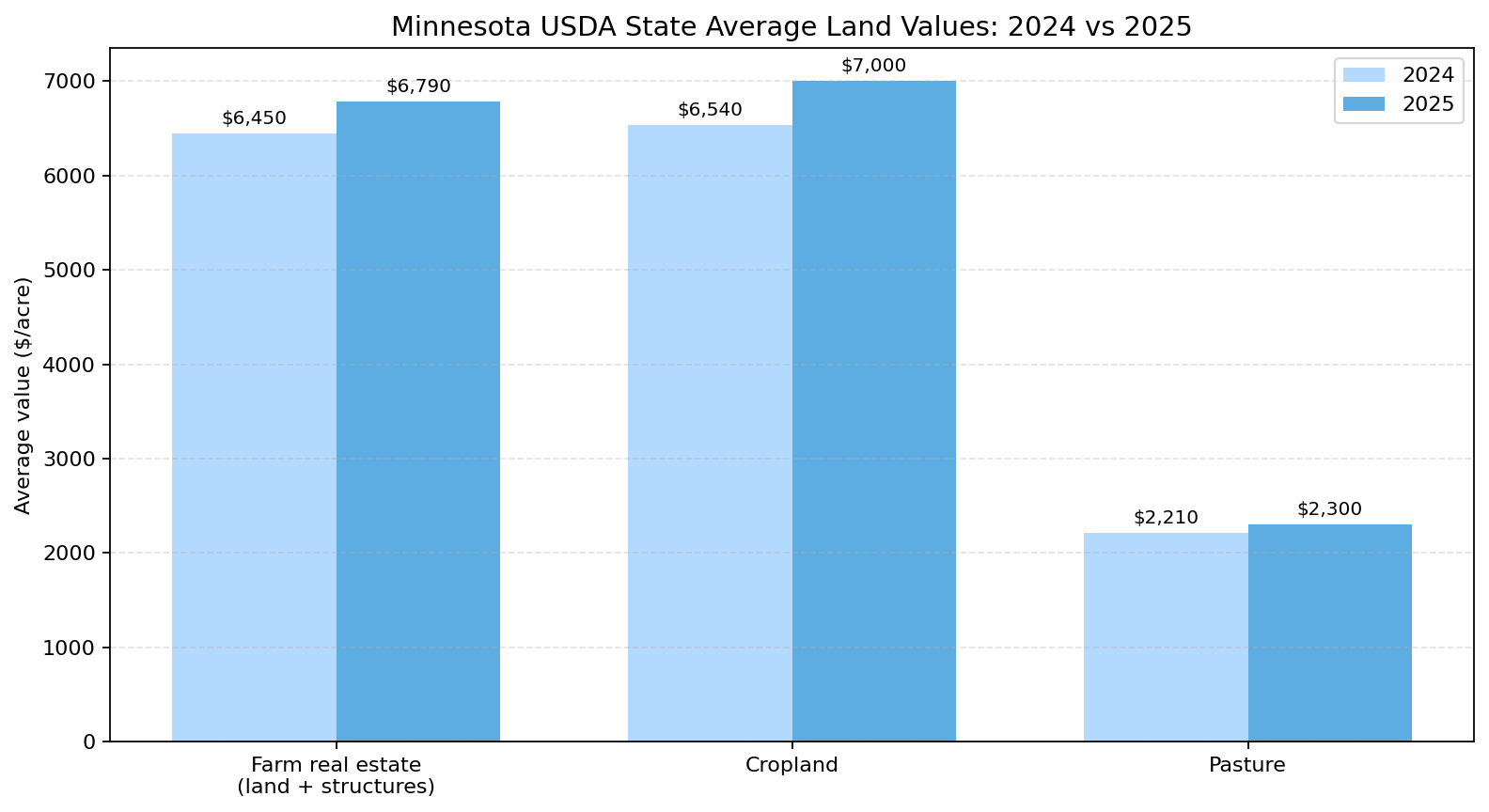
From the USDA 2025 land values summary (state averages):
Farm real estate (land + structures): Minnesota averaged $6,790/acre in 2025 (up from $6,450 in 2024).
Cropland: Minnesota averaged $7,000/acre in 2025 (up from $6,540 in 2024).
Pasture: Minnesota averaged $2,300/acre in 2025 (up from $2,210 in 2024).
For sellers, these are baseline signals about broad conditions—not a substitute for local pricing.
Neighbouring-state context
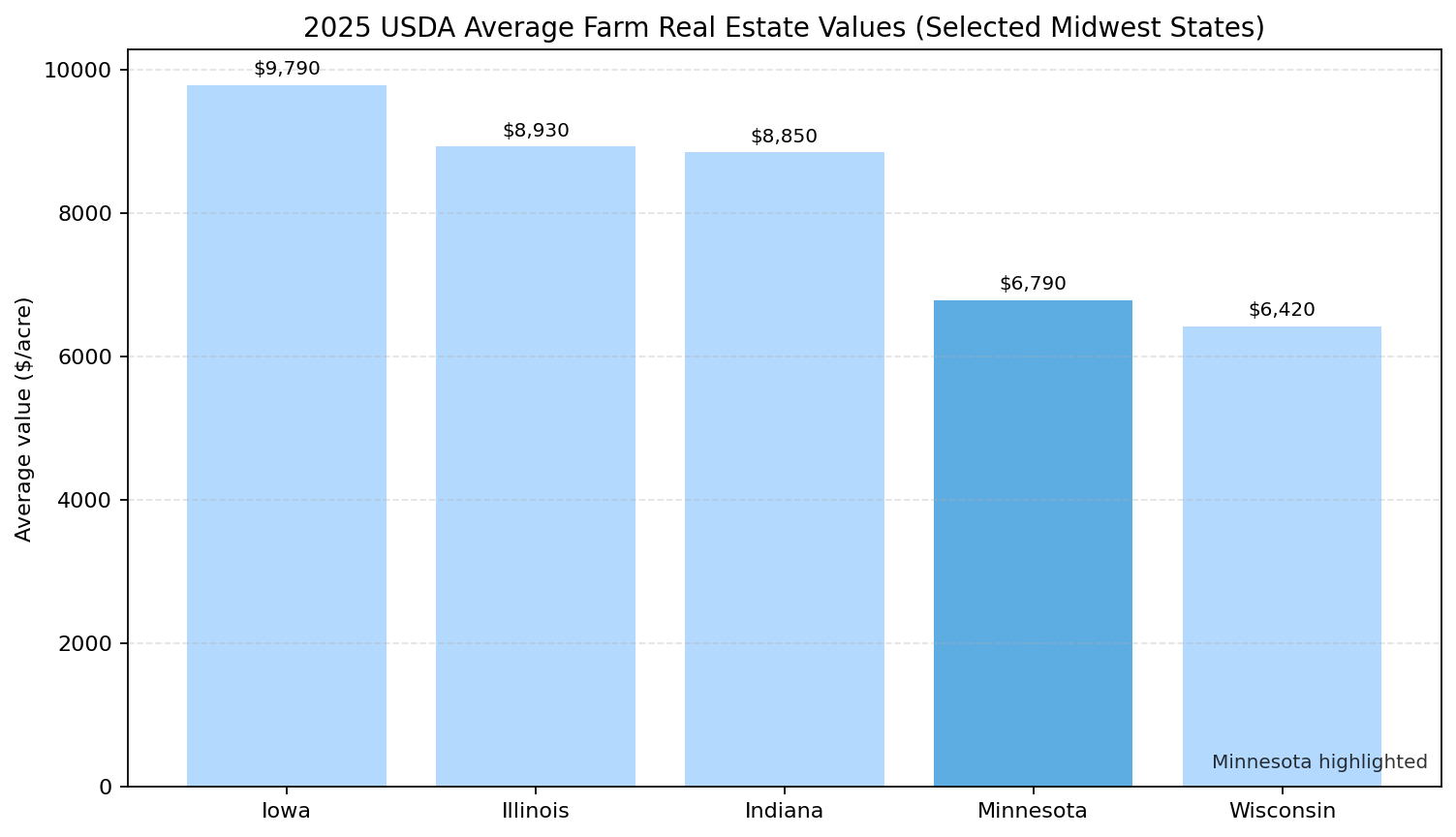
Buyers (farm operators, lifestyle buyers, and investors) often compare opportunities across the Midwestern United States. In the same USDA tables, 2025 average farm real estate values were higher in Iowa ($9,790/acre) and Illinois ($8,930/acre) than in Minnesota, while Wisconsin ($6,420/acre) was slightly lower and Indiana ($8,850/acre) was higher.
This matters in practical negotiation: when your parcel is competing for the same pool of buyers, comparative pricing affects demand and the number of bidders/offers.
In other words, land prices don’t exist in a vacuum. Buyers weigh your tract against nearby states and decide where the best deal is under today’s market conditions. If the market in Minnesota looks relatively better on price-per-acre, you may attract more interest from out-of-state buyers looking for land acquisition opportunities, especially when acreage, access, and productivity pencil out.
The key for sellers is to show why your parcel still has strong long-term value (soil ratings, drainage, leases, buildability, or location advantages) so you’re not competing on price alone.
2026 “direction of travel” of land development in Minnesota
The Minneapolis Fed’s Q4 2025 survey-based article describes:
Farm incomes generally decreased across the Ninth District, with lenders citing low crop prices and high input costs.
Demand for loans increased amid tighter cash flows, while agricultural loan interest rates fell notably by late 2025 in the survey data.
Land values “just barely increased from a year earlier overall, with mixed results by land type and state (Minnesota specifically described as “rose slightly” for nonirrigated cropland prices).
At the national level, the U.S. Department of Agriculture Economic Research Service emphasizes that farmland values are shaped by macroeconomics (like interest rates and alternative investments) and parcel-specific attributes (soil quality, rural amenity value, urban proximity, and government payments).
Inflation and employment conditions matter for land (especially residential and development lots) because they affect costs, credit availability, and buyer confidence. The U.S. Bureau of Labor Statistics reported CPI-U inflation was 2.4% year-over-year for the 12 months ending January 2026. The Minnesota Department of Employment and Economic Development reported Minnesota’s unemployment rate was 4.1% in December 2025 (seasonally adjusted).
Taken together, these signals help explain buyer behavior in early 2026: lenders saw softer farm incomes and tighter cash flows, yet borrowing costs eased, so many buyers stayed active, but more selective, due to demand for “safe” parcels that can justify the payment.
For sellers, the practical edge is market monitoring: track lending tone, rates, and local comps so your pricing and timeline reflect a realistic projection, not just last year’s headlines. A strong understanding of the market also helps you anticipate where deals stall (financing, appraisal gaps, or zoning questions) and prepare documents early to speed lender approval. When you reduce uncertainty with a clean info packet, you increase the odds of successful land transactions and position your property as successful land in a cautious market, one that buyers can underwrite with confidence.
Land-Type Value in Minnesota and Regional Patterns
Agricultural land
Agricultural land is where the strongest statewide data exists, and it’s also where “jargon” shows up most.
Key terms (plain language):
Price / Pricing: what buyers actually pay (often expressed as $/acre).
Market (economics): the interaction of supply and demand for land, credit, and commodities.
Market value: a typical sale price under normal conditions (often supported by a real estate appraisal).
Real estate appraisal: a professional valuation using comparable sales (and sometimes income approaches for farms).
Productivity: how well the land can produce crops; strongly tied to soil and drainage.
Volatility (finance) / Risk: crop prices and farm margins can change quickly; buyers price in uncertainty.
Commodity market: where maize (corn), soybean, wheat, etc. prices are set; farmers may use a hedge (finance) or option (finance) to manage price risk.
What’s happening in 2026? Minnesota is a major row-crop state. USDA/NASS state overview data (2024) lists millions of acres of corn and soybeans and shows corn and soybean value of production as leading crop categories. This crop mix matters because corn/soybean margins influence farm cash flow and land demand.
The Minneapolis Fed notes that 2025 had strong production nationally and cites a USDA estimate that corn production hit 17 billion bushels in the United States in 2025, while soybean production was also strong (though lower than the prior year). Strong harvests can coincide with weak profitability if commodity prices are low and costs are high, exactly the kind of environment that can soften buyer demand at the margin without necessarily causing a price collapse.
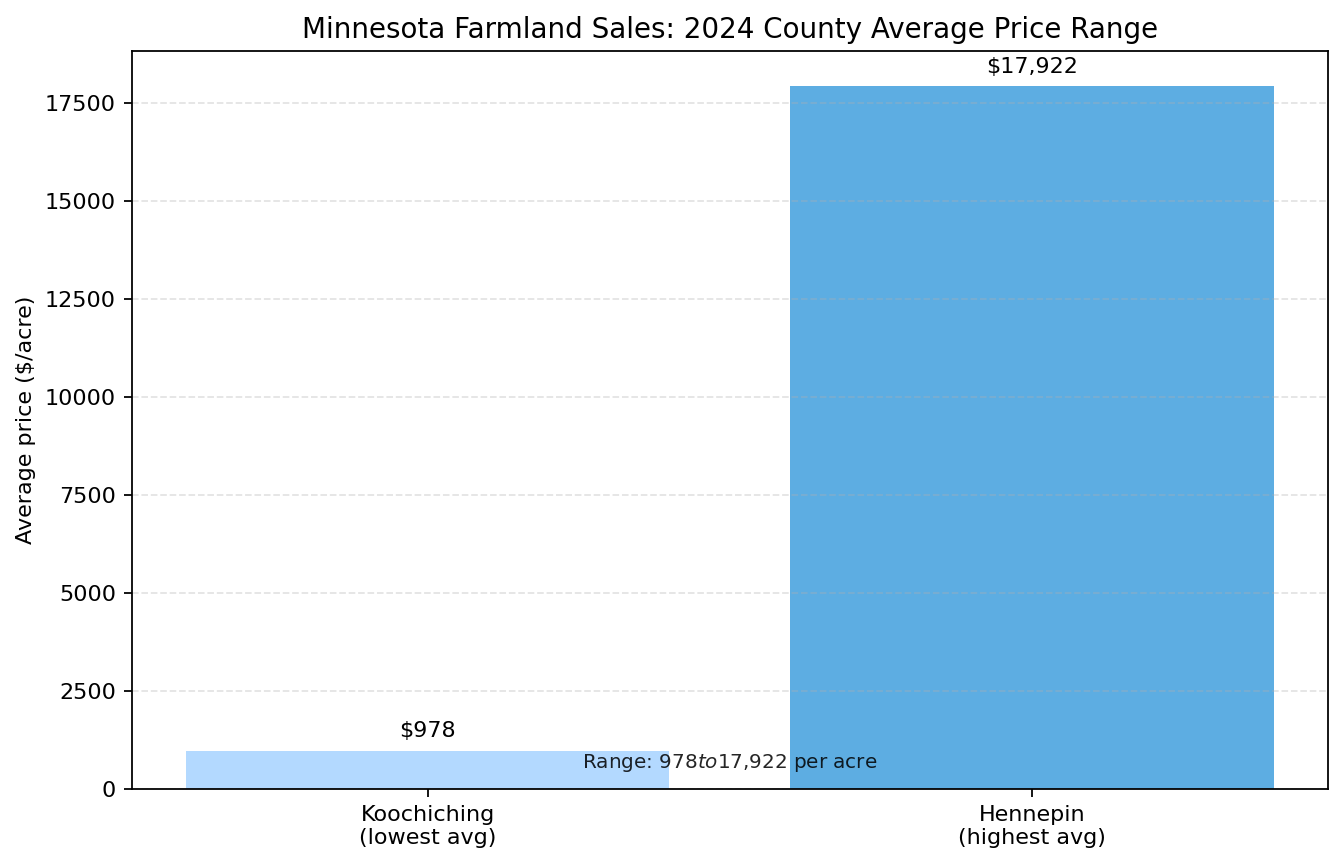
How wide is the price range across the state? The Minnesota farmland sales spreadsheet published via University of Minnesota Extension summarises 2024 farmland sales by county (number of sales, average price, min, max, and prior year average). In that table, county-level 2024 average prices span from $978/acre (Koochiching) to $17,922/acre (Hennepin), with many productive agricultural counties clustering much higher than most northern forest counties.
A useful way to interpret this (without pretending it’s perfect) is to remember that this is a county-average per-acre price, and counties differ wildly in soil, land use, amenities, and development pressure.
Soil and soil quality. Soil is not just a farming topic; it is a valuation topic. Minnesota uses productivity ratings that help compare soils’ crop potential on a 0–100 scale. The Minnesota Geospatial Commons page on crop productivity explains these indices provide a relative ranking of soils for intensive crop production.
For sellers, the action item is simple: if your land is marketed as agricultural land, provide credible soil information (maps + productivity ratings) so buyers can estimate expected performance and costs (tile drainage, erosion control, etc.).
All of this feeds directly into Minnesota land market demand in 2026: even with big harvests, buyer confidence can soften when margins tighten because of the costs associated with farming (seed, fertilizer, fuel, labor, and interest). That’s why pricing per tillable acre and proving productivity matters; serious buyers will separate “acres on paper” from truly workable acres, then adjust offers based on drainage, field shape, and soil ratings.
The county spread in 2024 sales also highlights regional dynamics: parcels in high-productivity and metro-influenced counties can price very differently from northern counties, and land adjacent to strong operators, good roads, or expanding communities may carry a premium.
To protect resale value, sellers should anticipate the buyer’s steps to buying: (1) verify access and boundaries, (2) review soils/productivity maps, (3) confirm drainage or erosion risks, and (4) validate local comps by county and land type. When you provide those facts upfront, buyers can underwrite the property faster and bid with less discount for uncertainty.
Forest and recreational land
Forest and recreation parcels often sell on a mix of “utility” and lifestyle value: timber income potential, hunting access, privacy, lake frontage, and adjacency to public land.
The Minnesota Board of Water and Soil Resources reports Minnesota has 17.4 million acres of forest land, about 22% of the state’s land area, used for timber production, recreation, wildlife habitat, and increasingly home sites; it also describes fragmentation and small-holding growth and notes many small tract owners prioritize recreation.
Key term: stumpage. “Stumpage” is the price paid for standing timber. It matters to both public and private woodland owners as a market signal for timber value. The U.S. Forest Service notes Minnesota’s public stumpage price reporting covers a large share of commercial public timber sales and provides a consistent time series and a price index.
Seller implications. Forest/recreation buyers often care about:
Road access and what’s legally recorded (easements, rights-of-way).
Buildability constraints near a lake (shoreland rules), wetlands, or floodplains.
Whether the tract is actually usable for the buyer’s goal (cabins vs hunting vs timber).
Documented timber volumes if timber value is part of the pricing story.
In Minnesota, rural land often draws a wider mix of buyers than people expect, especially outdoor enthusiasts who want hunting, lake access, and privacy, plus buyers building a diversified portfolio that includes timber or recreation acreage.
Because local demand can shift quickly by county and lake region, it helps to reference what has recently sold nearby and the current transaction activity (even a small number of sales can set expectations). Since land may look “simple” but hide constraints, thorough due diligence is what protects your price: confirm recorded access, shoreland/wetland limits, and provide timber details (including stumpage context and any cruise/volume estimates).
Parcels that are clearly usable and well-documented can often command higher prices due to reduced buyer risk, and they tend to attract steady demand even when the broader market is cautious.
Residential and development land
For parcels near the metro, land value is heavily tied to housing demand, infrastructure, and planning.
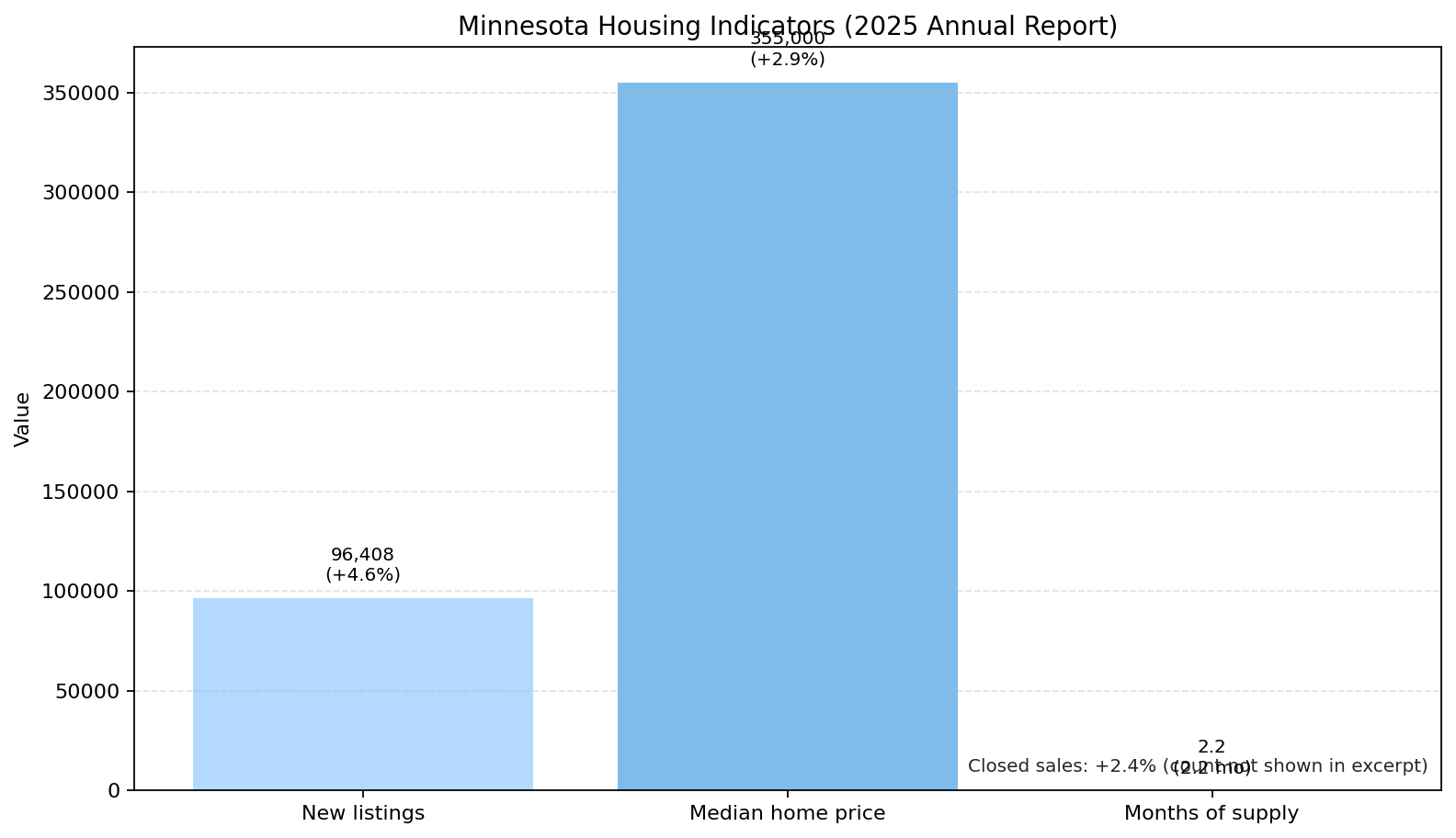
The Minnesota Realtors’ 2025 annual report (released January 2026) shows statewide housing indicators such as new listings (96,408; +4.6%), closed sales (+2.4%), median price ($355,000; +2.9%), and months of supply (2.2). The same release discusses “lock-in effect” easing and buyer affordability constraints even as inventory conditions improved somewhat.
For land sellers, the main reason to pay attention is that housing supply and demand influence builder appetite for lots, pricing of infill parcels (especially in strong school districts), and demand for rural residential acreage or a “hobby farm” within commuting distance.
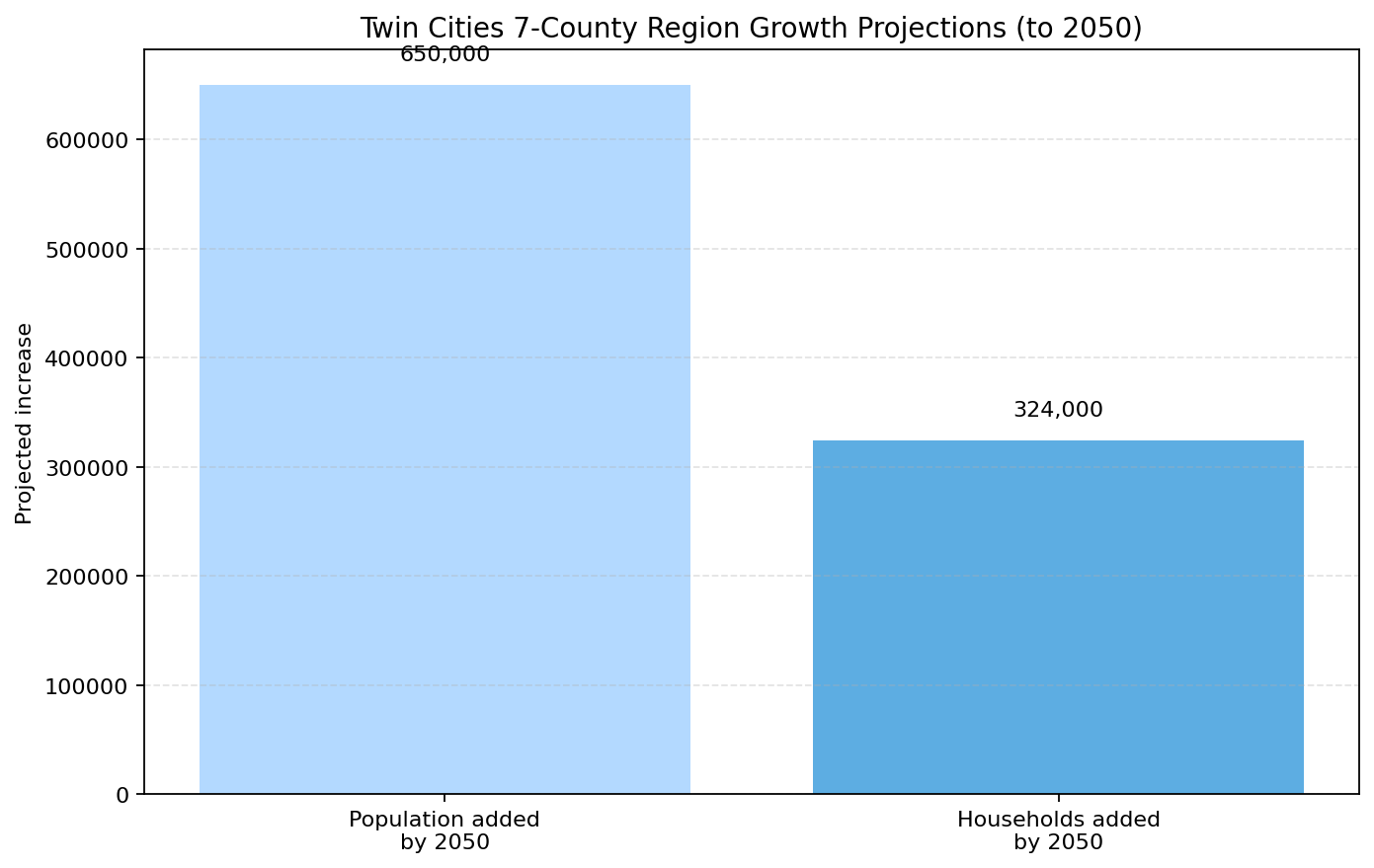
Growth and urban sprawl pressures. The Metropolitan Council projects the seven-county region will add 650,000 residents and 324,000 households by 2050, with growth leaning toward suburban and suburban edge communities. This kind of forecast can create development pressure on land at the metro edge (especially near planned transport and wastewater capacity), though zoning and infrastructure timing can significantly shape what is realistically buildable.
Zoning and land use really do affect price. Two Minnesota statutes are especially practical for sellers to understand at a high level:
Minnesota’s zoning authority and scope are described in § 462.357 (uses include agriculture, forestry, residence, recreation, trade/industry, and more).
Subdivision regulation and platting requirements are addressed in § 462.358, including when subdivisions must be platted.
Why this matters: if a parcel’s best buyer is a builder or an “end-user” who wants to construct, uncertainty about zoning, subdivision eligibility, setbacks, shoreland rules, and utilities can reduce demand or extend diligence periods, which can translate into lower offers.
In the Minnesota market, the gap between a “good parcel” and a “buyer-ready parcel” is often understanding local zoning and how it shapes real-world buildability. When zoning allows mixed-use (or a clear path to a conditional use), buyers may value flexibility more highly, while parcels with shoreland constraints can still win on recreational value if the intended use is realistic.
This also affects transaction volume: when rules are clear and documentation is strong, more qualified buyers stay in the deal, timelines shorten, and offers tend to be firmer. Finally, appraisals provide a reality check by tying permitted use and subdivision potential to comparable sales, so confirming zoning, setbacks, and platting requirements upfront can protect price and reduce renegotiation risk.
Seller Playbook for 2026
This section is intentionally “seller-first” and avoids investment tips. It focuses on pricing, sales execution, and reducing buyer risk.
Start with pricing logic (not a guess)
Most sophisticated buyers will think in some version of supply and demand. They compare:
What else is on the market (inventory)
recent sales (comparable sales)
financing costs (interest rate, credit terms)
expected usability (what can you actually do with the property)
Practical steps:
Build a short “pricing evidence” page: 3–6 comparable properties, noting acreage, soil quality (if relevant), utilities, road access, and sale dates.
If the stakes are high (estate sale, family partnership, major acreage), consider a professional real estate appraisal to establish market value and help with negotiations.
Create a buyer-ready due diligence packet.
Think like a buyer who is trying to reduce uncertainty and creditor risk. Your job is to make the property easy to underwrite (for a bank) and easy to understand (for a person). Include:
Ownership: deed/legal description, proof of ownership, and disclosure of any liens or special assessments.
Access: recorded easements, driveway permissions, and road maintenance responsibility.
Land use: zoning classification, permitted uses, and any conditional use process.
Utilities: what public utility services exist (electric, water, sewer, fibre) and what don’t.
Soils: maps and productivity ratings, plus known drainage tile and water issues.
Income/Ag programmes: leases, cash rent, and any farm programme participation where relevant. (These can influence perceived cash flow.)
Physical constraints: wetlands/shoreland limits, conservation easements, forest management commitments.
This is due diligence in the most practical sense: doing the work before the buyer demands it.
Sale method selection
Auction vs traditional listing
Auction: can be powerful for farmland and certain recreational parcels because it concentrates demand at a single moment (“competition effect”). It works best when buyers trust the information and have time to prepare financing.
Traditional listing: often better when the buyer pool is narrower or when zoning/utility complexity requires longer diligence.
Understand who your buyers really are
Your pricing and marketing should match the most likely buyer type:
Farmer
Focuses on productivity, field shape, soil, and operational efficiency.
Investor
May focus on stable cash flow and risk (without you needing to market it as an “investment”).
Recreation buyer
May pay for lake access, privacy, and nearby public land.
Developer
Prioritizes zoning, subdivision feasibility, and utilities, plus absorption and local housing conditions.
Policy awareness without trying to ‘time’ anything
Policy doesn’t set your sale price directly, but it shapes behaviour and expectations in agriculture and housing:
Farm programmes and “bridge” supports can affect farm cashflow expectations. The farm bill framework was extended through September 30, 2026, which continues major USDA programmes.
USDA’s Commodity Credit Corporation is a financing mechanism for agricultural programmes and has also been used as an authority pathway for certain bridge payments administered by USDA entities. Major federal tax law changes (including the One Big Beautiful Bill Act) can affect real estate transactions and reporting. The Federal Reserve is also relevant indirectly because its policy stance influences interest rates and credit conditions. For sellers, the actionable takeaway is not “invest”, it’s: ask your tax professional to estimate after-tax proceeds and any reporting considerations before you sign a purchase agreement.
Minnesota market: evaluate benchmark and 2026 resale value
In the Minnesota market, it helps to evaluate your parcel against a benchmark (USDA values plus recent county sales) rather than guessing. This frames 2026 expectations and supports resale value by showing buyers exactly what they’re paying for.
Conclusion
Minnesota’s land market heading into 2026 is best understood as a “local market inside a statewide trend.” Statewide benchmarks (like USDA land values) show where the baseline is, but real pricing power comes from parcel-specific facts: access, zoning, utilities, soils/productivity, buildability limits, and the quality of your documentation.
When you sell land in Minnesota, buyers are cautious in a higher-cost environment, which means uncertainty gets discounted fast. The sellers who win are the ones who make their land easy to evaluate and easy to finance by providing a clear due diligence packet, realistic local comps, and a straightforward path for the buyer to confirm what they can do with the property.
Whether you are selling cropland, timber/recreational acreage, a rural homesite, or a metro-edge parcel, your best move is to reduce risk, prove value with credible data, and choose the sales method that fits your buyer pool. Done well, you increase competition, shorten negotiations, and improve the odds of a clean close at a strong price.