

Key Takeaways
- Washington land prices show a sharp urban–rural divide, with small parcels near Seattle reaching up to $650,000 per acre while remote Eastern counties can be as low as $15,000 per acre, largely split by the Cascade Range.
- Land values have largely stabilized heading into 2026. High interest rates cooled demand and extended listing times, keeping prices near record highs but shifting growth to single-digit percentages instead of the double-digit jumps seen earlier this decade.
- Washington farmland remains highly valuable thanks to long-term investment demand and tight supply, but some central Washington orchards, vineyards, and hop farms have softened due to low crop prices and water concerns, keeping overall values relatively stable despite commodity dips.
- Land demand is strongest near transportation and population centers, especially along the Interstate-5 corridor and close to jobs and amenities, while remote areas with limited infrastructure face much lower competitive pressure.
- In 2026, land sellers should price strategically based on zoning, comps, and income potential, prepare for rigorous buyer due diligence by clearing legal/title issues and disclosing defects, and consider creative financing like owner carry to attract buyers amid high borrowing costs.
Washington State’s land market is diverse and dynamic, shaped by geography, economic forces, and regulatory policies. This guide provides a comprehensive look at land market trends in Washington as of 2026 – covering everything from pricing patterns and regional differences to legal factors and selling tips.
Whether you own a small residential lot in Puget Sound or hundreds of acres of farmland in Eastern Washington, understanding current market conditions will help you make informed decisions—and if you’re considering selling, you can also explore your options to sell land in Washington We’ll break down how different types of land (residential development land, agricultural land, timber/recreational land, etc.) are faring, what drives demand in various regions, and what sellers should keep in mind when preparing to sell their land.
Washington’s Geographic Divide: Puget Sound vs. Eastern Washington
Washington’s land market is essentially “a tale of two sides” of the Cascade Mountains. The Cascade Range splits the state into two distinct regions, each with its own pricing levels and demand drivers.
Puget Sound Region (Western Washington)
The western side, including the Puget Sound lowlands, is home to major cities like Seattle, Tacoma, and Olympia. Land here is in high demand for residential, commercial, and industrial use due to the dense population, booming tech-driven economy, and limited available land.
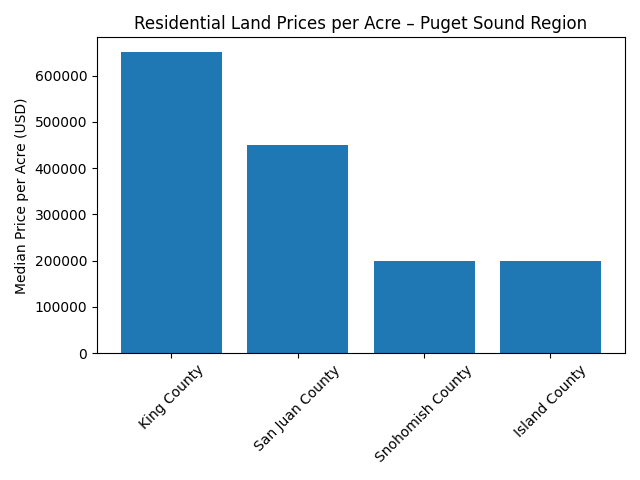
As a result, land prices in Western Washington are dramatically higher. For example, King County, which encompasses Seattle, has a median price of about $650,000 per acre for small parcels (0–2 acres). Nearby urban counties like Snohomish County (north of Seattle) and Pierce County (south of Seattle) also see hefty prices (e.g., ~$250,000 per acre in Snohomish, $175,000 in Pierce for small lots).
Even smaller cities and suburban areas – for instance, Clark County (Vancouver, WA area, part of the Portland metro) – command around $200,000 per acre for buildable lots.
The presence of Interstate 5, which runs through this urban corridor, further boosts land desirability by providing crucial transport links for commerce and commuting. Land near I-5 or within easy reach of Seattle’s job market often has a premium due to this strategic location advantage.
Eastern Washington
East of the Cascades, the state opens up into vast agricultural plains, forests, and high desert. Eastern Washington is more rural and traditionally agricultural (wheat, apples, vineyards, etc.), with smaller cities like Spokane (the largest Eastern WA city), Yakima, and Spokane’s suburbs. Generally, land in Eastern Washington is far more affordable on a per-acre basis.
Many rural counties have median small-parcel prices below $30,000/acre, and the lowest are in isolated areas: for example, Ferry County’s small acreage median is only $15,000 per acre– a tiny fraction of Seattle-area prices. Other sparsely populated counties like Lincoln or Pend Oreille see values in the tens of thousands per acre.
Even relatively developed Eastern regions (e.g., Spokane County) have land values that, while higher than the remotest areas, are still moderate (~$100k per acre for small lots) compared to Puget Sound. The arid climate and distance from major job centers keep demand (and prices) lower in the east, but the lower cost per acre can attract buyers looking for value or large acreage.
One reason for this stark West/East divide is the concentration of population and jobs west of the Cascades. The Puget Sound region holds the majority of Washington’s population and a robust economy (tech industry, ports, government, etc.), which drives up land use pressures for housing, industry, and infrastructure.In contrast, Eastern Washington’s economy relies more on agriculture and resource industries; it has fewer people and thus less intense competition for land (aside from productive farmland, which we’ll discuss later).
The Cascade Mountains also create climate differences – the west side is wetter and more temperate (desirable for many), while the east side is drier with extreme seasons – influencing what the land can be used for (dense urban development vs. farming or recreation).
The Cascades literally and figuratively form a price boundary: as one analysis put it, “the Cascade Mountains create a clear geographic price divide that defines Washington’s entire land market”. Western counties uniformly have higher values, while eastern counties offer exceptional value for buyers seeking acreage on a budget.
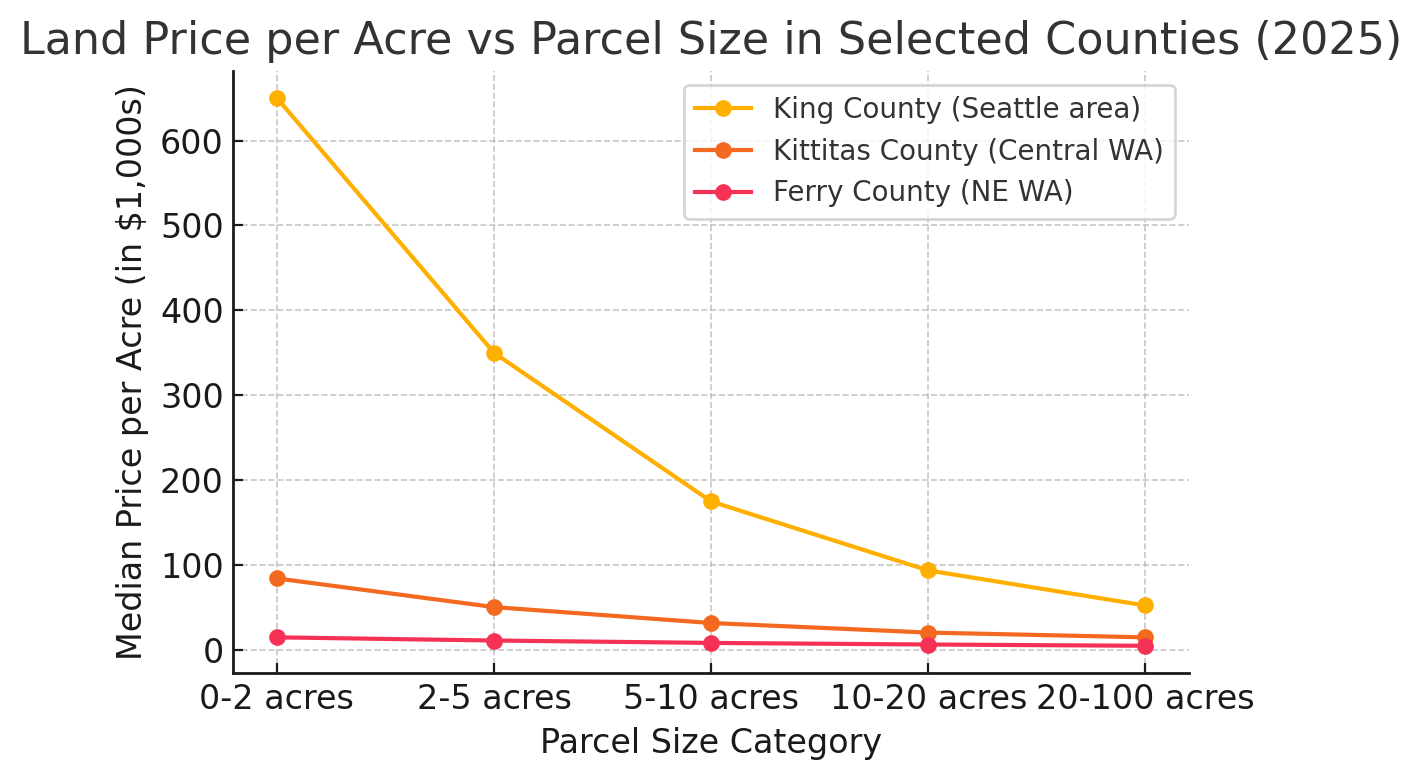
Figure: Land Price per Acre vs. Parcel Size in Selected Counties (2025). This chart compares median price per acre for different parcel sizes in three Washington counties: King County (Seattle area, high demand), Kittitas County (central WA, mid demand), and Ferry County (northeast WA, rural).
Land Market Trends by Type of Land
All types of land in Washington – residential, agricultural, timber, etc. – have felt the effects of broader economic trends in recent years. Below, we break down the current 2025–2026 trends for major land categories:
Residential & Development Land (Urban/Suburban Lots)
Residential land (lots intended for housing or mixed-use development) is hottest in and around urban centers. In the Puget Sound metro area, high demand for housing has made buildable land extremely scarce and pricey.
The ongoing affordable housing shortage plays a role: Washington needs an estimated 1+ million new homes in the next 20 years, yet strict land-use rules limit where new housing can go.
The state’s Growth Management Act (GMA) confines most development to designated Urban Growth Areas, preserving open space but also driving up land costs within cities and suburbs. Simply put, there’s not a lot of land available to build on near job centers, so any lot that is buildable commands a premium.
Over 2024–2025, however, higher interest rates cooled the frenzy somewhat for residential land. Developers face more expensive loans, so some have pulled back on land acquisitions. Reports note that development land sales have decreased due to elevated financing costs.
Additionally, by late 2025 many markets saw longer listing times for land and even price reductions on listings – signs that buyers have become more cautious. Still, well-located parcels (e.g. a zoned lot ready for home construction in Seattle’s outskirts or a tract near fast-growing suburbs) continue to find buyers.
Puget Sound counties remain the priciest: aside from King, places like San Juan County (with its scenic islands) have median small-lot prices around $450,000/acre, and Snohomish and Island Counties (north of Seattle) see around $150,000–$250,000/acre.In summary, development land prices are highest near booming job markets and along major transport corridors, and while growth has slowed, these prices have generally stabilized at high levels rather than dropping significantly.
One interesting note is that Washington’s 2025 housing policy reforms may gradually impact the residential land market. The state legislature passed bills encouraging higher-density housing (e.g,. allowing duplexes/fourplexes in traditionally single-family zones).
Over time, this could increase the utility of some residential lots – for example, a lot that could only hold one house might soon be allowed to host two or four units, raising its value. For sellers, it’s worth staying aware of local zoning changes: a change in zoning or urban growth boundaries can instantly make land more valuable by expanding what can be built on it.
Agricultural Land (Farms, Ranches, Orchards)

Washington’s agricultural land is a critical part of the state’s economy, ranging from wheat farms on the eastern Palouse hills to apple orchards and vineyards in central Washington to smaller specialty farms in Western Washington.
Overall, farmland values in 2025 are at or near record highs, reflecting a nationwide trend of strong farmland appreciation in recent years. The USDA’s Land Values 2025 report showed U.S. farm real estate averaging $4,350/acre (up 4.3% year-over-year), and Washington state’s average farm real estate value was in the mid-$4,000s per acre (slightly above the national average) – a figure that includes all farm land and buildings.
Washington’s cropland (especially irrigated orchards) tends to be valued higher than grazing land; for instance, the average value of irrigated cropland in Washington was reported around $7,600 per acre in 2025, showing how productive ag land in the state can command a premium.
That said, 2025 brought a few headwinds for certain farm sectors in Washington. According to AgWest Farm Credit’s analysis, land values have been “generally stable” but with declines in parts of Washington for specific crop land: notably, properties like wine grape vineyards (without purchase contracts), older apple orchards on less-productive land, and hop farms saw falling prices.
These declines are tied to lower commodity prices and water supply concerns in those areas. For example, a surplus of apples and resulting low apple prices made buyers less eager to pay top dollar for marginal orchards.
Similarly, the wine grape market has been soft, so vineyards without secure winery contracts are less valuable. Water is another factor – 2025 saw drought conditions return in parts of central WA, and uncertainty about irrigation water can reduce land appeal in arid farming regions.
Outside those specific crops, most farmland in Washington held its value in 2025. Farmland is often seen as a long-term stable investment (an inflation hedge and tangible asset), so even when farm income dips, land prices don’t necessarily crash. Indeed, AgWest noted that the link between farm commodity prices and land values had been weak in recent years (land kept rising even when crop prices fell), although that link strengthened a bit in areas with persistently low commodity prices.
Another supportive factor is limited supply: in much of the Northwest, quality farms don’t come up for sale frequently, so local farmers and investors compete for what does hit the market, helping floor the prices.
Many buyers are also long-term players (including institutional investors) who are less sensitive to short-term interest rates or crop swings; they view Washington farmland, particularly irrigated land for high-value crops (tree fruit, wine grapes, hops), as a valuable asset.
As of 2026, farmland values are expected to remain relatively strong, but with a cautious outlook. The agricultural economy’s profitability is tighter – farmers faced higher costs (fertilizer, fuel) in 2025, while crop prices for some commodities weakened.
This means buyers will be discerning: a top-quality orchard or good irrigated row-crop land will still fetch high prices, but lower-grade land may see negotiated discounts.
For instance, dryland wheat farms in Eastern WA (which depend on rainfall) might not increase in value as fast as irrigated farms, given grain price volatility. Farmland rental rates also factor in: Washington actually led the country in cropland cash rent growth in 2025 (up +10.7%), indicating strong demand to rent productive land. Higher rents can bolster land values (since buyers investing in farmland often look at the income it can generate).
In short, ag land sellers should be aware of the specific market for their crop type and region – the more profitable and scarce the land’s output (e.g., Yakima Valley orchard with senior water rights, or rich Skagit Valley vegetable ground), the more resilient its price.
Conversely, if you’re selling a parcel that might be better suited for another use (say, a pasture on the urban fringe that could be developed), its value might transcend its farming value and instead reflect development potential.
Timber and Recreational Land
Washington’s vast forests – from coastal timberlands to Cascade foothills – make timber land another significant category. Timberland values generally track timber prices and long-term investment views. In 2025, log and lumber prices dipped in the Northwest, and forecasts suggest they would remain lower through late 2025 before a slight uptick in 2026.
Softer lumber prices can temper how much buyers will pay for pure timber acreage, since the immediate harvest revenue is lower. Indeed, rural forested land and hunting/recreational parcels saw a bit of a cool-down in demand recently, partly due to interest rates: many buyers of recreational land borrow funds, and higher rates reduce their purchasing power.
AgWest notes that “most rural residential and recreational markets continue to cool”, with longer times to sell and stabilizing prices rather than steep climbs. This means that the frenzy of people buying remote land during the pandemic (when remote work and outdoor space boomed) has eased off. Buyers are more cautious now, and some may have shifted focus back to urban areas as offices reopened.
Still, Washington’s recreational land has enduring appeal: think mountain cabin sites, fishing or hunting properties, and vacation home lots. Areas with unique lifestyle value (e.g., near lakes, ski areas, or tourist towns like Leavenworth, WA) maintain strong interest.
For example, parts of Chelan County (home to Lake Chelan and Leavenworth) have higher land values than surrounding eastern counties because of recreation and second-home buyers – small parcels in Chelan County average ~$94k/acre, reflecting that premium.
Kittitas County, just east of the Cascades and within a couple hours of Seattle, also sees mid-high land values (e.g., ~$84k/acre for small tracts) as it’s popular for vacation cabins and has communities like Cle Elum/Suncadia resort. Sellers of such properties can still find eager buyers looking for a slice of the Northwest outdoor lifestyle.
For pure timber investors, Washington land is valued for the trees it can grow. Commercial timberland sales often consider the standing timber value (tree volume) plus land value. If lumber prices rebound in 2026 as projected, timberland may see renewed interest.One legal point for timber landowners: if you’ve logged your land and intend to sell for development, be aware of Washington’s Forest Practices Act rules. If a landowner harvests timber without a proper conversion permit and then sells the land for non-forestry use, the county can impose a 6-year development moratorium on that land.
In other words, the land can’t be built on for six years as a penalty for sidestepping forestry regulations. Sellers should disclose if any recent logging was done and ensure compliance with replanting or permits, so that a buyer isn’t blindsided by a building moratorium.
Large Acreage vs. Small Parcels
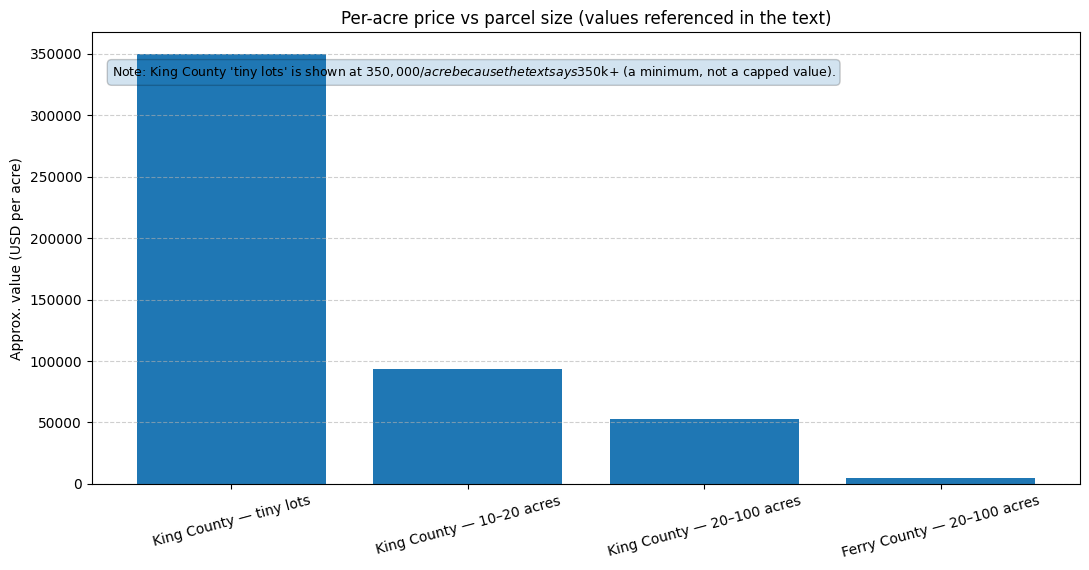
Across all land types, one consistent trend is that large acreage parcels sell for lower unit prices than small lots (as the earlier chart illustrated). Small parcels (like 1–5 acres) often attract residential or hobby-farm buyers willing to pay a premium per acre for a manageable piece of land to build a home or use recreationally.
In contrast, large tracts (50, 100, 500 acres) usually appeal to investors, commercial ag operators, or buyers looking for timber/resource value – a more limited buyer pool.
Thus, the price-per-acre drops as size increases: e.g., in Western Washington, a 1-acre lot might sell for a very high price per acre, but a 100-acre tract in the same county will be far cheaper per acre.
Statewide data confirms this: for 20–100 acre properties, King County’s median is about $52,500/acre, compared to $93,750 for 10–20 acre tracts and $350k+ for tiny lots. And on the low end, Ferry County’s 20–100 acre tracts average just $5,063/acre.
The implication for sellers is that valuing large properties isn’t as simple as multiplying a small lot’s price by your acreage – you must account for the diminishing per-acre value on bigger sales.
Larger properties might actually attract buyers who plan to subdivide in the future, but if subdivision is not readily allowed (due to zoning or infrastructure), the market will price it for its present use (farming, timber, grazing, etc.), which is usually lower on a per-acre basis than a building lot.
Key Factors Influencing the Washington Land Market for 2026 and Beyond
Several economic and policy factors are shaping Washington’s land market as we enter 2026. Understanding these can help a land seller position their property wisely:
Interest Rates and Financing
Perhaps the most significant current factor is the high-interest-rate environment. Through 2023–2025, interest rates rose sharply, making mortgages and land loans much more expensive for buyers. High interest rates were a frequently reported deterrent to land acquisition.
When buyers face double the borrowing costs compared to a few years ago, they either lower their offer prices or sit on the sidelines. This has tempered demand, particularly for discretionary purchases like recreational land or speculative development land.
As noted, developers have slowed land buys due to financing costs, and rural buyers have become more price-sensitive. One adaptation is creative financing: we’re seeing more instances of sellers offering owner financing (seller-carried notes) or real estate contract deals to facilitate sales. In these arrangements, the buyer pays the seller over time (often at an agreed interest rate), which can broaden the pool of potential buyers who can’t get a bank loan easily.
As a seller, being open to such terms in 2026 could give you an edge, especially for higher-priced land parcels.
Economic & Population Growth
Washington’s economy has been strong, especially in tech, aerospace, and logistics, which boosts land demand in certain areas. Seattle’s job market (Amazon, Microsoft, etc.) attracts people, keeping housing demand robust – hence high land values in the commuting range of Seattle.
Spokane and the Tri-Cities (Kennewick/Pasco/Richland) have also grown, spurring land development on a smaller scale. Population growth means more demand for housing, which eventually means more demand for land to build on.
However, if economic growth slows or if remote work enables more people to live elsewhere, demand patterns could shift. During the pandemic, there was a surge in interest for rural land (people seeking space), but some of that is normalizing as we return to more typical migration and work patterns.
Overall, Washington’s diverse economy (urban tech and services, rural agriculture) means land demand is supported by multiple sectors – but also not immune to national economic trends (inflation, recessions, etc.). As of late 2025, the broader economy was in a phase of tighter margins and caution in ag and real estate, which may keep land price growth modest in the near term.
Infrastructure and Location
Transportation corridors and infrastructure projects can greatly influence land markets. We touched on the I-5 corridor, where connectivity drives industrial and residential value. Similarly, the I-90 corridor (running east-west through Spokane and the Cascades) and other highways can make rural areas more accessible and attractive.
Proximity to rail lines, ports, or distribution hubs can raise land value for logistics and industrial uses – for example, land near the Port of Tacoma or along I-5 in Pierce and Thurston counties is in demand for warehouses and manufacturing.
Meanwhile, a lack of infrastructure (paved roads, utilities) can limit a property’s market. Many remote Eastern WA lands are “off-grid” – no public water, maybe no electricity – which restricts the buyer pool to only those specifically seeking such isolation or willing to invest in improvements. If you’re selling land, highlight any infrastructure advantages (access roads, utility hookups, water rights, etc.) because those directly impact value.
Also, be aware of major projects (for instance, if a new highway interchange or tech campus is planned near your land, it could boost interest).
Zoning and Land-Use Regulation
Washington’s land-use laws significantly affect value. The Growth Management Act (GMA), as mentioned, limits sprawl – good for preventing overdevelopment, but it means only a small fraction of land is buildable for homes.
If your land is outside a city or designated growth area, it may be zoned agricultural or forest and effectively off-limits to dense development. Such zoning keeps values lower than if the land could be subdivided for homes.
Conversely, land inside city limits or UGAs with residential/commercial zoning can be very valuable. Zoning classifications (ag, residential, commercial, industrial, etc.) and allowable density are crucial.
For example, 20 acres zoned for 5-acre residential lots might attract a developer, whereas 20 acres zoned for 40-acre minimum (strict ag preservation) will mostly interest farmers. Also, recent zoning reform bills (allowing duplexes on single-family lots, etc.) could incrementally increase what can be done on certain properties, as noted. Sellers should know their zoning and any proposed changes – sometimes lobbying for a rezoning or obtaining a zoning variance/permit before sale (say, a permit for a rural event venue or an approved subdivision plan) can dramatically increase the sale price because it saves the buyer time and uncertainty.
On the flip side, environmental land-use regulations (like wetlands, shoreline protections, and critical area ordinances) can constrain land use. A parcel with a protected wetland or steep slopes might have little buildable area, lowering its market value. It’s wise to obtain or provide information on these factors to prospective buyers.
Taxes and Incentives
Washington famously has no state income tax, so local governments rely heavily on property taxes. Property tax rates vary by county and city, but generally hover around 1% of assessed value annually (with some areas higher due to special levies).But be careful: if the land’s use is changed or the classification is removed at sale, back taxes can be owed. Typically, the seller (or the land at closing) might owe the difference for the past seven years of taxes, plus a 20% penalty, if land is removed from the program outside of a sale to a continuator.
However, if the buyer intends to continue the same use (for example, keep farming it), they can sign a Notice of Continuance to maintain the classification, avoiding those back taxes[44]. As a seller, you should either secure that continuance commitment or be prepared that the Deferred taxes will come due upon sale – it’s often your responsibility unless properly transferred. Additionally, Washington levies a Real Estate Excise Tax (REET) on property sales, which the seller usually pays at closing. REET is graduated: for example, 1.1% on the first $500k, 1.28% up to $1.5M, and higher for portions of very expensive sales (exact rates vary slightly by locality) – land sales often fall in the lower brackets, but sellers should factor this closing cost in (it’s akin to a sales tax on the land sale).
Environmental and Other Factors
Land that has natural resource considerations can be a double-edged sword. The presence of water (like a creek or water rights for irrigation) can enhance value for farming or estate homes, but it also triggers environmental rules. Ensure you know if your land has any protected habitat or contamination issues. For instance, if it’s former industrial land (brownfield), or if there’s an old underground tank, those need disclosure.
Washington law requires sellers to provide a Seller Disclosure Statement for unimproved land (unless the buyer waives it) where you answer questions about things like soil stability, environmental hazards, etc.. Also, some counties require specific reports (e.g., a septic system inspection report if there’s a septic system, at the time of sale). These legal requirements fall under “due diligence” – being ahead of them will make the selling process smoother.
Pricing and Valuation of Land
Pricing land correctly is one of the biggest challenges for sellers. Unlike houses, which might have dozens of similar sales to compare, land is often unique in its location and characteristics. Here are key points on valuation:
Comparable Sales (Market Approach)
The most common method is looking at recent sales of similar land in your area. This gives a market-driven baseline. For example, if 5-acre parcels in your county have been selling around $40,000 each, that’s a strong indicator for your 5-acre piece’s value. Pay attention to attributes like location (near town vs remote), utilities (has a well, power, etc.), and zoning. Even two 5-acre lots can vary if one is buildable and one is not.In Washington’s fast-changing market, try to use recent comps (past 6-12 months), because land values a few years ago might be outdate,d given the fluctuations we’ve seen (rapid rises and now leveling off).
Income Approach (Investment Value)
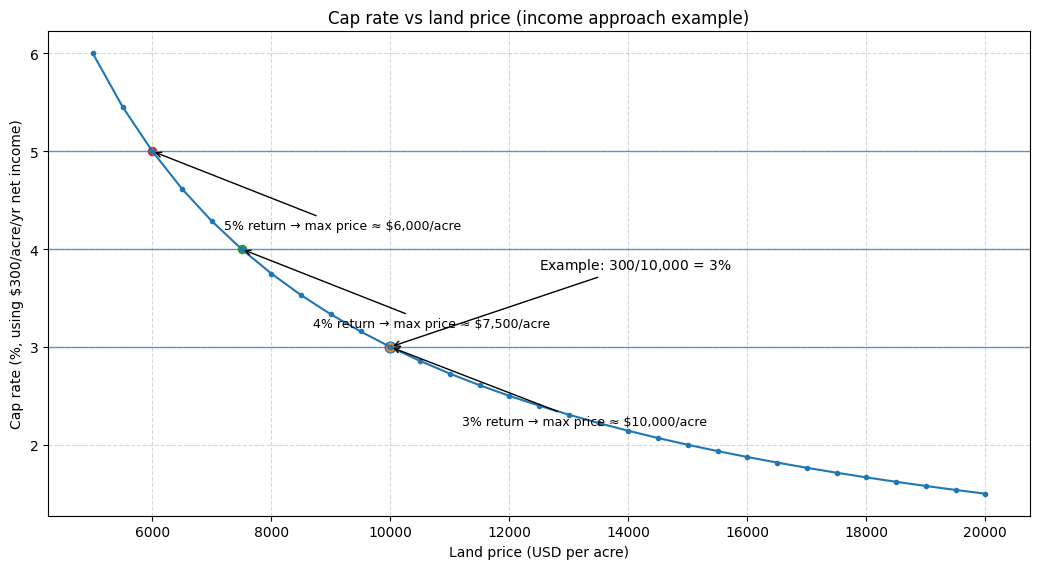
Another way to value land – especially farmland, timberland, or rental property – is by its ability to generate income. In economics, “an asset’s value equals the present value of its expected future benefits”. In simpler terms, a piece of land is worth what the future income (or benefits) from that land are worth in today’s dollars. For farmland, those benefits would be net farm income or cash rent; for timber, its future log sales; for commercial land, it could be lease income. Buyers might calculate how much money per year the land can make and compare that to alternative investments. A common metric is the capitalization rate (cap rate) – essentially, annual net income divided by land price. If a parcel can earn $300/acre per year in rent and it sells for $10,000/acre, that’s a 3% return (300/10,000). Investors will compare that to interest rates and other opportunities. If interest rates rise, they may demand a higher return (which means they’d only buy if the price is lower).
Discounted Cash Flow (DCF)
Some sophisticated buyers use Discounted Cash Flow (DCF) models: they project each year’s income and discount it back to present value using a required rate of return, summing to get what the land is worth today.
For instance, if they expect farm rents to grow and the land to be sold again in 10 years, they’ll factor all those cash flows in. While you, as a seller, don’t need to perform complex finance math, it’s helpful to understand that an income-producing land’s value will be tied to its earning potential. If you have property with income (like a leased farm, or a tract with marketable timber, or maybe a rental mobile home on it), be ready to show those numbers – buyers will pay more for a land asset that pencils out a profit. Conversely, if your land isn’t currently generating income, some buyers will view it purely as a speculation or personal-use asset and might heavily weigh the market comps instead of income.
Real Estate Appraisal
Hiring a professional appraiser can be a smart move, especially for unique or high-value land. Appraisers in Washington familiar with land will consider all three approaches: market (sales comps), income (capitalization/DCF), and cost (if applicable, though cost is more for improved property).
The appraisal gives you a documented, unbiased value opinion, which can guide your pricing and also serve as support during negotiations (showing buyers you didn’t pull the price out of thin air).
In summary, pricing land requires blending local market knowledge with an understanding of the land’s utility. Look at what similar land is selling for, but also at what someone can do with your land to make money from it (or enjoy it). If multiple valuation methods point to the same range, you’ve likely found a fair price.
If they diverge (say, the income approach suggests lower than current market comps), you might need to adjust expectations or realize certain buyers (like farmers) won’t pay as much as other buyers (like developers) might, or vice versa.
You can visit the Washington Center for Real Estate Research for more information.
Legal and Practical Considerations for Land Sellers
Selling land comes with a host of legal considerations that are just as important as market factors. Here’s a checklist of key issues and how to handle them:
Title and Ownership
Ensure you have clear, transferable title before listing the land. Resolve co-ownership, estate issues, unpaid contracts, liens, easements, or old mortgages early by ordering a title report.
Washington closings typically go through escrow and title companies, but identifying and fixing defects upfront prevents last-minute delays or failed transactions.
Legal Lot Status and Subdivision
Verify that your parcel is a legal lot of record created through proper platting or subdivision approval.
Illegal parcels can block building permits and may expose you to liability if sold without disclosure. If necessary, work with your county on a lot line adjustment or corrective plat before selling.
Zoning and Permitted Uses
Understand your property’s zoning, allowed uses, and whether conditional permits are required.
Highlight development potential (e.g., Urban Growth Area inclusion) or confirm build feasibility through septic or well investigations to increase buyer confidence. For commercial or industrial land, address environmental review requirements early to avoid deal disruptions.
Environmental and Regulatory Disclosure
Washington generally requires a Seller Disclosure Statement (Form 17) for vacant land, and sellers must disclose known material defects even if waived.
Be transparent about flooding, contamination, boundary disputes, wetlands, conservation easements, or septic conditions. Over-disclosing reduces legal risk and builds trust with buyers.
Timber Harvest and Forest Practices
If logging occurred, confirm it complied with Washington’s Forest Practices Act. Violations can trigger development moratoriums that follow the property and impact buyers. Disclose recent timber activity and confirm no outstanding replanting or regulatory obligations remain.
Taxes and Closing Costs
Property taxes are prorated at closing, and the seller typically pays the Real Estate Excise Tax (REET). If the land is enrolled in Open Space or Current Use and won’t continue under the buyer, significant back taxes may apply. Clarify how closing fees, title insurance, and potential tax liabilities will be handled to avoid surprises.
Marketing and Presentation
Prepare documentation that answers common buyer questions, including surveys, maps, soil data, utility access, and septic or well information.
Make the property accessible and clearly marked to improve the showing experience. Strong visuals and highlighting unique features (e.g., creek frontage, timber value, proximity to highways) significantly enhance marketability.
Tips for Selling Land in Washington
Selling land can be quite different from selling a house. Here are some actionable tips to help landowners in Washington make a successful sale:
Understand Your Market
Highlight the Land’s Best Use and Potential
Get Your Documents in Order
Ensure Accessibility for Showings
Consider Seller Financing Options
Be Patient and Flexible in Negotiations
Consult Professionals When Needed
We have a detailed guide on how to sell land here.
Don’t hesitate to engage a cash land buyer who is ready to pay for your land in as little as 2 weeks
Conclusion
As Washington heads into 2026, land values are stabilizing, but the urban–rural divide and location-driven demand (near jobs, infrastructure, and major corridors) continue to shape pricing and time on market.
The best results come from realistic comps-based pricing, clear documentation (zoning, legal lot status, title), and flexibility in a higher-rate environment. If you’d rather skip traditional listing steps, you can also explore getting a fair cash offer for your Washington land in as little as 24 hours.